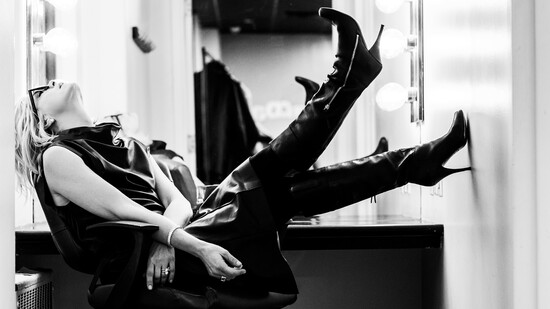
“I remember having a snow day on April 16, when I was at Hillel,” Selma Blair says. “It might have been 1980, I can’t remember. But it’s a very distinct memory.”
On the day of our conversation in March, sitting in her sunny L.A. home, she’s curious about the weather in Birmingham, where I tell her it had been snowing that morning. She chats easily, eager to reminisce with another native about her Michigan childhood, growing up in Southfield and hanging out at Linda Dresner and Mark Keller — even if it’s about the weather. She asks me where I live, we play a bit of “did you know this person,” and she’s excited to learn we have friends in common.
To the world, Blair is known as an actor, a connoisseur of style and an advocate. But to locals, we love to claim her as our own, a graduate of Hillel Day School in Farmington Hills, Kingswood-Cranbrook Schools in Bloomfield Hills, then the University of Michigan. With roles in iconic classics Cruel Intentions and Legally Blonde, John Waters’ A Dirty Shame and Guillermo del Toro’s Hellboy, she’s also appeared on stage, had a turn on Dancing With the Stars and authored a New York Times bestseller, Mean Baby: A Memoir of Growing up. Most recently, she’s made appearances in Ethan Almighty, S.W.A.T. Exiles and reprised her role in Hellboy II: The Golden Army.
In August 2018, at age 46, Blair was diagnosed with relapsing-remitting multiple sclerosis. Since then, she has balanced raising her 14-year-old son, Arthur, as a single mom, her health and a profound interest in advocacy. Here, Blair catches us up.
BIRMINGHAM CITY LIFESTYLE: You’ve been so open about living with MS. What made you decide to go public with your diagnosis?
SELMA BLAIR: I wasn't planning some big public statement. I didn’t think it was the biggest tragedy, but it was something that was having an impact on my life. A few months after I was diagnosed in 2018, a stylist went out of her way to help me — I was so happy and appreciative that someone would help to dress me. I wasn't really ready to tell many people about it. But at that time, my abilities were changing and it was kind of obvious that there was something off with me. So I did come out with it, and it really got me out of myself because I began to realize how many people were craving a connection, or craving someone they knew publicly to talk about just a tiny bit of their challenges. I definitely developed a broader kind of connection with people.
Little things like that make a big difference. Like showing up on a red carpet in a lovely gown but with your walking stick. How much that might mean to people who use that, who might feel it makes them look geriatric, or too young, or out of the workforce — whatever people’s feelings are that might be slightly negative about using something like that. I think it was an opportunity to show a different perspective, that it just felt natural and easy.
I had undiagnosed symptoms for years, so I was actually very grateful to be diagnosed. So I had a very different kind of reaction to my diagnosis than other people might. When I had a warm reception from so many people in similar situations, it really broadened the way I thought about relating to the public and putting myself out there. I have those exact people to thank, who noticed me in that time where I was really vulnerable and felt a commonality.
BCL: Your walking canes have become iconic in their own right.
SB: I had a vintage cane that a stylist friend turned into a patent-leather walking stick. My manicurist Tom Bachik put diamonds on the head of the cane, and it made it feel really gorgeous. That’s the sensibility I’d like to give to other people too — that not everything has to look medical. I mean, it’s fine if it does — that’s a choice, and who really cares. But it’s not all lost if you need to make a compromise with your balance or your gait. There are ways to do it that can make you happy.
BCL: How did your collaboration with Benny’s Eyewear — Selma Blair X Benny’s — come about?
SB: I found this pair of eyeglasses by this company, Benny’s, years ago. Every time I was on a Zoom, or reading, as I got older, I realized I needed readers. I had the Gianna’s — and every time I wore them, everyone loved them. After my MS diagnosis, my vision went kind of wonky and my prescription kept changing, and I kept losing pairs. I lost a pair on a plane and replaced them with generic drugstore ones, I was like, oh, there is no compromising. I cannot wear these. I cannot see because I cannot wear drugstore readers. So selfishly, I reached out to Susan Berryman, the founder of Benny’s — when I found out they were a Michigan company, that was it. I asked if we could collaborate on a collection. I was a fan of hers way before she was a fan of mine!
I wound up adoring her, we have a great relationship, so we did this collaboration of readers and sunnies, and they all have names that are special to me. The Arthur is my favorite reader, named after my son, Arthur Saint. They actually look great on him, too. The Saint is my favorite sunglass, named after his middle name, which was also my childhood nickname — probably facetiously by my mother. There’s a Molly after my mother, a Grace after Grace Kelly, and a Kelly after my friend from Cranbrook. So it’s personal. Also, a portion of their proceeds go to the American Brain Foundation. So I was so impressed that this company that I harangued into doing a collaboration with me. [Find Benny’s locally at Found Objects in Birmingham, and online at bennyseyewear.com.]
BCL: For your advocacy, you have been honored with Glamour’s Women of the Year award, the Equity in Entertainment Award by the Hollywood Reporter, the SAG-AFTRA Harold Russell Award, the Media Access Visionary Award and were named one of Time magazine’s People of the Year as a Silence Breaker. What other organizations do you work with?
SB: I am the Global Ambassador and National Chair for the American Brain Foundation. [americanbrainfoundation.org] — I realized how important it was to raise funding for research to find a cure for so many brain diseases. And in May 2025, I hosted a fundraiser in Michigan for Yoga Moves MS, founded by another Michigan woman, Mindy Eisenberg, and I was presented with a Key to the City of Southfield.
BCL: What are your favorite spots to hit when you return to Michigan?
SB: I had a great childhood in Michigan — climbing pine trees in Pierce Park, having lunch at Olga’s and discovering fashion — so I love revisiting some of those formative spots. I still have family here — in Birmingham and Royal Oak, and my mom lives in Plymouth. When I come back, I love going into the woods near my old house in Southfield. There are these incredible woods that a lot of people don’t know about, with the Rouge River running through. I love taking long walks there. I love the Townsend and the Daxton. And of course, the Franklin Cider Mill — that’s a real memory for me. I just love being back in Birmingham, visiting Cranbrook, all the things I loved when I was young.
BCL: What does your son think of Michigan?
SB: He loves it. He likes going downtown to Royal Oak, hitting the thrift stores in Birmingham and Southfield. We love finding cool vintage pieces together.
BCL: Who were your local fashion inspirations growing up?
Linda Dresner was one of my biggest inspirations — absolutely an icon to me. Whether it was on Park Avenue, at Somerset or in Birmingham, that store shaped my sensibility. Linda was friendly with my mom, and she really embraced me growing up. I credit her with teaching me about bringing a Michigan sensibility of great style outward into the world. I also loved going to Mark Keller and It’s the Ritz in Birmingham.
BCL: What does style mean in your life now?
SB: Karl Lagerfeld made my wedding dresses and embraced me for years — those were tremendous compliments in my younger years. But you age and find new people who touch you with their kindness and incredible work, like Christian Siriano. And then you find amazing designers like Susan Berryman from Benny’s. Fashion has always meant something to me — in part, related to my mom.
BCL: How do you balance everything — work, health, activism, being a mom?
SB: I don't do it that well, but I do it. I’m fortunate that I’m in remission right now. And my son is now 14, so he’s pretty self-sufficient in a lot of ways. It’s a labor of love, building stamina after recovering, finding people who inspire you, people with passion like Susan — I find it so comforting to find people from where we hail from, that feels like you have a shared kind of experience. It really feels like home. But your social life suffers. Something’s going to suffer — your social life, maybe — because you might need to sleep more than the average bear when you have a chronic illness. But so far, so good.