Years after Emily Hungenberg passed away, family members sorting through old belongings discovered envelopes filled with thread she had carefully saved from worn clothing. It wasn't the kind of keepsake most families expect to find, but for the generations who followed her, it became a small reminder of the woman who started it all. To Emily, even something that small still had value, a lesson that continues to echo across the family farm more than a century later.
For many Greeley residents, Hungenberg Produce is a familiar name. Families purchase its carrots at grocery stores across the region. Schoolchildren visit the farm and pull vegetables from the ground for the first time. Drivers pass fields planted by the Hungenberg family without realizing the story behind them.
What many don't know is that one of Weld County's longest-running family farming operations began with a widow, three young sons, and seven acres of land.
In 1904, Emily Hungenberg arrived in Greeley after losing her husband. Like many who came west seeking opportunity, she was looking for a way to provide for her family and build a future. A few years later, she purchased seven acres, and by 1908 the family was farming.
The family never knew Emily as someone who spoke often about hardship. Instead, they remember the habits she left behind. She saved what could be used, repaired what could be repaired, and found value in things others may have overlooked. The envelopes of thread discovered years later became one of the clearest reminders of the woman she was and the example she set.
Her oldest son, Edward, carried that example forward. Years later, when asked to describe his mother, his answer was simple.
"My mom was a good woman. My mom worked really hard."
Those eight words have endured for generations, not because they tell the entire story of Emily Hungenberg, but because they capture the qualities her family still sees reflected throughout the farm today.
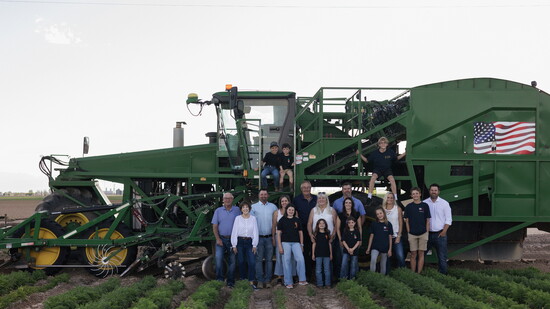
What began on seven acres eventually grew into a thriving operation, passing from one generation to the next along the way. Today, the farm is owned and operated by fourth-generation brothers Paul and Mike Hungenberg alongside members of the fifth generation, including Paul's sons, Jared, Jason, and Jordan. Together, they represent just part of a family story that now stretches into a sixth generation.
Ask the Hungenbergs about growing up on the farm, and the conversation quickly moves beyond carrots. They remember lunches delivered to the field during planting and harvest, summer evenings spent outside until dark, and children racing through rows with flashlights before heading home covered in mud. Many of the lessons they carry today weren't learned in a classroom, but alongside parents, grandparents, siblings, and cousins working together.
The farm became more than a livelihood. It became the backdrop for family life.
That connection between generations is still easy to find.
Jared Hungenberg, a fifth-generation owner, remembers riding with his grandfather Don while working ground. One day, Don turned around in the tractor seat and began counting.
Don was counting the bottoms on a plow being pulled behind a modern tractor. During his lifetime, farming equipment had changed dramatically, and even he found himself marveling at how far things had come. For Jared, the moment was a reminder that while the equipment continues to evolve, the work itself remains connected to the generations that came before.
The farm Emily knew would look very different today. Modern irrigation systems can be monitored remotely, equipment covers more ground than previous generations could have imagined, and inside the processing facility, nine baby-carrot baggers package product at speeds approaching one bag every second.
Yet for Paul, the heart of the operation has never been the equipment.
"People tend to think about food as a commodity that 'appears' on the grocery shelves," he says. "They have a very limited knowledge about how food gets there."
That perspective has shaped the way the family approaches education and community involvement. School groups regularly visit the farm to learn where their food comes from, often discovering that carrots are planted at a density of roughly 14 to 18 seeds per inch. Pulling a carrot from the ground proves harder than many expect, and seeing the scale of a working farm often changes the way children think about the food on their plates.
Mike has witnessed decades of growth and change, but he sees the farm's success as the result of something much simpler: generations of people willing to put in the work and build on what came before them. The operation may be larger than Emily could have imagined, but the commitment behind it remains familiar.
For Jordan, that continuity is what makes the farm special.
"Not many people get the chance to be part of a family farm that's been around this long," he says. "It makes me proud, and it reminds me to take care of it for the next generation."
That next generation is already paying attention.
Children still climb into tractor cabs. They still learn equipment names long before they understand the complexities of running a farm. They still spend their summers in the fields, listening to stories from parents and grandparents who once stood in the very same places.
Among them is Brayden, a sixth-generation Hungenberg who already knows the tractors by number and can identify equipment many adults wouldn't recognize.
More than 120 years after Emily arrived in Greeley, the farm she started remains in the hands of her descendants. The fields are larger, the equipment is more advanced, and the family tree has grown considerably since those first seven acres. Yet the values that helped Emily build a life for her children continue to shape the generations that followed.
When asked what Emily would think if she could see the farm today, Pam Hungenberg, Paul's wife, doesn't hesitate.
"She would be overwhelmed," Pam says.
Then she smiles.
"Overwhelmed, and happy."
"My mom was a good woman. My mom worked really hard." — Edward Hungenberg