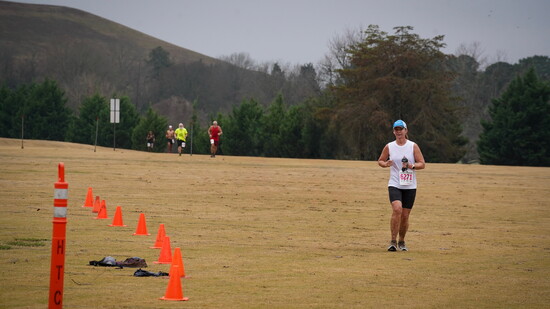
Kathy Faulkner Youngren (51), Attorney
What first inspired you to start running?
While in college at Georgetown University, I cheered on runners in the Marine Corps Marathon as they ran past, and in that moment, I knew—this was something I could do. With very little preparation, I ran the race the following year, and to my delight, I loved every single minute of it. Between undergrad and law school, some friends told me that if I could run a marathon, I could run 40 miles. I took their challenge to heart and signed up for the Strolling Jim 41.2-Mile Race. From the moment I crossed that finish line, I was hooked.
Which race has been the most challenging, and why?
Every race comes with its own set of challenges, and sometimes those challenges have nothing to do with training or the course itself—they lie in just getting there. My husband and I signed up to run a marathon in Antarctica. To reach it, we flew to Argentina and caught our ship in Ushuaia, the southernmost town in the world. From there, we faced the infamous Drake Passage, a notoriously rough stretch of
ocean connecting the Atlantic and Pacific. On the way down, the Drake Passage was surprisingly kind, and we arrived in Antarctica without incident. Even running the marathon on wobbly sea legs, my husband won the race, and I finished second overall. The race was an unforgettable experience, but the real adventure came on the return journey.
The Drake Passage showed its true colors. Half the ship spent two days bedridden,
while the rest of us engaged in what we jokingly called the “Don’t Spill a Drop
Challenge.” The goal? Keep your coffee upright while navigating a tossing, rolling
ship. It turns out, this makeshift competition was tougher than the
marathon itself!
Describe what it felt like crossing the finish line at the Spartathlon and knowing
you traced Pheidippides’ historic path?
With a love of ancient history and a minor in classical archaeology, I was
captivated by the idea of following in the footsteps of Pheidippides. He was a Greek messenger sent from Athens to Sparta in 490 BC to solicit military help while the Athenians were being attack by the Persians. Pheidippides ran 246 km on foot, leaving at daybreak and arriving the next day at sundown. The Spartathlon race honors that legendary journey of 153 mile with a 36-hour cutoff. Running through the Greek countryside and quaint little towns was an experience I will never forget. No matter how late I arrived, children on bikes would ride alongside, asking where I was from and escorting me through the town, while parents and grandparents watched from porches, playing chess. The race itself was punishing. There was no finish line, no arch, no timing mat. Instead, the clock stops when you climb a few stairs—where I may have tripped—to touch the foot of a massive statue of King Leonidas. The Mayor of Sparta placed an olive leaf wreath on my head, and I was handed a goblet of water from the Evrotas River, a process similar the way Olympians were honored in ancient times.
How do you prepare for running in brutal conditions?
Training to run Badwater, a 135-mile race in Death Valley in July, requires extra preparation. The process is two-fold: not only do you have to train your body to run the distance, but you also have to train it to endure 125-degree heat. For months leading up to the race, I would sit in the sauna after my runs for 30 minutes or more. Another method I used was heat layering—putting on extra clothes and running in the sun. I remember a July 4th training run where I wore tights, a thermal base layer, a down jacket, and gloves. I
ran around Hampton Cove, up Cecil Ashburn, and back—before finishing by
jumping into a friend’s pool to cool off.
How do you keep yourself motivated?
My motivation is closely tied to determination. When I am determined, the
motivation seems to follow. This is not to say that there are times in a race when
I succumbed to super low morale and the thoughts of quitting, but typically when
running an ultra, you learn to ride the highs and fight through the lows. At those
low points, I reflect on everything I’ve done to get to this moment. Remembering all
that snaps me out of my pity party, and helps bring my focus back to the task at
hand.
Is there a moment or race that stands out as your proudest
achievement?
One of my proudest moments wasn’t finishing a race well—it was surviving a race. Starting at 11pm, I was already quickly becoming sleep deprived before I even started Badwater 135 that year. Badwater is a 135-mile race in Death Valley in July. As the race progressed, my body felt as if it were shutting down. My belly revolted, preventing me from eating and drinking. All I could do was suck on ice cubes to satisfy my dry mouth
and thirst. Curling up on the side of the road and taking a nap is all I wanted to
do. Hallucinations were playing tricks with my mind—I saw bridges and huge
hotels in the middle of the desert. I was struggling and questioned my life
choices, but my crew didn’t give up on me—they supported, encouraged, saved
and carried me through every tough mile. 34 hours later, I finally crossed that finish line.
Do you have a favorite “running mantra” or piece of advice for women?
Start where you are, trust the process, stay consistent, and believe in yourself. Treat your training as a gift to yourself.
How has your perspective on running and life changed over time?
Running has been an important part of my life for over 30 years. Due to
hip dysplasia, I’ve had both hips resurfaced, and my comeback has been long and
slow. I’m finally starting to see progress, and there is no better way to test myself
than by running the Vol State 500k again this summer. Going through this
journey has taught me that success isn’t always measured in speed or distance.
Sometimes it’s simply getting out the door and running—or walking—a few miles
at the pace your body allows that day. And even those small steps are victories.
Kristin Sullins (45), Optometrist
What first inspired you to start running?
During Optometry School I started running longer. That is where I ran my first half marathon. But it wasn’t truly until after I graduated and started practicing optometry when further distance training took off. I met friends who were training for a Half-Ironman, joined in, and fell in love.
What is training like for these races?
My training has ebbed and flowed through my own seasons. Currently most of my training is in the mornings. I run 4x a week with friends and l may ride my Peloton and lift 2 days a week. If it doesn’t happen in the mornings it tends not to happen. Plus it always makes my day go better.
Which race has been the most challenging, and why?
After a series of life events I am most proud of my recent marathon PB at the Marine Corps Marathon in DC this Past October.
How do you keep yourself motivated?
When exhaustion hits I usually repeat positive affirmations to myself. I remind myself, “You are stronger than you think. You’ve done harder things and you are capable of so much more. Just put one foot in front of the other, relentless forward motion…”
Do you have a favorite “running mantra” or piece of advice for women?
Running really translates into professional life well. Those mantras are the lessons I’ve learned over the years of endurance sports. You show up and put in the work on the good days and the bad days. You grow and learn from the successes and the failures. Hard work and perseverance pays off in the long run. When you put your mind to something, anything can happen. Have a plan, but be flexible. These go for training and life. Always strive to be the best on that day with what you are given.
Future plans?
I’ll slowly chip away at the Abbott World Marathon Majors. This would fulfill a goal of running more overseas. I was also eyeballing a half marathon around Mt Kilimanjaro. Which would precede a possible climb to the top of said mountain!
Favorite quote?
“Just keep swimming.” -Dory
The Mayor of Sparta placed an olive leaf wreath on my head, and I was handed a goblet of water from the Evrotas River, a process similar the way Olympians were honored in ancient times.