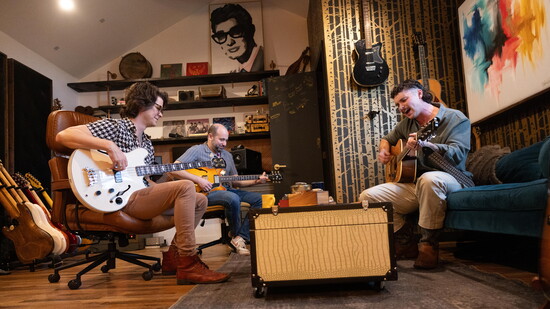
If you drive through South Austin long enough, you begin to understand a fundamental truth about the city’s music scene: much of what defines it doesn’t happen on big stages or inside glass-walled studios.
It happens in garages, spare rooms, and converted backyard spaces — places you might pass every day without realizing someone inside is tracking vocals, layering strings, or finishing a song that could land on a playlist months later. That quieter, behind-the-scenes work is the backbone of Austin music, and Studio 601 is built squarely in that tradition.
From the street, Studio 601 looks like just another South Austin home with a detached garage tucked behind it. A decade ago, that was precisely what it was. But for co-founders Eric Harrison and Mike Ingber, both longtime working musicians, the modest property held potential. Today, the garage-turned-studio is booked months in advance and known for an artist-first, deeply collaborative approach that has made it a trusted creative home for emerging musicians.
Harrison and Ingber met in the mid-2000s while working live sound gigs downtown. Both were recording on their own and growing frustrated with what they were hearing from larger studios.
“We’d hear our friends’ albums and think, ‘How did a killer band make something that sounds like this?’” Harrison said.
Commercial studio time was expensive and often impersonal. When Harrison converted his garage into a working studio, the space offered something different: a room that was affordable, flexible, and focused on the song rather than the spectacle. Ingber soon joined him, and Studio 601 took shape — not as a flashy facility, but as a practical workshop grounded in trust and efficiency.
“We thought we’d just engineer records,” Ingber said. “But people started coming in without bands, without arrangements, really needing help shaping everything. And we realized we were actually a production team — totally by accident.”
That collaborative mindset defines the studio. Harrison and Ingber aren’t just pressing record; they’re involved in structure, arrangement, and creative problem-solving. Artists often arrive with rough demos or unfinished ideas, and the process becomes one of shared discovery.
“Nobody cares about gear,” Harrison said. “They care about whether the song is good and whether they felt supported while making it.”
That philosophy resonated with singer-songwriter Greyson Turner, who began working with Studio 601 in early 2024. Turner moved to Austin from South Carolina for graduate school, earned a master’s degree in accounting from the University of Texas, and now works full-time at Oracle. Like many Austin artists, he balances a demanding day job with an increasingly serious music career.
“When I walked in, I didn’t have a big production plan,” Turner said. “Here, it’s collaborative. We rework song structure, talk through arrangement, and build the vision together.”
Turner credits Studio 601 with helping him refine not only his sound, but his confidence. “I don’t know if I would’ve had the courage to really attempt a music career without meeting Eric,” he said. “Feeling believed in mattered.”
The ecosystem around Studio 601 is distinctly Austin. South Austin is full of working musicians, which means collaboration is often just a text away. In one recent session for another artist, a pedal steel player canceled hours before recording began. Harrison made one call and had a replacement in the studio within the hour. One of Turner’s projects had a full string quartet recorded inside the garage — proof that scale is less about square footage than intention.
Studio 601 has also become a creative base for artists at different stages of their careers, including influencer-songwriter Zach Tellander and rising band NetherHour, now signed to William Morris. For those artists, the draw is consistency, focus, and an environment where collaboration stays at the center.
“There are great big studios here, but overhead doesn’t guarantee a better product,” Harrison said. “What matters is the end result and how the artist feels in the room.”
As Studio 601 celebrates 10 years, both founders say the studio’s identity remains anchored in the same mission that launched it: keep the space warm, keep the ego out of the room, and keep the song at the center.
“There’s an energy to this place. If you’re tuned in enough to feel it and trust it, you know you’re here for a reason.”
“Having someone believe in you as an artist can change everything, especially when you’re still figuring out who you are.”