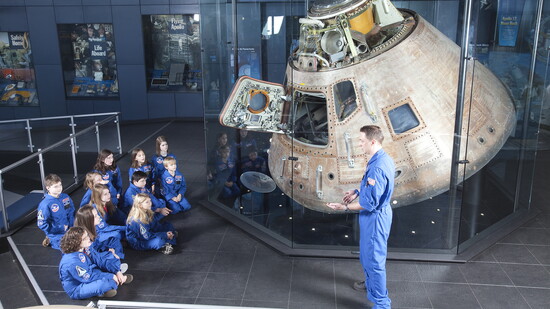
Space Camp grew directly out of Huntsville’s integral role in America’s space program. By the late 1970s, Huntsville had already become known as “Rocket City” because of the work by NASA engineers and the team led by Wernher von Braun, whose Saturn V rocket technology sent astronauts to the moon.
The idea for Space Camp was first envisioned in 1977. While touring the U.S. Space & Rocket Center, von Braun noticed children intensely studying the exhibits and suggested creating an immersive educational camp where young people could experience astronaut-style training firsthand. The concept was developed by the center’s executive director, Edward O. Buckbee, who wanted to inspire children to pursue science, engineering, and technology careers through hands-on learning.
Space Camp officially opened in 1982 at the U.S. Space & Rocket Center in Huntsville. It became the first camp of its kind in the world, blending education with simulated astronaut missions, teamwork exercises, rocket launches, and training experiences modeled after NASA programs.
The timing was significant. America’s excitement about space exploration had shifted after the Apollo moon landings, and Space Camp helped keep public enthusiasm for STEM and space travel alive for a new generation. The camp quickly became nationally famous during the 1980s, especially after the release of the 1986 movie SpaceCamp, which was filmed partly in Huntsville and introduced millions of Americans to the program.
Over the decades, more than a million students, teachers, families, and adults from all 50 states and more than 150 countries have attended Space Camp programs in Huntsville. Many alumni later became engineers, pilots, scientists, and astronauts.
Today, Space Camp remains one of Huntsville’s defining institutions and one of the most recognizable educational programs in the world, symbolizing how the city transformed from a small Alabama town into an international center for aerospace innovation and STEM education.