When Luis Pazmino moved from Brooklyn to New Jersey with his wife and children, he quickly noticed something was missing.
As a young parent, Pazmino was looking for a place where his kids could move, play and socialize, especially on cold, rainy or too-hot days. But the options felt limited, and most required a drive.
“Everything we wanted to do was at least 30 minutes away,” Pazmino says. “Especially during winter or bad weather, it became difficult. We just wanted somewhere local where kids could move, socialize and have fun.”
That need became the starting point for Space Play Academy in Hillsborough, an indoor play space designed for young children and the grown-ups who love them.
The timing made the idea feel even more important. Like many families, Pazmino saw how COVID-19 changed the way children learned, played and connected. His oldest daughter missed important early school experiences because of virtual learning, and he saw how much children and parents were craving connection again.
“There’s only so much kids can get from a screen,” he says. “After COVID, families were craving social interaction again.”
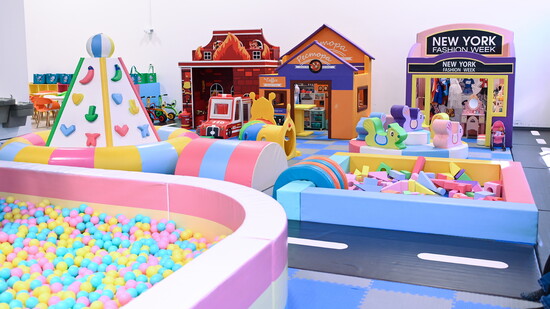
At Space Play Academy, children can climb, slide, imagine, build and explore in a colorful, high-energy environment filled with obstacle courses, pretend-play stations and climbing structures. But unlike larger play centers, Pazmino intentionally designed the academy to feel manageable, clean and community-focused.
“We wanted something that was not overcrowded, always clean and flexible for families,” he says. “A lot of the things we didn’t like as parents at other places, we decided to do differently.”
That parent-first perspective shapes nearly every detail. The facility limits attendance to about 40 children and 40 adults at a time, creating a more relaxed environment. Families are allowed to bring outside snacks, especially for children with allergies or dietary restrictions, and the team prioritizes nightly cleaning routines.
Before committing to the business, Pazmino turned directly to local parents for feedback. He posted in community Facebook groups asking what families wanted in a toddler-friendly indoor play space. The response surprised him.
Within a week, more than 500 families had completed surveys, commented on ideas and shared suggestions.
“I realized very quickly this wasn’t just something my family wanted,” he says. “There was a real need.”
Many of those families helped shape the final design. Parents voted on attractions and play concepts, influencing everything from the fire station pretend-play area to dress-up stations. That collaborative approach continues today, with customer feedback helping guide programming ideas and future additions.
While Space Play Academy is centered around fun, Pazmino also sees it as a place for development. Obstacle courses help children practice balance, climbing and motor skills. Interactive cause-and-effect installations encourage curiosity and problem-solving. Foam building pieces invite children to construct towers and structures through open-ended play.
“There’s a lot more happening than just entertainment,” Pazmino says. “Kids are learning while they play.”
One of the most distinctive parts of the academy is the way it invites parents into the experience. Instead of watching from a distance, adults are encouraged to play alongside their children. Parents slide into ball pits, navigate obstacle courses and ride tricycles with younger children seated behind them.
“You see parents becoming kids again,” he says. “That bonding experience is a huge part of what makes the space special.”
Safety remains central to the design. Much of the 4,000-square-foot play area is covered in padded foam flooring to help reduce injuries. Staff members supervise play zones and guide families on safety rules, particularly around accessories that could create hazards.
“We want kids to have freedom to explore,” Pazmino says, “but we also want parents to feel confident that the environment is safe.”
Although Space Play Academy is still in its first year of operation, Pazmino is already thinking about what comes next. His long-term goal is to see the space grow into a community hub centered around education and enrichment, with possible future offerings such as STEM workshops, tutoring programs, literacy initiatives, art classes and partnerships with local businesses and nonprofits.
As an engineer with a background in tech, he is especially excited about hands-on science programming, including LEGO programming, chemistry projects and other learning experiences that can grow with children over time.
“The idea is for this to become more than a playground,” he says. “We want it to grow with families.”
For now, families are already finding their way in. Birthday parties are booking months in advance, regular visitors are returning and the academy has quickly become a gathering place for parents and children alike.
At its heart, Pazmino says Space Play Academy is built around a simple idea: families need places where they can be together.
“We built the kind of place we wished we had for our own kids,” he says.
Space Play Academy
315 Roycefield Road, Suite 123
Hillsborough, NJ 08844
spaceplayacademy.com
“We wanted something that was not overcrowded, always clean and flexible for families, a lot of the things we didn’t like as parents at other places, we decided to do differently.” —Luis Pazmino