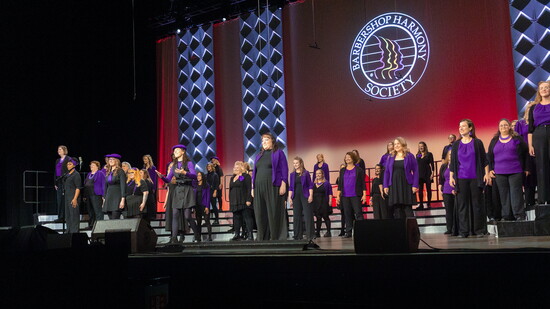
Some 6,000 visitors are expected to descend on St. Louis from June 28 through July 5, 2026, for the Barbershop Harmony Society’s 2026 International Convention.
“That level of attendance could translate to between $3.8 million and $7.8 million in direct visitor spending, with additional ripple effects potentially bringing total business sales into the $6- to $12-million range,” says Shelly Snow-Pordea, local author, Visions of Harmony member, and executive vice president of Harmony STL.
The Convention is the Society’s flagship and highest-level annual competition event and draws thousands of singers, judges, educators and fans from around the world, including world-class competitions, large-scale concerts, educational sessions and community-focused events.
Founded in 1938, the Barbershop Harmony Society is an international nonprofit dedicated to preserving and advancing the art of barbershop harmony. The Society represents tens of thousands of singers worldwide and emphasizes vocal precision, emotional storytelling and community connection.
St. Louis is home to many of the Society’s most respected and influential arrangers, educators, directors and vocal coaches. It also is home to Harmony STL, the Society's first chapter of its kind with a high-voice chorus, Visions of Harmony; mixed-voice youth singers under 25, The Recruits; and low-voice chorus, Ambassadors of Harmony. Each chorus is led by world-renowned directors, who have all placed in the top 20 a capella groups in the world. Ambassadors of Harmony is a five-time International Chorus Champion, recognized around the globe for their artistic excellence.
Robert Rund, a St. Louis native and CEO of the Barbershop Harmony Society, says what makes St. Louis “the perfect place” for the art form is that music is simply part of St. Louis’ DNA. “I can’t tell you how special it feels to invite the world to my hometown for our International Convention. I grew up surrounded by the sounds that have shaped American music, the legacy of ragtime, the blues echoing up from the Mississippi River, the pulse of jazz, and the birth of rock ’n’ roll. Music is part of this city’s DNA.”
Robert says there’s nothing quite like the sound of voices ringing in harmony, “and there’s no better backdrop for it than a city with a musical story as rich as ours. We’re beyond excited to welcome singers and fans from around the globe to the Gateway City and to celebrate the role St. Louis has played, and continues to play, in shaping the soundtrack of America. And on the nation's 250th Anniversary, no less.”
Shelly says the economic impact on St. Louis cannot be understated. “The Events Industry Council says convention participants in the U.S. spend an average of $1,294 per attendee between lodging, meals, local transportation and shopping. So, if 6,000 people attend, that’s an estimated $7.8 million in direct visitor spending.”
Still, while the economic impact of hosting an international convention is measurable in visitor spending and hotel nights, the deeper impact is cultural and communal, says Shelly.
There is an investment of time and talent as Harmony STL is largely sustained by volunteers. Singers devote evenings and weekends to rehearsal, performance and mentorship. And hosting the international convention strengthens the local infrastructure by spotlighting St. Louis talent and energizing arts participation across the region.
As a native St. Louisan, Shelly says, “Stepping into a community filled with world-renowned arrangers and record-holding singers has been genuinely surreal. It’s a reminder that we don’t always recognize the extraordinary things we have right in front of us.”
Harmony STL also actively invests in arts education by raising funds to fully cover participation costs for members of The Recruits youth chorus. Through community support and fundraising, students participate in elite-level choral training, travel and competition at no cost to their families. This model ensures access to high-level music education regardless of financial background and strengthens the pipeline of young artists in the region.
“Since the convention is open to the public, it provides an accessible entry point into a national arts network,” says Shelly. “Community members can attend competitions and performances, purchase event passes and volunteer in various capacities.”
She adds that the event creates momentum that extends well beyond the week of competition. “They inspire future singers, elevate local ensembles and reinforce St. Louis’ role as a city that actively produces and supports high-level performing arts.”