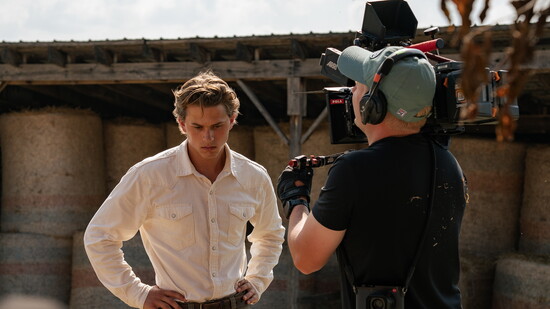
For Deacon Phillippe, Brother Save Us was a story that immediately felt personal.
The actor, musician and first-time executive producer stars as Cole, a young man navigating family responsibility, personal sacrifice and the weight of protecting those he loves. Premiering at the Nashville Film Festival, the independent feature showcases Phillippe's performance both in front of the camera as well as his creative contributions behind the camera.
Brother Save Us is an indie dystopian sci-fi drama that follows a 12-year-old boy in the Midwest who befriends an AI farmworker while his father is ill, causing tension with his older brother.
"When I first read the script, it honestly felt like someone had found the words I’d never been able to," says Phillippe. "I have a little brother that I love more than anything, and there are so many things you feel for someone like that that are almost impossible to put into language. {Director} Jesse found a way to put that unconditional love on the page so beautifully that I knew exactly how far Cole would go for his brother because I know how far I’d go for mine."
While the circumstances facing Cole are far more dramatic than his own life, Phillippe found the character's emotional arc relatable. "I think I felt that Cole, while he had much harder choices and things to carry than I ever had, just the way that he handled that and how in the end, his story is about learning that it's about what you do and being open with the people around you about your struggles that is going to help you ultimately find the courage to save them."
In addition to starring in the film, Phillippe also serves as an executive producer for the first time. Although he is quick to credit writer-director Jesse Behrenwald and producer Caroline Ohlson for establishing the film's vision, he appreciated being welcomed into the creative process from the very beginning.
"It was an incredibly involved project between me and Jesse and Caroline," he says. "And I'm so honored that they wanted to have such lengthy discussions about characters and they asked for my input in so many ways. And just the fact that they had the curiosity and humility to invite me in on that process was the biggest honor of my life."
Some of his favorite moments came after filming had wrapped."I would say I had the most fun sitting in on sound mixes and giving notes on edits and music," he says.
The experience of serving as an executive producer has already influenced how Phillippe hopes to approach future acting projects. "I think, first of all, in any type of acting, you want to be as involved with the storytelling as you can so that if you really care about a character you can vouch for them in the filmmaking process or bring your own humanity into it."
More importantly, it sparked a new creative ambition. "Getting to work so closely with the team behind the film, it's really inspired me personally to want to write my own films and produce my own films in the future. Just be on all facets of the storytelling."
When asked whether he prefers acting or producing, Phillippe doesn't see a distinction.
"I think in a weird way, there's something magical or similar about both where just caring about telling the story in any way possible. And if I think that someone could do it better than me in front of the camera, I'd love to be behind the camera. But it's all about heart and just trying to get that across."
The film's premiere at the Nashville Film Festival holds special meaning for Phillippe, who moved to Nashville when he was 15.
"It truly means so much," he says. "I think when I first heard about the opportunity to show the movie there, I was just really taken back by the reality of Nashville being such a story-driven town, but also an underdog driven town."
He sees many parallels between Nashville's music community and the independent filmmaking world.
"You have so many people working their butt off playing in bars musically. And it's a dreamer's town. And I think the people behind our movie and the people in our movie are all characters that aspire to tell their story and put their heart on their sleeve in an artistic way. And that just feels so natural to me."
Music also plays an important role in Brother Save Us, extending beyond the film's score to its original end-credit song, "Fork In Our Road." Phillippe co-wrote and performed the track alongside Oscar Cellura and Jaden Miller after receiving an unexpected invitation on the final day of filming to write the track.
But preparing for the role required more than memorizing lines. Before filming began, Phillippe spent months working alongside the farmers whose lives inspired the story.
"I worked closely with the farmers on the farm that we shot on for months before we started filming," he says. "And I just saw firsthand how great of a stressor and how big of a deal farming is for our livelihood as people. We spent a lot of time talking about what can go wrong on the farm. And there's a lot of things. There's pests, infections, weather, but then when you're really out there and you're looking out at the sunset and there's fireflies flying over the crop and you stare out, you realize why farmers will go to this length to protect and to hold onto their land. It was magical."
Phillippe hopes to continue blending his passions for acting, filmmaking and music while telling stories rooted in genuine human experiences.
"My main goal is to bring them all together in any way I can. But I think the stories I'm interested in telling next are very similar to Brother Save Us. Stories that make us think about humanity, but also connect with the basics of daily life and how complicated our lives can all be."
NashvilleFilmFestival.org
A Q & A with Director Jesse Behrenwald
This is a very personal film for you. Tell me what was it like returning to the farm that you grew up on, but this time as a director?
It's definitely a full circle moment. I feel like I dreamed up this story sitting in my family tractors doing long drives with my brothers on the farm. And so it was very surreal to be able to come home and do it. And I was so grateful that my family helped on the film a lot. My brothers drove tractors, helped with the farming logistics. My sister was a PA. My mom catered a lot of the food, so it was a full team effort.
What did the farmer's bootcamp process unlock for the actor's performances?
From a practical standpoint, they learned how to drive farm equipment. Deacon drove tractors. My brother taught him how to drive a stick-shift grain truck. Deacon was awesome and did all his own stunts, so that was cool from a practical standpoint. And I think just getting to spend time with my brothers, my family on the farm, and the people that work on the farm and absorbing their way of life and how they see agriculture, see growing crops, see how they provide for people from a food standpoint and their respect for the land I think was super helpful.
I think getting a sense of brotherhood on a farm was essential. And I think also Deacon, Thomas, and Chandler all got to work together, which brought a natural bond for filming. The camaraderie helped with understanding the farm, and helped with being comfortable with each other on set even more.
How did the decision to capture genuine farming during a real harvest shape the visual language of the movie?
It was interesting because sometimes when you film, you film out of order for production logistics or for whatever reason. Maybe you film the middle of the movie first or whatever, but because we had an actual harvest happening, we had to film it basically in chronological order because at some point there was a full harvest and the crops were gone in the background. And so we couldn't do it out of order because that would've looked very weird.
So it led to kind of a cool thing, which you don't get to do a lot in film, which is have it a little bit more linear and chronological and see the characters grow as we progress through the set. You planted these crops and then now it's time to hopefully reap the benefits of that and get to provide some crops and food to people. So it was cool for that to be happening while we were filming a movie.
Brother Save Us is referred to as a dystopian sci-fi drama, which kind of doesn't pair with a rural setting on a farm. How did those two worlds come together and what made the family farm feel like the right backdrop for a story about the future?
I think I've always been a big fan of dystopian fictional movies like Children of Men - they were really influential on me. And I love the book The Road by Cormac McCarthy, which is kind of dystopian fiction, but also on a very rural landscape. The movie lends itself a little bit to the Western Americana stories where it's a little bit of the slow burn that builds into big action and big sci-fi.
And I think for me, farming technology is also way more advanced than a lot of people who are not familiar with agriculture realize. On farms a lot of times, and now on my family farm they use GPS to drive the tractors and they can set it up and it has the whole field mapped out. And some people use drones to spray crops for chemicals, and there's all these advancements that almost feel like a sci-fi movie if you're not expecting it or not used to it, so I think that's where that came from. And I think I've always thought that sci-fi in its best use is able to talk about themes that maybe are an unconventional but an exciting way to talk about them.
How did producer (and fiancée!) Caroline Ohlson's, an MIT graduate, perspective and expertise shape the way the film approaches the theme of AI and human relationships?
MIT is kind of the hub of AI in a lot of ways. So that was super fascinating while we were working on this to be just ingrained in that culture and hearing about AI. And it was things that I was speculating on or worried about or not worried about depending on how I looked at it, but how AI would interact with human relationships. And I think when I first started writing this, I saw only the negative and the scary parts of AI, of them saying whatever is perfect to people at the perfect times.
And I think that was a fear for me: what if AI could be a perfect brother or a perfect family member when humans are not perfect? But there are benefits that we're starting to hear about too, of AI helping with elderly people when they're lonely. And so it made me think about it from a full head and heart. And for her, it was also about the scene, how relevant the themes are that we were talking about, even though it's a futuristic movie.
How do you determine where a film premieres? Why the Nashville Film Festival?
We're still sorting out the premiere at this stage, but I think for Nashville, it was a really great fit because for Deacon, it was a return home. I think he's had a special experience in Nashville, and I think we loved Nashville's historic programming. And I think Nashville also has a great balance of film and music, and music was a really important part of this film. Deacon wrote an end-credit song that is so moving to me and was one of those things that was no notes required. He sent us his first version of it and we just were like, "This is everything we want the movie to be and represent." So that was super special.
And we also put a lot of effort and time and care into our film score, which is composed by a woman named Carla Patullo, who's a multi-Grammy winning song musician in her own right. And so she came to the set and really absorbed the lifestyle of farming and picked up all these interesting recordings of things that happened on a farm from engines humming to things that happen inside of a silo and how that could sound if you warp it into an interesting sci-fi way. It was a really sonically and musically driven process. So it felt like a great fit for Nashville.
This is your feature film debut. What are you most personally excited about for this film?
It's a personal film because it's a story about brotherhood and farming, which is so much of what I grew up. But I also love dystopian and action films, and I hope that people take away the action and the dystopian cool sci-fi elements of it. And they're also able to take away a more human relationship -- emotions of the brothers and maybe look at the lens of farming from a different perspective if they haven't thought a lot about it and the people that sacrifice so much to grow food for our way of life.
Nashville Film Festival, one of the country's longest-running festivals, is set to return to Music City for its 57th edition September 24–30. The week-long festival will present nearly 150 films from around the world.
The festival announced its first three titles, each carrying its own special connection to Tennessee: Frampton, a portrait of rock icon and Nashville resident Peter Frampton; The Lorraine, Sam Pollard's documentary on Memphis's Lorraine Motel; and Little Hollywood, Tennessee, a coming-of-age story following the high school filmmakers of the Tennessee Governor's School for the Arts. Rock and Roll Hall of Famer Peter Frampton will appear in person on the festival's Opening Night for a post-screening discussion, while Emmy-winning director Sam Pollard will join a post-screening discussion of his film alongside writer and executive producer Alvin D. Hall.
This year's festival will unfold across some of Nashville's most distinctive venues, including the National Museum of African American Music, Belcourt Theatre, Hooky Entertainment at the Nashville Yards, Regal Green Hills and more. The week will include filmmaker Q&As, industry panels, and parties connecting creatives, industry members, and film fans.