There is a moment, if you know where to stand, when the distance between generations disappears.
It happens at Island Grove near dusk on the Fourth of July, when the light over the high plains goes from gold to amber to the particular deep blue that belongs only to Colorado summer evenings. Families have been arriving for hours—lawn chairs in one hand, children ahead, grandparents a few steps behind, everyone moving toward the same stretch of grass with the easy familiarity of people who have done this before and expect to do it again. The crowd builds slowly, the way a good fire builds: first a few people, then more, then something that feels like a whole community breathing together.
For a moment, the years collapse.
This July, they carry unusual weight. America turns 250. Colorado turns 150. Greeley marks 140 years as an incorporated city, though its roots stretch back to the Union Colony settlement of 1870. Three birthdays on the same landscape, each telling a different piece of the same story—about what it costs to build something from dry ground, about who gets to belong to it, and about why the people who stayed, generation after generation, decided it was worth staying for.
The word for all of it is not arrived, but becoming.
The Centennial State in a Centennial Moment
The timing of Colorado’s statehood has always felt like something more than coincidence.
When President Ulysses S. Grant signed the proclamation on August 1, 1876—one hundred years after the signing of the Declaration of Independence—Colorado entered the Union with a name already waiting for it: The Centennial State. It was the 38th star added to the American flag during the nation’s own birthday season, as if by design.
This year, that alignment returns in a way that happens only once in a very long time. As America marks 250 years of independence, Colorado marks 150 years of statehood at the exact same moment. No other state shares that distinction. Colorado was built to mark time with the nation. Their stories are wound together at the root.
Neither story was simple, and perhaps that is exactly why they endure. America, across 250 years, has always been a work in progress, shaped by generations of people striving to build something stronger than what existed before.
A Town Built on Purpose
Six years before Colorado achieved statehood, a journalist from New York City stood where two rivers met the high plains of northern Colorado and decided it was exactly where he wanted to build something that had never been built before.
Nathan Cook Meeker was the agricultural editor of the New-York Tribune, working for the paper’s celebrated owner, Horace Greeley. In 1869, Meeker traveled west on assignment and returned not with a story but with a conviction. He believed communities could be built on purpose—that education, cooperation, agriculture, shared morality, and the hard work of irrigation could produce not just a functional town but a meaningful one. A demonstration that the American frontier did not have to be seized recklessly; it could be reasoned into existence.
Like many reformers of the post–Civil War era, Meeker believed carefully planned communities could model a better version of the country itself.
In December of 1869, he placed an advertisement in the Tribune describing his vision. He specifically sought people of strong moral character who believed in temperance, education, and collective effort. Thousands responded. By the spring of 1870, the first settlers were arriving by train at the place where the Cache la Poudre and South Platte rivers converged, carrying their belongings and expectations onto open prairie.
The expectations did not survive the wind. Some colonists left within weeks, unwilling or unable to reckon with the distance between the vision and the reality. Those who stayed found that every element of a livable place had to be built from the beginning: homes, schools, fences, roads, a newspaper, a post office, and a sense of what they were to one another.
Nothing was given, and everything was constructed from the beginning.
Water made that possible. Early irrigation ditches transformed dry prairie into productive farmland, allowing settlers to establish roots where many believed none could exist. The systems they built helped shape settlement across much of the American West.
The Many Lives of This Place
Long before settlers arrived, Plains tribes gathered along the rivers surrounding present-day Island Grove, where communities formed beside the same water that later drew Union Colony settlers west.
What Meeker imagined and what Greeley became are two different things, and the distance between them is the most interesting part of the story.
The founders envisioned a cooperative agricultural colony of like-minded settlers. What emerged over the following decades was something the founders could never have fully predicted.
The sugar beet industry, which transformed northern Colorado in the early twentieth century, brought waves of immigrant laborers whose arrival permanently shaped the character of this region. Germans from Russia. Japanese workers. Hispanic families from the Southwest, followed later by Mexican laborers who arrived during periods of agricultural expansion and stayed for generations.
Those families did not simply pass through. They built churches, businesses, schools, traditions, neighborhoods, and generations of community life that continue shaping Greeley today.
Their presence complicated the original blueprint in ways the founders could not have anticipated—and that complication became one of the city’s greatest strengths.
Education settled into the city just as permanently. Strong schools were central to the Union Colony vision from the beginning, and the Meeker School opened in 1874 as one of the largest schools in the state. In 1890, the State Normal School of Colorado opened in Greeley with the mission of training teachers for a growing state. That institution eventually became the University of Northern Colorado, whose campus still shapes the rhythm and identity of the city more than a century later.
Downtown evolved too.
The streets no longer resemble the earliest archival photographs preserved by local historians, but their purpose remains surprisingly recognizable. People still move toward downtown looking for connection: restaurants, conversation, music, festivals, coffee shops, public art, celebrations, routine. The storefronts changed. The generations changed, but the instinct remained.
That may be what defines cities that last—not their ability to stay the same, but their ability to change without entirely losing themselves in the process.
What the Prairie Holds
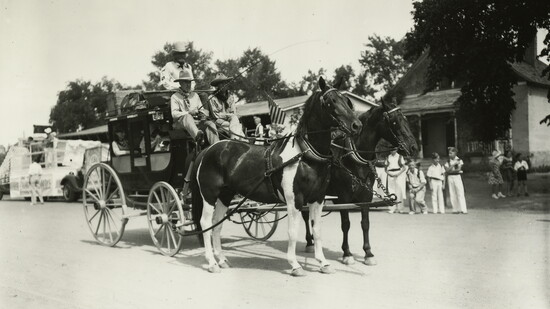
Greeley has been gathering to celebrate the Fourth of July since 1870, when residents marked the holiday at Lincoln Park with fireworks, music, and a massive American flag that still survives today in the collection of the Greeley History Museum.
On the night of July 4th, when fireworks crack open the sky above Island Grove and the crowd goes momentarily quiet before the cheering starts, something passes through the air that is genuinely difficult to name.
It is not nostalgia. Nostalgia wants to return somewhere. This feels different.
It feels like standing in a place that has absorbed a remarkable amount of human effort and human hope over a long period of time—and held it.
Where families built homes on open prairie. Where immigrant communities helped shape a growing city. Where education remained a priority. Where traditions endured because each generation decided they were worth carrying forward.
This is what this particular July makes impossible to ignore about Greeley: not a perfect history, but an honest one. Not a city that has arrived somewhere final, but one still taking shape.
America, at 250, is the same.
The country is still wrestling with its founding promises while balancing its past against the pressure of its future. The work continues because the nation itself continues evolving.
And maybe that is what places like Greeley understand best.
The prairie has never rewarded people who expected permanence without effort. Everything here had to be built—the schools, the neighborhoods, the traditions, the meaning. Each generation inherited something incomplete and made a decision, quietly or loudly, to continue the work.
That decision is still being made here every day.
A child watching fireworks rise above the plains tonight is connected, in some unbroken way, to the settlers who first stood on this ground and asked what it could become.
These things are not small. In many ways, they are everything.
Because the measure of a place is not what it looked like at its founding. It is what it has chosen to keep, what it has been willing to change, and who it has made room for along the way.
By that measure, Greeley is not a city with a 140-year history. It is a city still in the middle of becoming one.
And on a warm July night, standing beneath a Colorado sky that has watched all of this unfold, that feels less like a limitation and more like the most hopeful thing imaginable.
The most enduring stories are never finished. They are only continued.
Editorial Note: Historical research for this feature included archival materials and regional records from History Colorado, Greeley Museums, Weld County collections, the University of Northern Colorado, Visit Greeley, and Colorado historical archives.
"The measure of a place is not what it looked like at its founding. It is what it has chosen to keep, what it has been willing to change, and who it has made room for along the way."