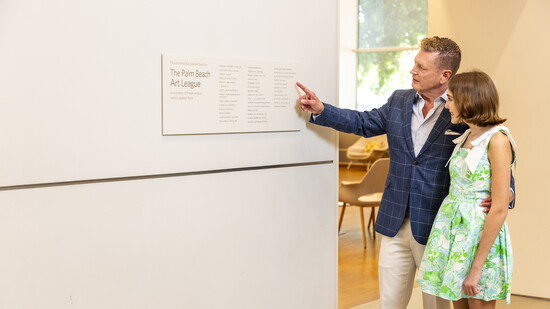
In the courtyard of the Norton Museum of Art, the light settles softly across the stone. Visitors pass through as they always do—pausing for sculpture, for shade, for a moment of quiet. It reads, at first glance, like any other afternoon in West Palm Beach.
But beneath the courtyard, the story runs deeper.
Forty of the area’s earliest pioneers remain buried here, on what was once the region’s first cemetery. Among them are the great-great grandparents of Harvey E. Oyer III. It’s a place he often visits with his 12-year-old daughter Eve at his side—five generations behind him, and a sixth just beginning.
For Harvey, history has never been abstract.
His lineage traces back to 1872, when his ancestors arrived in what is now The Palm Beaches—decades before Palm Beach County formally existed. His great-great grandparents, Captain Hannibal D. Pierce and Margretta Moore Pierce, are widely recognized as the first permanent non-Native American settlers in the region. Captain Pierce later served as Keeper of the Jupiter Lighthouse and homesteaded Hypoluxo Island, further anchoring the family’s presence in the area’s earliest days.
The stories that followed read less like recorded history and more like origin myth. A shipwreck off the coast—the Spanish vessel Providencia—yielded thousands of coconuts, salvaged and planted by the early settlers along the same stretch of shoreline where the Bath & Tennis Club and Mar-a-Lago stand today. Those groves would later give Palm Beach its name.
But the throughline has never been spectacle. It has been continuity.
Generations of Harvey’s family lived not just in Palm Beach, but with it—helping shape the earliest communities across what is now Palm Beach County. His great-grandmother, Lillie Pierce Voss, was the first non-Native American child born between Jupiter and Miami—an area that today is home to millions. As an adult, she and her husband helped bring Major Nathan Boynton to the area, laying the foundation for what would become the City of Boynton Beach, and later assisted William Linton and David Swinton in establishing what is now Delray Beach.
Her brother, Charles Pierce, was one of Florida’s famed Barefoot Mailmen and later became a noted historian and conservationist. He would go on to be recognized as a Great Floridian, and his story would later be preserved in the children’s book series Harvey himself would go on to write—stories now read by tens of thousands of fourth graders across the state each year.
In a region defined by reinvention, Harvey has focused on preservation.
“If you lose the history, you lose the identity,” he says. “And once that’s gone, you don’t get it back.”
Over the course of his career, he has helped shape how Palm Beach County understands and protects its past—leading the effort to save and restore the 1916 Palm Beach County Courthouse and playing a central role in the creation of the Johnson History Museum. His work across institutions has been consistent in purpose: ensuring that growth does not come at the expense of identity.
That perspective extends beyond his work.
Eve, poised and observant, is already part of the continuum. She has grown up attending the annual Pioneer Picnic held on these grounds—a tradition that has endured for more than a century. She moves through spaces layered with meaning, many of which carry her family’s imprint in ways both visible and unseen.
“I don’t feel like I’m teaching Eve history so much as introducing her to something she already belongs to,” he says.
There is something distinctly Palm Beach about that idea—the quiet coexistence of past and present, of legacy and evolution. But rarely is it so clearly embodied.
Here, it is unmistakable.
The Norton itself has long been intertwined with Harvey’s family. Before it was a museum, this land was part of the original Pioneer Memorial Park cemetery, maintained by early settlers before public cemeteries were established. Many of those buried here were later reinterred across the street at Woodlawn Cemetery, but dozens remain—including members of Harvey’s family.
“This has always been a deeply meaningful place for my family,” he says. “Long before it was a museum, it was where our people were laid to rest and where we gathered to celebrate them and our common heritage.”
He has spent his life returning to this place—not just as a visitor, but as a participant: attending gatherings, advising on expansion, and watching as each generation leaves its own imprint.
Standing in the courtyard, the layers compress. The distance between then and now narrows.
A father. A daughter. Their connection to this place stretches back more than 150 years.
For Harvey, the work has never been about legacy in the abstract. It has been about stewardship—about understanding that what is inherited is not owned, but held in trust. And for Eve, that trust is already being passed forward, not through instruction alone, but through presence. Through place.
“At the end of the day,” he says, “it’s not just about looking back. It’s also about making sure there’s something worth passing forward.”
One day, she will return here on her own terms. Perhaps with a child of her own. The museum will look much the same. The courtyard will still hold its quiet.
In Palm Beach, history is often preserved.
In this family, it is carried.