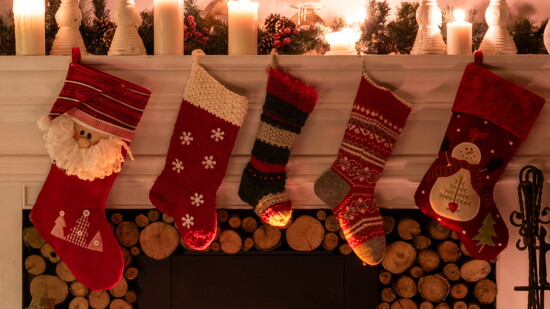
“The stockings were hung by the chimney with care…” (A Visit from St. Nicholas, 1823)
I grew up watching Little House on the Prairie, so when my daughter and I recently found ourselves watching a Christmas episode from the new Little House series, I was reminded of how simple the holidays once were—and how some of the simplest traditions have endured.
For many families, decorating for the holidays begins with opening boxes and tubs filled with things that have been carefully packed away and stored for a year, then unpacked again and again, sometimes for decades. There are ornaments made by little hands now grown, decorations inherited from parents and grandparents and, tucked somewhere among beloved items, the Christmas stockings.
In our family, the stockings were handmade by my grandmother. Traditional red felt with white tops, each was decorated with hand-sewn sequins, felt Christmas cutouts and sometimes bits of quilting, with our names embroidered across the top. No two were exactly alike.
Those stockings stayed with us through childhood. When we grew up and began families of our own, my grandmother made new ones. As babies arrived and our families grew, she simply added more.
There is something about opening our Christmas boxes each December and finding my childhood stocking. Seeing my children’s stockings. The stitches, the sequins and slightly worn felt carry memories of Christmases that somehow seem more magical in retrospect.
For us, Christmas wasn’t really about the gifts. It was about being together, wonderful food and the stockings hanging from the mantel, filled with small treasures and always—an orange.
My sister and I were raised by our grandparents, who had been children during the Great Depression. To them, an orange in winter was something special, and the tradition continued long after fresh fruit became readily available year-round.
I can’t remember everything that filled those stockings over the years. But I remember the oranges.
Perhaps that’s part of the reason Christmas stockings endure. Long after we’ve forgotten what was inside them, we remember the people who filled them, the hands that made them and the feeling of seeing them hanging there year after year.
Why the orange in the toe?
For generations, an orange tucked into the toe of a Christmas stocking was considered a special treat. Before modern transportation made fresh produce readily available year-round, citrus fruit was often considered a winter luxury, particularly for families of modest means. And, the nutrients that a simple orange could impart to those who tasted its sweetness in the dark of winter could not be overstated.
The tradition may also echo the legend of St. Nicholas. Oranges, with their round shape and golden color, are sometimes said to symbolize the gold he secretly gave to those three impoverished young women.
During the Great Depression, when Christmas gifts were often simple, an orange could still feel like a treasure—a bright, sweet reminder of abundance and generosity.
Hung with Care
The exact origins of the Christmas stocking are difficult to trace, but its best-known story begins with St. Nicholas, the fourth-century bishop whose legendary generosity eventually helped inspire our modern-day Santa Claus.
According to legend, Nicholas learned of a struggling father who could not afford dowries for his three daughters. Wanting to help anonymously, he secretly delivered bags of gold to the family. In one version of the story, the gold landed in stockings of shoes that had been left near the fire to dry.
Over time, children in part of Europe began leaving shoes or stockings out for St. Nicholas to fill with small gifts. Customs varied from place to place, but the tradition traveled and evolved.
By the early 19th century, stockings were already part of American Christmas celebrations. The familiar image was forever woven into holiday lore with the 1823 publication of A Visit from St. Nicholas, better known as ‘Twas the Night Before Christmas.
The stockings themselves evolved, too. Everyday socks gave way to stockings made especially for Christmas. Some were knitted, quilted or embroidered by hand; others were handcrafted from felt and decorated with names, Santas, snowflakes, reindeer or Christmas trees.
Today, stockings come in nearly every imaginable style. Some families choose beautifully coordinated sets. Others hang a wonderfully mismatched collection—one made by a grandmother decades ago beside another added for a new baby, spouse, grandchild or even a beloved pet.
And perhaps those mismatched stockings tell the better story.
Year after year, they emerge from boxes and bins, a little more worn and a little more precious. New names join old ones. Families change and grow. Children become parents and grandparents. Yet the stockings return to the mantel, staircase or hook each December.
What began as something meant to hold a few small Christmas treats can become an heirloom in its own right—a simple piece of fabric and thread carrying the stories of the people who came before us and those still being added to our family.
Maybe that’s why, after nearly two centuries, those familiar words still feel just right as we pull out our stockings and recall the stories of the past and create new ones for generations to come.
Sidebar pg. 4 (pg. 6 of recipe)
What’s in the Stocking?
From simple treasures to sweet surprises, a look at traditional stocking stuffers through the years
- Oranges and nuts: Once considered special winter treats, especially when fresh fruit was a luxury.
- Candy canes and sweets: Peppermint sticks, ribbon candy, chocolates and other sugary surprises.
- Coins: Shiny pennies, nickels or silver dollars, echoing the legend of St. Nicholas and his gifts of gold.
- Tiny toys: Marbles, jacks, spinning tops, miniature dolls and toy soldiers.
- Practical presents: Warm socks, mittens, handkerchiefs and other everyday necessities.
- Little luxuries: Small books, pencils, hair ribbons and other personal treasures.
Though stocking stuffers have changed through the generations, the magic of discovering what's tucked inside remains much the same.