For many women, midlife brings a quiet shift in the body—one that becomes harder to ignore over time. Yet for years, we’ve been told this stage is a kind of “crisis” to manage or fight, shaping how we feel, see, and think about ourselves in the process.
We notice things feel different. Strength isn’t what it used to be. Energy comes and goes. Recovery takes longer. And underneath it all, there’s a quiet awareness that our bodies are changing in ways we don’t fully understand.
These changes—especially during peri- and post-menopause—are directly tied to diminishing estrogen, progesterone, and testosterone, leading to a loss of muscle mass and bone density. That loss can impact not just how we look or feel, but how we move through our everyday lives.
While they are a natural part of aging, they’re also the reason strength training becomes an important component to incorporate into our lifestyle.
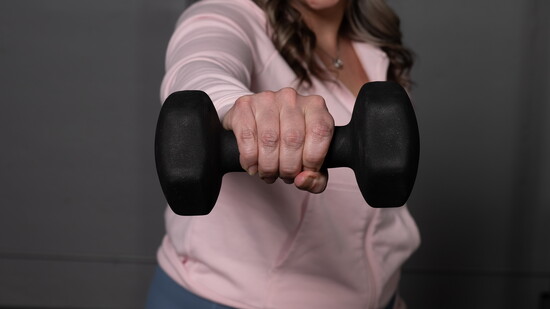
And not just lifting for the sake of lifting—but intentional strength. Resistance training helps maintain muscle, preserve bone density, and improve balance—supporting your body for the long term.
For many women, a hesitation around lifting weights—especially heavier ones—comes down to one persistent fear: I don’t want to get bulky. But the truth is, most women simply don’t have the hormonal profile to build large, bulky muscles. In fact, lifting heavier weights with fewer repetitions tends to do the opposite—it creates a stronger, denser muscle that supports your bones, improves balance, and helps your body function better in everyday life.
Understanding this is one thing—applying it is another. This is where the conversation begins to shift. It becomes less about how the body looks and more about how it functions—how it moves, supports, and carries us through everyday life. This is where functional training comes in.
Tracy Izquierdo, owner of Pvolve Algonquin, emphasizes that how you move matters just as much as what you lift. She focuses on controlled, low-impact strength work that builds stability, supports joint health, and strengthens the deep core and pelvic floor—areas that become increasingly important during menopause.
For Denise Smith, physical therapist and owner of Smith Physical Therapy +, this way of thinking isn’t limited to one program or one type of client—it’s how she approaches every person she and her team work with. From athletes to everyday movement, the focus is rooted in building strength that supports real life.
In practice, that approach isn’t about choosing one method over another, but finding the right balance. On one hand, there’s functional movement—training the body to move well, stay stable, and support everyday life. Denise suggests exercises such as burpees which can be modified based on fitness levels, and mimic the movements needed to get oneself up from the floor, whether you got there from a fall or from playing with grandkids. Or overhead presses which build shoulder muscles that can help support you reaching for things on shelves above your head.
On the other hand, there’s a more intentional focus on building strength through adding heavier lifting, once or twice a week. In practice, that often means fewer repetitions with more intention—lifting a weight that feels challenging for about 5–8 reps, taking time to rest, and repeating that a few times, if possible. It’s a different kind of effort—less about pushing through fatigue and more about building strength that lasts. Denise even challenges some of her clients to lift the heaviest weight they can for only one or two reps.
The heavy lifting-functional lifting combination is purposeful. While functional training supports how the body moves, heavier lifting plays a critical role in how the body adapts. It helps stimulate then relax the nervous system, improve muscle recruitment, and place the kind of load on bones that encourages them to stay strong. For women in perimenopause and beyond, that load becomes especially important—helping to grow, maintain, or at least slow the loss of bone density while building strength that feels solid and lasting.
For Rose Blake, a longtime D155 high school teacher nearing retirement and owner of Get After It, LLC,a personal training business in Crystal Lake, her approach starts with a simple message: just lift something. Getting started is the key, so lifting even a light weight is better than doing nothing.The heavy lifting-functional lifting combination is purposeful. While functional training supports how the body moves, heavier lifting plays a critical role in how the body adapts. It helps stimulate then relax the nervous system, improve muscle recruitment, and place the kind of load on bones that encourages them to stay strong. For women in perimenopause and beyond, that load becomes especially important—helping to grow, maintain, or at least slow the loss of bone density while building strength that feels solid and lasting.
In her private training sessions or small group classes—made up mostly of women in midlife—she encourages her clients to let go of idealism and fear, and instead focus on simply beginning. Her approach emphasizes listening—to the body, to energy levels, and to what feels sustainable. Some days that might mean heavier lifting. Other days, it’s functional movement or simply going for a walk. The goal isn’t perfection—it’s consistency.
Rose also offers guidance on how to structure strength workouts including curls, tricep extensions and presses, rows, deadlifts, Bulgarian squats, and good old push-ups and planks. Two of her clients, Christine G., 53, and Kristin L., 51, have been training with her for years. And both credit weight training with Get After It with Rose, for their better balance and strong bones.
The underlying principles of Rose’s approach align closely with other trainers working with women in this stage of life, including Kelly Tafoya, owner of Kelly Tafoya Training, LLC, who trains clients privately and in small groups at the Smith PT+ facility. Both Kelly, 55, and Rose, 54, are not only training women through menopause—they’re navigating this stage of life right alongside them.
That shared experience is echoed by Tracy, who is also navigating menopause herself. “The focus shifts from simply working out to building a body that is strong, resilient, and capable for the long term—supporting muscle, bone health, and overall function,” she explains.
Functional fitness training combined with lifting heavy weights in menopause preserves muscle mass and builds strength, supporting bones, balance, posture, while reducing joint pain and stiffness.
Smith Physical Therapy + brings this philosophy to life through its Women Strong program—six-week group training sessions designed for women navigating perimenopause and beyond. At the center of it all is a question Denise encourages each participant to consider: What does healthy look like to me?
There isn’t one answer—and that’s the point. Each woman comes in with her own starting place, her own goals, and her own definition of what strength means at this stage of life. The program is designed to meet them there.
The sessions are led by Kelly Tafoya, guiding women as they build strength in a way that feels both manageable and empowering. As participant Lisa C. described, the groups are small—just six to eight women—making it far less intimidating than walking into a gym full of younger, more experienced athletes.
For Kathy G. and Sandy P., both 57 and longtime run-walkers who participate in races, strength training wasn’t part of their routines—until recently.
After battling injuries that landed her in PT, Sandy heard about the Women Strong program and decided to give it a try, inviting her Friend Kathy to join. In a short amount of time, what she learned from the class and then carried into training on her own, translated into running stronger with less pain and quicker recovery. She attributes this to the muscle that she has built and functional training that literally carries her throughout the miles, not to mention her everyday activities.
Kathy, too, has seen a difference. And, maybe more importantly, has gained confidence in what she can challenge herself to do. What started as a desire to tone up her arms and fight off the “menopause middle” (a sentiment echoed by many women), has become a lifestyle. “I am proud of myself. I want to be able to keep being physically active into my older years. I feel like I am building that foundation now.”
What begins as a physical goal, often evolves into something deeper—a shift in how we see ourselves and what we believe we are capable of. Somewhere along the way, many of us were taught to measure our bodies by size, by weight, by how tightly we could hold onto something from the past.
But this stage of life offers a different opportunity.
A focus on strength—not just in how we look, but in how we live. To build muscle that supports us, bones that keep us steady, and confidence that carries into everyday moments we might otherwise take for granted.
And if you’re not sure where to begin, you don’t have to figure it out alone. There are trainers like Kelly or Rose, or groups like Women Strong, who can teach and guide you to get you started. Remember, the first step doesn’t have to be perfect—it just has to be yours.
Because strength, at this stage, isn’t about becoming someone new.
It’s about supporting yourself exactly where you are—and building from there.