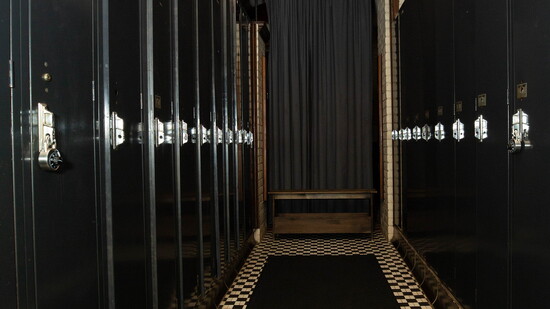
When Paddy Lynch first walked into the Schvitz with a friend, more than a decade before he ever dreamed of owning it, the place was… well, rough. Dingy carpets. Drop ceilings holding decades of smoke. A stench that hovered somewhere between chlorine and cigarettes.
But down the long hallway, in the belly of the venerable building, he found something that stopped him in his tracks. A table of older men, mostly Jewish and Russian, sat in towels and robes, drinking red wine, taking shots of vodka, eating steak, and warmly welcoming the two curious neighbors who’d wandered in.
“They couldn’t have been nicer,” Paddy recalls. “They realized real fast we weren’t weird voyeurs—just guys who lived nearby.”
That night, Paddy took his first steam in the room Detroiters have been sweating in since 1930. The rocks were blisteringly hot. The pool was shock-cold. And something in his life shifted.
After graduating college, he spent four months in Haiti with monks, teaching orphans and working with sick babies. The experience broke him down mentally. Back home, depressed and on antidepressants for years, he felt flatlined: nothing depressed him, nothing excited him. That's when the Schvitz became medicine.
"When I decided to come off my SSRI, the withdrawals were painful," Lynch explains. "The Schvitz helped me get through that process. I'd go hot-cold-hot-cold for two hours.”
The science is popular now: heat/cold contrast therapy, lymphatic flow, improved cardiovascular response, cortisol regulation. Paddy didn’t know any of that. He only knew his body felt better. His mind felt quieter. And the ritual became weekly.
Fifteen years later, he still goes every Wednesday. He also owns the place. And he's poured over a million dollars into saving it.
In 2017, the Schvitz wasn’t for sale. It was barely functional. But Lynch, a longtime funeral director, realized a funeral home and the bathhouse "are two sides of the same coin. Kind of private, kind of public. People come to let go, to be gentle with each other when the world is brutal."
After visiting the legendary Russian & Turkish Baths in New York, and seeing what a bustling, all-ages bathhouse culture could look like, Paddy called the aging caretaker and asked the question that would change everything: “Is she actually thinking about selling?”
What followed was a leap of faith driven by gut instinct. Paddy took out a line of credit against his house. Bought the building “as-is,” uninsured, no inspection. He walked into a project that immediately proved to be, as he puts it, “a total money pit.”
“There wasn’t a square inch that didn’t need attention,” he laughs. Roof replacement alone was half a million dollars. Masonry repairs, plumbing, electrical, and peeling back decades of ill-advised renovations followed. “Restoration by subtraction,” he says. “Getting everything back to the original hard surfaces.”
The building started as a Jewish Community Center in 1918. By 1930, Russian Jews—some with Purple Gang connections—converted it to a traditional banya. In a 225-degree room, you can't hide weapons or wires, making it perfect for confidential conversations during Prohibition.
When Lynch ripped up the carpet, beneath the floorboards lay a perfectly intact mikvah, a Jewish ritual bath, that had been covered for half a century. “Rabbis came right away. Their minds were blown,” Paddy says. Today, surrounded by plants and art, it sits exposed and honored in the women’s locker room.
The Schvitz’s heat is the stuff of legend: 15,000 pounds of rock, heated by an 800,000-BTU blast furnace installed by gangsters in 1930. As regulars proudly say, it’s the hottest room in the Midwest.
The cold plunge runs brutally cold, often dropping into the mid-40s during Detroit’s winter months, when the supply lines bring in naturally frigid water. The new Himalayan salt sauna adds a dry-air respiratory boost. And upstairs, one of Detroit’s most iconic kitchens serves ribeyes, strips, soups, and legacy dishes: generous plates without the downtown markup.
But what draws over a thousand people a week is more than the heat, the cold, and the food. It’s the community.
“There’s this unspoken rule,” Paddy says. “You don’t have to like each other, but you have to love each other.” Conservative old-timers steam alongside younger creatives. Wealthy suburbanites sit next to blue-collar regulars. Veterans, artists, immigrants, recovering addicts, chefs, athletes all sweating shoulder to shoulder. And as Paddy points out, “they might not otherwise hang out if it weren’t for this place.”
And women have become the backbone of the business. Three women-only sessions a week, each staffed entirely by women, now pack the building. “They take care of each other the same way the men always have,” Paddy says. “They’ve built their own sisterhood here.”
If someone’s nervous to try the Schvitz? Paddy says, “Dip your toe in the water—no pun intended. Come for dinner first. No cover if you’re not steaming. Let us give you a tour. Feel the place. Then come back when you’re ready.”
And if you’re still unsure, he offers the mantra that anchors the entire experience: “Come unwind back in time.”
That’s what time at the Schvitz really is: unwinding. The city’s noise falls away, strangers become companions, and the body remembers what it knew long before wellness had a name. Nearly a century after those first rocks were fired, this Detroit ritual remains the same: sweat, plunge, rest, repeat.
To experience the historic Schvitz, visit schvitzdetroit.com