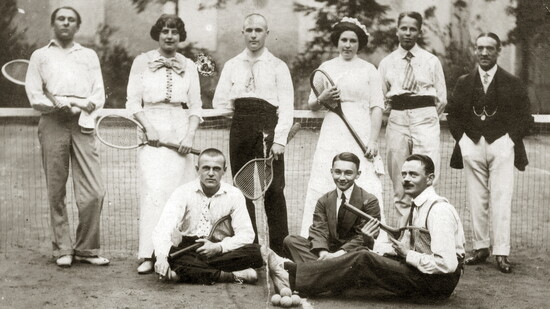
Did you know that the first tennis ball was stuffed with feathers and wrapped in animal and human hair? Around the 12th century, France was playing a form of handball called "jeu de paume," or "game of the palm," which later allowed the option of playing with a bat or paddle. France is also credited (or discredited) with inventing the scoring system, including the score of "deuce" from the French translation "deux," "advantage" from "avant," and "love" from "l'oeuf." Known as the "sport of kings," King Charles V set up a court in his Louvre Palace and, across the pond in England, Henry VIII's tennis game was once rudely interrupted when receiving confirmation that his wife, Anne Boleyn, had been successfully beheaded.
Tennis evolved from playing against outdoor walls to playing indoors, and, at one point in time, it had evolved into hitting over nets five feet high. In 1874, a Welsh Major in the British Army, Sir Walter Clopton Wingfield, ambitiously patented the rules and equipment of "lawn" tennis, and they have withstood the test of time quite well. It was only in the 1980's that wooden racquets changed to lightweight, more powerful racquets made of graphite, titanium, carbon, or steel. White tennis balls didn't change to optic yellow, for better visibility, until the 1990's.
The first Wimbledon tournament was held in 1877, with the hourglass shaped tennis court being changed to rectangular. Several years later, women were competing at Wimbledon in their long dresses, corsets and hats, and Wimbledon's requirement for all players to wear white continues to this day.
Tennis came to America in 1873 when the vacationing New Yorker, Mary Ewing Outerbridge, saw tennis being played in Bermuda by some British Army friends of Sir Windfield. Determined to carry a net, racquets, and balls home, despite U.S. Customs confiscating the "contraband" at first, she finally succeeded and laid out the first U.S. tennis court at her cricket club on Staten Island. The first U.S. Open tournament was held four years after the first Wimbledon, in 1881, in Newport, Rhode Island, at what is now the International Tennis Hall of Fame & Museum, which still annually hosts the only "grass" professional tournament held in North America.
By 1900, clay court surfaces were introduced, followed by hardwood flooring, and then by "hard" courts that started as cement or asphalt.
Tennis Quiz
Tennis has always been a game played politely. Starting with the royals and gentry of England and France, tennis is steeped in a history of manners and etiquette. "Politesse," coupled with the knowledge of the rules of tennis, will keep players calling you back for another game. The following is an opportunity to assess your knowledge of some unusual rules and important etiquette:
1. Can your shot be good if the ball touches part of your body?
a. No.
b. Yes, if it touches your finger(s).
c. Yes, if it touches any part of your hand.
2. When spinning a racquet or flipping a coin at the beginning of a match, how many choices has the winner of the spin?
a. Two: the choice to serve or receive first and the choice of preference as to which side to start the match.
b. Three: the choice to serve or receive first, choice of preferred sides to begin the match, and the choice to defer to the opponent to choose from the choices above.
3. Do you win a point if you hit a ball that goes around the net post, not over the net, and lands fair on the opponent's side?
a. Yes.
b. Yes, if the ball is hit at least as high as the net's height.
c. No.
4. May you reach over the net to hit a ball if you do not touch the net with your body or clothing?
a. No.
b. Yes.
c. Yes, but only if the ball has gone over the net to your side first.
5. In doubles, what happens if the served ball touches the net and then, before the bounce, hits the receiver's partner who's standing outside the proper service court?
a. The serving side wins the point.
b. The receiving side wins the point.
c. It is a "let," so the server repeats the serve.
6. In doubles, during a point, when may a player say something to his/her partner?
a. Never.
b. Only after the opponent hits a ball.
c. Anytime.
7. If there's uncertainty about a ball landing fair or out, may either side make the call?
a. No, only the side receiving the ball.
b. Yes.
c. Whoever had the best view.
8. Under what circumstances is the server allowed to repeat a faulted first serve (there may or may not be more than one correct answer)?
a. A ball from another court enters your court between serves.
b. The receiver needs to re-tie a shoe between serves.
c. A bird nearby starts squawking between serves.
d. The receiver calls "out" and hits the faulted first serve softly into the net, but because it rolls back from the net, needs to clear the ball before the second serve.
e. The server needs to re-tie a shoe between serves.
"Having grown up socially struggling herself, Taffy Lewis loves to build self confidence in girls ages 5--18 through her free, private tennis and pickleball lessons. Change fears to smiles!"
Call or text Taffy: 858 722-7258, or email: taffy@sbcglobal.net
Retired Tennis Teaching Professional, Master's in Counseling"
Answers to the Tennis Ettiquette Quiz: 1. c 2. b 3. a 4. c 5. c 6. b 7. a 8. a, b, & d (Server is entitled to no delay between serves and receiver must play at server's pace.)