As the nation gears up to celebrate its 250th birthday, there is no better time to reflect on a pivotal moment in American history – Theodore Roosevelt’s first trip to California in 1903. This transformative journey not only marked a monumental adventure for Roosevelt, but also ignited the movement that would ultimately give birth to the National Park Service. Through his travels during a nine-week, 14,000-mile tour across the United States, Roosevelt came face-to-face with thousands of Americans, reinforcing his role as a champion of conservation.
The year 1903 was significant for many reasons. Alongside Roosevelt's expedition, it saw the Wright brothers achieve their first powered flight at Kitty Hawk, the introduction of the teddy bear inspired by a hunting mishap and the birth of the very first World Series. Each event encapsulated the spirit of progress and innovation that characterized the early 20th century. Roosevelt, who became president after William McKinley’s tragic passing in 1901, faced a nation poised at the intersection of change and tradition.
The origins of the teddy bear can be traced back to an ill-fated hunting trip in Mississippi. Roosevelt found himself without a trophy when his hunting party couldn't catch a bear. To salvage the situation, the governor provided a sickly bear cub tied to a tree. However, Roosevelt, honoring the ethics of fair sport, refused to harm the defenseless creature, declaring it was not true hunting. This incident quickly captured the attention of the media, leading to a political cartoon that depicted Roosevelt’s moral stand. It inspired a Brooklyn candy shop owner to create the iconic teddy bear in honor of the president, forever linking Roosevelt to the beloved toy.
By April 1903, excitement and anticipation were building as Roosevelt prepared for his cross-country trip, keen to experience California’s natural beauty firsthand. His decision to reach out to famed naturalist John Muir, whose writings about Yosemite ignited Roosevelt's interest, laid the groundwork for what would become a historic camping trip. Roosevelt sought to escape the burdens of politics for a brief respite in nature, envisioning a three-night journey focused on camaraderie and reflection amid the spectacular scenery.
Muir was not just a renowned conservationist; he was a pivotal figure in advocating for the protection of America's wilderness. Despite concerns from Roosevelt's staff regarding the potential risks of such an isolated excursion, Roosevelt was resolute. His determination to camp in the awe-inspiring Yosemite Valley reflected his deep connection to nature and desire to connect with Muir, whose ideals about conservation resonated with him.
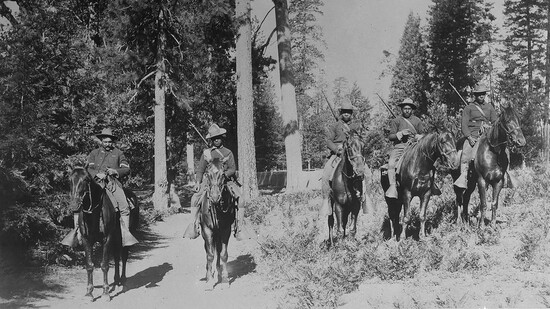
On May 7, 1903, Roosevelt arrived in California, embarking on a journey that would take him through Redlands, San Bernardino, Riverside, Los Angeles and San Francisco. Once in San Francisco, a massive parade was held in his honor. Notably, Roosevelt insisted on having the Ninth Cavalry, a regiment of Buffalo Soldiers, serve as his bodyguards during the parade. This decision was laden with social implications, as it challenged the racial norms of the time. Roosevelt, who fought alongside these Black soldiers during the Spanish-American War, credited them with saving his life in Cuba. His decision to honor and employ them amidst a divided nation spoke volumes about his character and commitment to equality.
The Buffalo Soldiers, recognizing Roosevelt’s respect and admiration, would later become the first park rangers at Yosemite, a testament to their bravery and service.
During his three nights in Yosemite, under the vast canopy of stars, Roosevelt and Muir forged a friendship centered on their shared vision for protecting America’s natural wonders. They conversed over campfires, discussing the future of the nation’s landscapes and the need for conservation. During this profound experience, they began to forge a vision for a national parks system that would protect these lands for future generations. The camping trip with Muir represented a pivotal point in the evolution of Roosevelt’s views on conservation and the environment.
Established just a few years prior, Yosemite was, at that time, the only protected park in the country, thanks to the Yosemite Valley Grant Act signed by Abraham Lincoln in 1864. Lincoln’s appreciation for Yosemite was sparked by the breathtaking photographs of pioneering photographer Carleton Watkins. His images played a critical role in raising awareness and admiration for the land, making it vital to the conservation movement.
When Roosevelt returned to Washington, D.C. in June 1903 after the Great Loop tour, he was invigorated by his experiences in California. Inspired by his time with Muir and his newfound appreciation for the Western landscape, Roosevelt focused on enacting policies that would protect millions of acres of land across the nation. His commitment to conservation led to the establishment of numerous national parks, monuments and wildlife refuges, further solidifying his legacy as one of the most significant environmental advocates in American history.
While Roosevelt never visited Long Beach directly, the city holds a unique connection to his legacy. At the Long Beach Navy Memorial, there is an anchor from one of the ships of the Great White Fleet, a grand naval armada created by Roosevelt in 1908. This fleet’s mission was not only to showcase American naval power but also to promote peace and diplomacy. The Great White Fleet notably docked at Long Beach, highlighting the city’s importance in waterborne endeavors during Roosevelt’s time.
Additionally, in the Bixby Knolls neighborhood lies a quirky little attraction — a tiny national park located at the intersection of Long Beach Boulevard and Roosevelt Road (a road named in honor of Theodore Roosevelt). The park serves as a humorous nod to his significant contributions to conservation and reflects the lasting impression he left on the American cultural landscape.
In my new book, “Theodore Roosevelt in California: The Presidential Adventure that Saved the Wilderness,” I have detailed the rich history leading up to and including Roosevelt’s momentous camping trip. It provides not just a narrative of his adventures but also acknowledges the unsung heroes of that time, including the Buffalo Soldiers and Carleton Watkins. Their stories contribute to a comprehensive understanding of an era that paved the way for future generations to admire and enjoy the beauty of the national parks.
Roosevelt’s 1903 trip to California was not only a historic expedition; it was a profound journey that ultimately shaped national conservation efforts and inspired countless individuals to appreciate and protect America’s natural treasures. As we celebrate the 250th birthday of the nation, let us also honor the legacy of Theodore Roosevelt and the adventures that kindled the spirit of environmental stewardship that we continue to cherish today.
Chris Epting is the author of more than 50 books, spanning genres from memoir and music to baseball and American history. His work includes many bestsellers, showcasing his diverse literary talent. Beyond his books, Epting spent a decade as a columnist for the Los Angeles Times and the Huffington Post, along with contributions to other publications, cementing his reputation as a versatile and respected voice in journalism.
His latest book, "Theodore Roosevelt in California: The Presidential Adventure That Saved the Wilderness," explores Theodore Roosevelt’s influential role in conservation. Currently, he is working on "The Hidden History of Long Beach," where he digs into the rich and often overlooked stories of the city.
Roosevelt’s 1903 trip to California was not only a historic expedition; it was a profound journey that ultimately shaped national conservation efforts.