For many people with loved ones affected by Alzheimer’s disease, their confrontation with the illness can trigger feelings of isolation, especially when they don’t know where to go for help. Paul Irwin-Dudek, executive director of the New Jersey Chapter of the Alzheimer’s Association, experienced this firsthand when his daughter was born.
“One of the moments I looked forward to most was introducing her to my Babci, my Polish grandmother. She was the first great-granddaughter in a family full of great-grandsons, and I couldn’t wait to see the joy on my grandmother’s face,” Irwin-Dudek recalls. “But when I placed my daughter in her arms, she looked at me and asked, ‘Who is this?’ She said it in Polish. At first, I was confused. My Babci knew I didn’t speak Polish, but my uncle quickly stepped in to translate. I thought she was just being sweet and funny, until I realized she wasn’t asking about my daughter. She was asking about me. My grandmother no longer recognized me. Dementia had taken that from her. Even more heartbreaking, she had lost the ability to speak English, a language she had spoken fluently for more than 50 years. Alzheimer’s took away the last way I could communicate with her without help. Alzheimer’s didn’t just steal my grandmother’s memories; it stole our connection.”
Compounding the heartache, Irwin-Dudek’s family was unaware they could get help from the Alzheimer’s Association. “At the time, we didn’t know there was a 24/7 Helpline available in more than 200 languages—including Polish,” he says. “We didn’t know there were resources, education, and support available for caregivers like my aunt and uncle. We didn’t know we weren’t alone. My grandmother lived the final six years of her life disconnected from the world she once knew. And today, more than a decade after her passing, my uncle, who cared for her throughout her illness, is now facing his own journey with dementia. That is why this work matters. That is why support matters. And that is why I do what I do.”
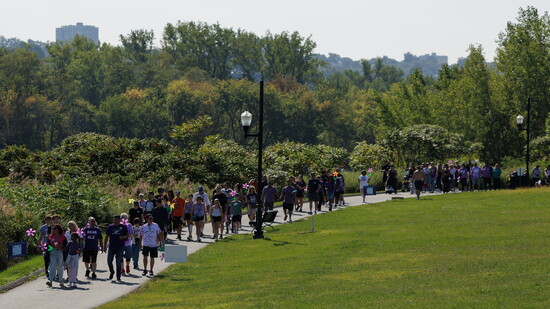
The work and support Irwin-Dudek references is the Alzheimer’s Association Bergen-Passaic Walk, which has become the leading grassroots event supporting the state’s dementia community. “This truly underscores the Alzheimer’s Association New Jersey’s impact statewide,” he says.
For many people, the walk is their first experience getting acquainted with the local organization. “It’s really how they come to learn about us, whether they saw a flyer in their company breakroom or someone talked about the walk or invited them to join a team walk,” says Katy Lido, the chapter’s development director in New Jersey. “It’s not just a one-day event; it’s a year-round campaign.”
Each year, the New Jersey Chapter of the Alzheimer’s Association organizes a Walk to End Alzheimer's event in different communities. This year, in Bergen-Passaic, the walk will take place on September 27.
Last year, Jim Prussak, owner of Applause Home Care and chair of the Bergen-Passaic Walk to End Alzheimer’s, sponsored all five regional events within territories under the umbrella of the chapter. This year, he committed to serving a second year as the executive leadership chair for the 2026 walk. “His example reminds us that leadership is not only about results,” Irwin-Dudek says. “It’s about building a legacy of impact and commitment.”
The Alzheimer’s Association is the leading brain health organization in the nation, and their work continues to evolve alongside the science. While they were once primarily focused on supporting individuals living with Alzheimer’s and other dementias—and the caregivers who walk that journey with them—their mission has expanded in powerful ways. Groundbreaking findings from their U.S. Pointer Study have shown that Alzheimer’s can, in many cases, be prevented or its progression slowed through lifestyle interventions and early detection.
As a result, the Association’s efforts now reach further upstream. In addition to providing care, support, advocacy, and research funding, they are intentionally engaging younger audiences and broader communities—educating individuals about brain health, risk reduction, and the importance of early diagnosis. By equipping people with knowledge sooner, they are not only supporting families today but also working to change the trajectory of this disease for generations to come.
“Last year at the Bergen-Passaic Walk, we raised almost $275,000 with over a thousand people attending,” Lido says. “The more people that we can have there on Walk Day, the more lives we can help, and we welcome anybody and everybody who wants to learn more about Alzheimer’s to become involved.”
When participants register, they receive a personal page they can choose to share with friends and family—a space that highlights when they’re walking and, if they wish, why this cause matters to them. Many people personalize their page with a photo of the person they’re honoring or remembering, and some include a story that reflects their connection to the journey.
While these pages offer a gentle way for those who want to raise funds in support of the mission, it’s entirely optional. At its heart, the event is about coming together—walking in solidarity, honoring loved ones, and building a community of hope and support.
Participation in the Walk has continued to grow each year, alongside meaningful increases in revenue—a reflection of the community’s deepening commitment to the cause, according to Lido. “Last year, the Bergen-Passaic Walk not only reached its financial goal of $265,000, but the community’s incredible support helped push us to nearly $275,000,” she shares. “Seeing everyone come together and lean in the way they did was truly inspiring.”
Besides being one of the 2025 Walk’s top sponsors, Prussak also personally fundraised through his team and offered a challenge to personally match whatever was raised within a 24-hour period.
“Jim’s generosity played a meaningful role in helping us surpass that goal, and we are incredibly grateful for his ongoing support,” Lido shares. “We’re truly honored that he’ll be serving as our Executive Event Chair again this year.”
Local businesses play a vital role in the success and impact of the Walk, and there are many meaningful ways for companies to get involved—whether through sponsorship, forming a corporate team, or engaging employees in the experience.
Nationally, the organization works alongside more than 80 corporate partners—with nearly 50 engaged right here in New Jersey—reflecting a strong and growing network of businesses stepping forward to make a difference. Sponsorship offers companies the opportunity not only to visibly support the mission, but also to activate their workforce in a purposeful way by building teams that walk together.
“The Walk naturally fosters teamwork and connection,” Lido says. “Companies rally around a shared cause—sometimes in honor of a colleague or loved one impacted by the disease—and it becomes a powerful way to bring employees and their families together. It strengthens culture internally while demonstrating a very real commitment to the community externally.”
The Walk begins with one of its most powerful and moving traditions—the Promise Garden Ceremony. After participants check in, they’re invited to visit the Promise Garden, a beautiful display of vibrant symbolic flowers. Each participant selects a colored flower to hold during the ceremony or place within the garden installation at the Walk site.
While simple in form, the flowers carry deep meaning. Each color represents a personal connection to Alzheimer’s or dementia, and many participants write the name of a loved one directly onto the petals—transforming the garden into a living tribute of stories, memories, and love.
Purple is for an individual who has lost someone to Alzheimer’s or dementia; yellow is for a caregiver; blue is for someone who is actually living with Alzheimer’s or another form of dementia; and orange is for anyone else who may not have someone in their direct circle that’s been affected by Alzheimer’s dementia, but they really care about the cause.
At the heart of the ceremony is a single white flower—the most powerful symbol in the garden. “We only have one,” Lido shares, “and it represents our collective hope for a future without Alzheimer’s.” The individual holding the white flower stands as a beacon of that hope—a visual reminder of the progress being made and the day we are all walking toward: a world with a cure.
Just before the Walk officially begins, the community gathers for a moment of gratitude and recognition. Sponsors are honored for their commitment, and the volunteers and organizers whose passion brings the event to life are celebrated. With energy building and flowers raised high, the ribbon is cut—marking the emotional start of the journey as participants step forward together.
“Many walkers choose to carry their flower along the route and take it home as a keepsake,” Lido shares. “Others return and plant it in the Promise Garden—adding their story to the collective display of strength, remembrance, and hope.”
Throughout the day—filled with activity, connection, and moments of reflection—volunteers remain the heartbeat of the event. From registration to route support, they help create a seamless and meaningful experience for every participant.
Beyond Walk Day, volunteers continue to extend the mission’s reach—serving as trained community educators and advocates who raise awareness, share resources, and ensure families know they are not alone in navigating Alzheimer’s and other dementias.
And for those who may not be able to attend in person, there are still meaningful ways to stand with the cause. Supporters can contribute online—donating to an individual walker, a team, or the event overall—ensuring that every act of generosity helps move the mission forward.
Lido’s call to action is an open invitation to experience the power of this community firsthand. “Come be part of this movement,” she urges. “The people who show up are some of the most compassionate and dedicated individuals you’ll ever meet. No matter your connection to the disease; whether you’re a caregiver, someone living with Alzheimer’s, honoring a loved one, or simply want to stand with the cause…you are welcomed with open arms.”
She emphasizes that participation isn’t measured in dollars, but in presence, purpose, and heart. “It doesn’t matter if you raise $5 or $500. What matters is that you’re there walking beside others who understand, who support, and who believe in a future without this disease.”
More than a single day, the Walk is a gateway to connection—linking individuals and families to resources, support, and one another. “We use the Walk as a way to bring people together,” Lido says, “to help them find hope, community, and the strength that comes from knowing they are never alone.”
To learn more about the New Jersey Chapter of the Alzheimer’s Association, volunteer, or donate, visit alz.org/nj, or call 800-272-3900. In addition, you can follow the organization on their Facebook page, facebook.com/AlzAssnGNJ/ or on Instagram, instagram.com/alzassngnj/ or on Twitter (X), x.com/AlzAssnGNJ.