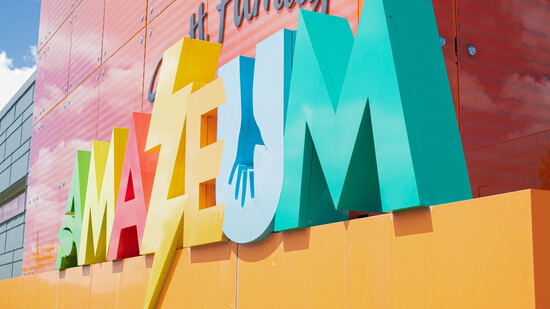
Since the Scott Family Amazeum first opened its doors at 1009 Museum Way in 2015, the children’s museum has been more than a destination for Northwest Arkansas’ youth; it has become a key pillar of Bentonville’s development as a family-forward city. It is a space where parents, educators, and children can find their tribe through the joyful messiness of learning through play.
Chief Learning Officer, Mindy McElroy, has been with the Amazeum since the address was nothing more than a plot of grass. She says one sentiment has remained a constant with each phase of the museum’s growth: How do we honor the messiness of childhood and put that into a physical space?
“Our educational approach [STEAM] is rooted in national and global research that has been proven over and over again,” she explains. “Data shows that physical exhibits and hands-on learning make a huge difference, and we’ll always prioritize authenticity. We don’t want kids to have a fake experience–nothing in the museum is rigged.”
STEAM learning combines Science, Technology, Engineering, Arts, and Mathematics. Evidence of this approach can be found in exhibits like the new Materials Lab, Water Amazements, Nickelodeon Play Lab, Art Studio, and more.
McElroy explains that the success of the Amazeum’s learner-led experiences, along with the rapid growth of Northwest Arkansas, have inspired its $25 million "Expanding Futures" campaign. Within this campaign, the museum will expand its footprint by more than 34,000 square feet with three distinct, immersive environments. These additions include the Early Learning Advancement Center [ELAC], The Hangout–featuring Headwaters Cafe & Lounge–and The Backyard.
The expansion is an architectural triumph, designed to seamlessly blend with the natural splendor of the Ozarks. Director of Special Projects, Catherine Griswold, notes that the design choices were intentional, drawing inspiration from organic forms found right here in our backyard.
The exterior of the new spaces will feature unique panels reminiscent of brown trout scales, creating a striking visual that feels rooted in the local landscape. On the west side, "The Hangout" serves as an architectural handshake to the community. Designed as a welcoming hub, it greets trail-goers and visitors from the nearby Crystal Bridges campus. With serene forest views, flexible gathering areas, and a café, it invites families to pause, recharge, and connect.
On the east side, the vision continues. "The Backyard" expands the museum's playscape. Here, children are encouraged to climb, build, and experiment, engaging with water, erosion exhibits, and nature zones that turn the outdoors into a living laboratory.
For our youngest learners, the new "Early Learning Advancement Center" (ELAC) provides a dedicated environment for children up to six years old. This space is tailored for caregivers and educators alike, featuring open-ended gallery spaces that foster deeper exploration and critical development.
“Working here has been like cracking open that internal love for getting your hands into things, making messes, and experimenting,” she said. “One of the most fun experiences has been bringing our crazy ideas to the design team.”
“We love organic, oodley-noodley shapes,” McElroy added with a giggle.
Through these new spaces, the Amazeum invites families to leave their mark, turning every visit into a shared narrative of discovery. As we near the finish line for this expansion project, both McElroy and Griswold share a common indicator of success: make learning visible.
McElroy compares the Amazeum to an iceberg: the museum is what you see above the water, but "below the waterline" lies an impact on the community five times greater. In a region where many residents are transplants, missing family roots, the Amazeum offers a critical sense of belonging. Whether playing alongside another family or sharing a quiet moment in the lounge, guests are finding connection.
“A month after opening The Hangout, I’d consider it a success when we see those connections happening,” Griswold says. “To see families leaving their mark on the space–making learning a visible thing they share.”
How do we honor the messiness of childhood in a physical space?