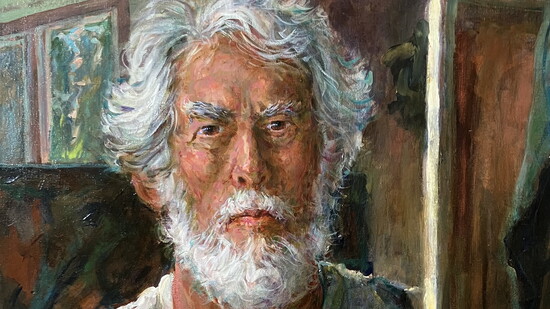
At ninety-one years old, John Killmaster possesses the rare kind of energy that has very little to do with age and everything to do with curiosity. Some people seem to grow older while remaining fundamentally unchanged; others continue to evolve so persistently that age becomes almost beside the point. John belongs firmly in the latter category.
His accomplishments are easy enough to list. As a painter. printmaker, illustrator, sculptor, enamel pioneer, educator, innovator, and mentor, John’s work has appeared in museums and exhibitions across the country, and his contributions to the field of enameling helped expand what many artists believed the medium was incapable of becoming.
The moment I stepped through the front door of his home, I found myself immersed in a world shaped by a lifetime of making. Every room seemed filled with evidence of his artistic journey, from landscape paintings and abstract enamel works to early automotive illustrations that traced the beginnings of his career. John greeted me with the warmth of an old friend, and before we had settled into our seats, he was already reaching for books, photographs, and catalogs, eager to share stories.
The son of a school principal and teacher in Michigan's Copper Country, John spent his childhood surrounded by long stretches of wilderness. In the 1940s, life there required a certain degree of self-entertainment. John’s small town consisted of one school, one store, and endless woods. Nature became his playground, his refuge, and eventually one of the deepest wells from which his artistic life would draw.
As he spoke about those early years, it became clear that his relationship with the natural world was never simply visual. Being in nature, he explained, was a hobby in itself. While many artists treat representational and abstract painting as separate pursuits, John speaks about them as different ways of investigating the same mystery. His landscape paintings explore the visible beauty of the world, while his abstract works search for the underlying structures beneath the visual world. This forces John to not just look, but to really see what exists beyond the surface.
When John was still a teenager, his world changed with the loss of his father. The years that followed demanded sacrifice. He spoke of sleeping on a screened porch while attending art school, completing his homework on a bay windowsill, working long hours, and sharing living spaces with other young artists trying to find their footing in the world. None of it was easy, but there was never any indication that he considered another path.
That spirit followed him to Mexico in the 1960s, where he studied for eight weeks at the University of Guanajuato. The vivid landscape, vibrant culture, and exposure to new techniques introduced fresh possibilities into his work while deepening his understanding of painting and form.
Even then, John was never interested in arriving at a final answer. He was interested in discovering what came next. After graduate studies at Cranbrook Academy of Art and a brief teaching position in Michigan, that search eventually brought him to Boise in 1970, where he joined the faculty at Boise State University and helped shape generations of artists.
Throughout our conversation on his years teaching, the emphasis was placed never on instructing students what to make, but encouraging them to discover what was possible. The philosophy that shaped his teaching was the same philosophy shaping his own studio practice.
Perhaps nowhere is John's spirit of experimentation more evident than in his relationship with enamel. At its simplest, enameling is glass fused permanently to steel, a medium that captivated him through its unique marriage of science, industry, and fine art. A commission for the Boise Art Museum in the 1970s led him toward enamel on steel, a medium largely unexplored within the contemporary Western art world.
The deeper he ventured into the medium, the more possibilities he discovered. He explored watercolor, oil, and acrylic enamels, helped pioneer enamel crayons inspired by childhood memories of drawing on an enamel-coated icebox in the Michigan woods, and continually sought new ways to bring the language of drawing and painting into the permanence of fired glass.
Later in the afternoon, John led me toward his studio. What should have been a short walk became another conversation as we passed artwork hanging from fences, attached to trees, and resting against sheds and garden structures.
At the studio door, he stepped aside and laughed, "Well, walk in." Inside, he settled into a chair and invited me to ask whatever I wanted. By the time our conversation ended, I found myself thinking less about John's remarkable career and more about the quality that has sustained it for so long: curiosity.
When I asked what he hoped his legacy would be and what he hoped visitors might take away from his upcoming exhibition at Idaho Art Gallery, he laughed first.
"Well, I hope they buy a painting!"
The joke came easily, as it often does with John, before he offered something more reflective. More than anything, he hopes people understand that he loves painting and loves the places he paints, whether they are landscapes he has lived, people he has known, or places that exist only in his own head.
As Idaho Art Gallery presents work by John Killmaster this September, visitors will encounter landscapes shaped by a lifetime of looking closely at the natural world, abstractions that seek the structures beneath appearances, and enamel works born from decades of fearless experimentation. But the exhibition points toward something larger: the enduring power of curiosity, and the belief that creativity remains alive only when we stay willing to explore.
Now & Then, Idaho: A Living Exhibition by John Killmaster is on view at Idaho Art Gallery in downtown Meridian September 1-September 26, 2026. With an artist reception on Wednesday, September 9th, 4-8PM.
Idaho Art Gallery is located at 830 N Main St #110, Meridian and is open Tuesday - Saturday 11AM-6PM.