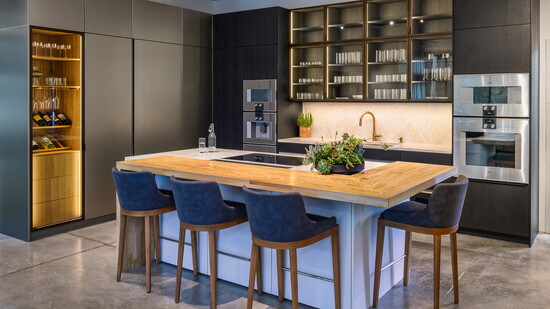
Forest Kitchen Design has a reputation for creating stunning kitchens and the portfolio to prove it. Their work is a marvel in modern design, celebrating sleek finishes, disappearing hardware and the latest in European cabinetry, appliances and style. They create uncanny elegance in rooms built for food prep, or as co-founder Joel Linn says, “where you make the fire.”
Linn learned all about cutting-edge kitchen design growing up in Destin, Fla., where his Aunt, Sherrie, and Uncle, John Linn, started an award-winning kitchen design firm in the 1980s. They were among the first to introduce granite and marble countertops in properties throughout exclusive Seaside, Alys and Rosemary Beaches. Linn discovered his lifelong passion working an after-school job emptying trash cans and cleaning eraser residue off designers’ draft boards in Linn’s Prestige Kitchen showroom.
After college, he joined Forest Millwork in Asheville and eventually split off to launch Forest Kitchen Design in Greenville, S.C. There, in central South Carolina, is where his appreciation for European kitchen craftsmanship grew. Greenville serves as a home base for German companies like BMW, Bosch Rexroth and the French company Michelin. Greenville is also where Linn joined forces with co-designer Todd Mercer, who spearheaded the opening of Forest Kitchen Design’s Charlotte showroom in 2024.
Both Linn and Mercer love to cook. They say ultimately it’s a kitchen’s function that matters most.
“We want a design to be beautiful,” Linn says. “We want the proportions to be scaled perfectly. And we want it to be a very usable kitchen.”
That’s why he and Mercer spend an extended amount of time getting to know their clients in their own kitchens, peppering them with questions as they plan the designs.
One client loved to bake bread, so they designed his kitchen island with the eating surface at standard height, and at his hip height, an area perfect for kneading dough.
“It's much more of a collaborative design approach, which is honestly way more fun,” Mercer says.
One grandmother presented them a quandary because she had little room in her kitchen for an island, but she wanted a surface for baking cakes with her grandchildren. Linn designed a smaller counter-height island where an eat-in kitchen table would have been. They created a more spacious feel by using a cabinet-integrated subzero refrigerator and still managed to incorporate a two-oven Wolf range.
“She uses the island all the time,” Linn says. “Every now and then, I get a picture of her cooking something. Sometimes she brings us something that she cooked.”
That’s the ultimate compliment, he says.
“Where you make the food is where people are going to gather,” Linn says. “It is naturally the most lived-in living space you could be in. Everybody has memories built around being fed good food, even if it's simple, even if it's chicken soup or mac and cheese.”
Mercer says their attention to detail remains the same whether they’re working on a modern or traditional kitchen, a $35,000 remodel or a $30 million home like one belonging to a client in Lake George, N.Y.
The homeowner wanted to add a scullery where seconds could be prepared for her grandchildren even after dinner was served. She wanted a Gaggenau cooktop with gas, induction and electric grill all in one unit. Forest Kitchen Design also installed an exposed rail, like one professional chefs use, where she could hang accessories like knife blocks, spice racks, paper towel holders and recipes, keeping them all off the countertop.
“We want a kitchen that'll work for her,” Linn says. “And we don't want to sacrifice the beauty as well.”
“Where you make the food is where people are going to gather,” Linn says. “It is naturally the most lived-in living space you could be in.