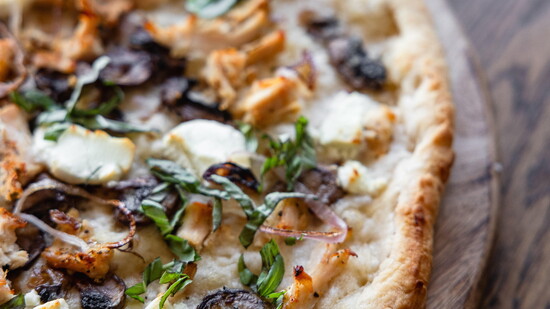
For Lindsay Borg, her home-cooked pizza journey began with a simple problem: How do you make one meal that everyone in the family will actually eat?
In the Borg household, that is no small feat. Two of her three children, along with her husband, Shane, are notoriously picky eaters, and her youngest has several food allergies. Pizza, Borg discovered, offered something rare—not only something that everyone liked, but it was a meal everyone could customize.
“I love to cook, and I LOVE to cook for my family,” Borg says. “One of the only types of food we all like is pizza.”
But what began as an easy, family-friendly dinner has evolved into something considerably more ambitious.
About a year ago, Borg began making her own pizzas from scratch. Since then, she has experimented with dough, sauces, and toppings, drawing inspiration from favorite dishes and classic food pairings. There has been plenty of trial and error along the way, but the experimentation is part of what she enjoys most.
Her family’s favorites are relatively classic—BBQ chicken and pepperoni—but Borg’s homemade pizzas go well beyond the usual.
One night might bring prosciutto, thinly sliced white onion, mozzarella, and fresh rosemary. Another might feature grilled chicken, goat cheese, mushrooms, grilled shallots, and fresh basil over a creamy lemon, butter, and white wine sauce.
And then there is the dough.
Borg’s approach is intentionally simple. She uses unbleached flour, water, and yeast, without the oil or sugar found in many dough recipes. The process, however, is anything but rushed.
After mixing the dough, Borg lets it rest before stretching and folding it to create air pockets. It then spends about 12 hours proofing at room temperature, with additional folds every few hours. From there, it goes into the refrigerator for a 24- to 48-hour cold fermentation.
The result is dough that has been given plenty of time to develop flavor and texture—and, according to Borg, proof that sometimes the best recipes are the ones that require a little patience.
She describes her recipe development as “taking inspiration from some of our favorite dishes and also traditional food pairings,” which is followed by “a bunch of trial and error.”
Now, Borg is taking the hobby one giant step further—she and Shane are building a pizza oven in their backyard.
A Backyard Labor of Love
The project is part cooking experiment, part construction project, and part future family memory.
Unlike a conventional kitchen oven, a traditional brick pizza oven can reach temperatures of 1,000 degrees or more. Pizzas are generally cooked at temperatures between 600 and 900 degrees, depending on the dough and how well done she wants the crust. At those temperatures, a pizza can cook in less than two minutes.
The heat also reaches the pizza in three different ways.
There is convection from the hot air circulating inside the dome, radiant heat from the dome cooking the top of the pizza, and conduction from the hot brick floor browning the bottom of the crust.
“It’s unique but versatile,” Borg says.
And pizza is only the beginning. Once finished, the oven can be used to cook breads, vegetables, steaks, whole chickens, ribs, and even desserts, she says.
For now, Borg makes her pizzas in the kitchen oven, setting it to its maximum temperature of 550 degrees. For heavier or particularly saucy pizzas, she sometimes finishes them on the grill, where the higher heat can help achieve the desired crust.
“This usually requires an even higher temp!” she explains. “Warning: stay close if you are cooking on the grill because it will burn if left too long.”
The backyard oven, she says, promises something her kitchen oven can’t—precision, convenience, and the experience of making pizza at an entirely different level.
The project requires a substantial foundation. Borg and Shane are building the base with cinder blocks, rebar stakes, and cement, as the finished oven will be extremely heavy.
“Make sure the oven's dome is formed with refractory mortar and brick that can reach high temperatures and won't crack over time,” Borg advises. “The floor of the oven needs to be food-safe. I purchased food-safe clay and refractory bricks from Amazon. They are made from natural materials and will not release toxins into your food.”
Safety was part of the research, too. Borg initially considered using a 55-gallon drum for the cooking dome, but after researching the potential effects of heating the metal to extremely high temperatures, she abandoned the idea in favor of the traditional brick-and-clay design.
The couple’s goal is to have the oven completed before Christmas.
Borg says she’s looking forward to the convenience and improved cooking accuracy, while acknowledging that it’s not really a common cooking oven to have in a backyard.
“It gives my family something to plan on and share new happy memories together,” she shares.
And considering the Borg family has already turned pizza night into a tradition, the backyard oven may simply be the next chapter.
Lindsay Borg’s Pizza Recipes
Homemade Pizza Dough
Ingredients
400 grams unbleached flour
300-325 grams warm, filtered water (100-105 F)
1 packet (1/4 oz.) yeast for same-day dough, or 1/2 packet (1/8 oz.) for cold-fermented dough
Directions
Slowly combine the warm water with the flour and yeast, mixing and folding until a loose, shaggy dough forms.
Cover with a damp towel and let rest for 1 hour.
Transfer the dough to a floured countertop. Stretch and fold it over itself several times to create air pockets, being careful not to push the air out.
Place the dough in a floured bowl and cover with a damp towel. Let rise at room temperature for about 12 hours, folding the dough over itself with wet hands every four hours. Again, avoid forcing the air out.
After the 12-hour rise, cover the bowl and refrigerate for 24-48 hours for cold fermentation.
When ready to make pizza, remove the dough from the refrigerator and allow it to come to room temperature. Do not stretch cold dough.
Gently press the dough ball into a thick, round shape. Do not roll it or force out the air bubbles. Let rest for 20 minutes.
For the final stretch, allow the dough to hang from your fist, holding it by the edges and letting its weight gently stretch it. Place it on a floured pan or pizza peel and use your fingertips to gently press it into its final circular shape. Aim for an even crust about 1/2 inch thick.
Preheat oven to 550 F.
Add sauce and toppings of your choice. Bake for 7-8 minutes, or until the crust is browned to your liking and the center is fully melted.
Borg notes that toppings can be used according to preference; she does not typically measure specific amounts.
Grilled Chicken With Goat Cheese, and Lemon Sauce
Toppings
- Grilled chicken
- Goat cheese
- Grilled shallots
- Mushrooms
- Fresh basil
Creamy Lemon, Butter, and White Wine Sauce
- Lemon juice
- White wine
- Heavy cream
- Butter
- 1 Tsp. flour, optional
Directions
Over high heat, add lemon juice and white wine to a saucepan and reduce.
Lower the heat to medium and slowly add the heavy cream, whisking as you go. Simmer for 2 minutes, whisking occasionally.
Lower the heat and slowly add the butter, whisking continuously until melted.
For a thicker sauce, add 1 Tsp. flour. Whisk as the flour cooks and the sauce thickens.
Spread the sauce over the prepared pizza dough and top with grilled chicken, goat cheese, grilled shallots, mushrooms, and fresh basil. Bake according to the dough recipe.
Prosciutto, Onion, and Rosemary
Toppings
- Marinara sauce (Borg uses Rao’s)
- Prosciutto
- Thinly sliced white onion
- Mozzarella
- Fresh rosemary
Directions
Spread marinara over the prepared pizza dough. Add prosciutto, onion, mozzarella, and fresh rosemary. Bake according to the dough recipe, or until the crust is browned and the cheese is melted.