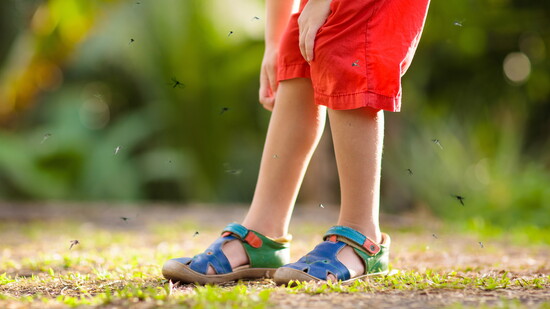
There is a very specific kind of Florida heartbreak: the moment a perfect evening gets driven indoors.
The table is set outside. The pool still holds the day’s warmth. Someone lights a citronella candle that (let's be honest) never really works. Kids are barefoot in the grass chasing each other at dusk when suddenly the swatting begins. Then the itching. Then the retreat back through the sliding glass doors.
In South Florida, mosquitoes and no-see-ums are not simply annoyances. They are practically a season.
And thanks to our tropical climate, they thrive here almost year-round.
Mosquitoes need surprisingly little water to reproduce. A bottle cap’s worth can be enough. After heavy summer rains, standing water collects everywhere: gutters, birdbaths, clogged drains, overturned toys, flowerpots, even the natural cups formed by bromeliads. In Florida heat, the full lifecycle of a mosquito can happen in roughly a week.
No-see-ums — the tiny biting midges infamous along the coast — are even more maddening. Small enough to pass through standard screens, they breed in damp soil, mangroves, marshes, and coastal vegetation. Their bites can leave intensely itchy welts that linger for days.
And despite popular belief, not all mosquitoes wait for sunset.
While many Florida species become most active during dawn and dusk, the aggressive Aedes aegypti and Aedes albopictus — commonly known as the yellow fever mosquito and the Asian tiger mosquito — bite during the daytime as well. These are also the species most associated with viruses like dengue, chikungunya, Zika, and yellow fever.
In other words: the brunch patio is not necessarily safe either.
For Michigan mother Diana Shea, the battle against bugs became unexpectedly personal after her daughter developed a severe skin reaction following a mosquito bite during an evening swim years ago. It was not life-threatening, but it changed the atmosphere around summer almost instantly. Outdoor play suddenly came with a heaping side of anxiety.
Shea remembers cycling through nearly every natural remedy she could find — sprays, bracelets, oils, stickers, yard treatments — searching for something that would let her children simply enjoy being outside again.
At the time, she had already spent years experimenting with homemade remedies for her son's eczema, so she returned to the kitchen once again—this time in search of a natural bug repellent that actually worked for her family. The result was Buzz Blocker, now part of her company, Katie's Clean Creations.
Made with certified organic ingredients and formulated without harsh chemicals, the repellent has developed a loyal following among families seeking alternatives to traditional sprays. Customers also report success against horseflies, ticks, and even fire ants. Buzz Blocker is available as a spray, a tallow-based version, and a travel-friendly roll-on.
Like sunscreen, it is only effective where applied, making thorough coverage and reapplication important during long periods outdoors. Buzz Blocker is also classified as an EPA-exempt minimum-risk pesticide, the lowest-risk designation available for products of its kind.
Locally, Buzz Blocker is available at Phipps in West Palm Beach.
Shea's journey may have started in a Michigan backyard, but the challenge she was trying to solve is one Floridians know all too well.
Here in South Florida, outdoor living comes with an unwelcome sidekick: mosquitoes and no-see-ums. What began as a mother's determination to help her daughter enjoy the outdoors eventually became a solution for families facing the same problem.
For the rest of us, it's a reminder that innovation often starts with a simple question: there has to be a better way.
And in a place where biting insects are practically a season of their own, that's an idea worth buzzing about.