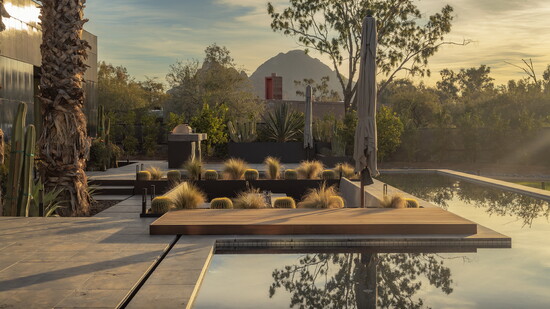
Set in Paradise Valley, The Blu House feels less like a traditional home and more like a livable work of art.
“This home is for someone who connects to design on a deeper level, someone who values intention, material, and how a space makes you feel over time,” says Katrina Barrett, owner of Local Luxury Christie's International Real Estate, listing The Blu House.
And when a home is created at that level, you don’t just invite people to see it. You invite people to experience it.
For our Explore Issue, we stepped inside the private debut of The Blu House, an exclusive, invite-only evening that drew an international crowd. Not just from across the country, but from across industries and creative disciplines. Art, architecture, fashion, design, hospitality, craftsmanship, and legacy all collided under one roof, with acclaimed local Western artist Mark Maggiori among the attendees.
“As the light changed throughout the evening, the whole home transformed with it,” Katrina says. “The exterior would shift from these rich terracotta and deep blue tones to almost black by sunset, and inside, every room felt so intentional. Everything was positioned to take in the landscape, so it felt cinematic but also really intimate at the same time.”
The landscaping was a huge part of the experience. There were over 20,000 square feet of planted gardens that really softened the architecture into the desert, and the pool deck opened straight toward Camelback Mountain. As the night went on, people naturally kept migrating outside because the setting was just incredible.
At the center of the evening, PVCL’s Nadine Bubeck moderated a panel featuring individuals whose work all explores the same larger idea from very different perspectives: how do you create something timeless in a world constantly chasing trends?
Louis Lefebvre answered that question through the lens of history, craftsmanship, and evolution.
Born in Paris, educated at Cambridge, and trained at Christie’s in both European and Asian ceramics, Lefebvre grew up surrounded by centuries of decorative arts through his family’s gallery, established in 1880. But rather than simply preserving tradition, he has spent much of his career modernizing it.
In 2009, he shifted the gallery toward contemporary ceramics, introducing artists whose work pushes the medium in unexpected directions while still respecting its permanence and history.
“Ceramics have always been about permanence,” he shared during the panel. “What changes is how each generation chooses to express it.”
For readers and collectors alike, Lefebvre’s perspective offered an important reminder that timeless design is rarely about copying the past. It is about understanding it well enough to reinterpret it thoughtfully.
That philosophy extends into his own life as well. A historic townhouse outside Paris, once tied to Louis XVI and later home to a young Elie Wiesel, now sits under his direction. Rather than restoring it exactly as it was, Lefebvre carefully layered contemporary works into the historic architecture, creating a space that feels lived in, relevant, and evolving instead of frozen in time.
That same balance between heritage and modern relevance carried into the conversation surrounding Trudon.
Founded in 1643, Trudon is the oldest candlemaker in the world still in operation and was once responsible for lighting Versailles under Louis XIV. Yet despite its centuries-old history, the brand continues to feel strikingly modern.
Anthony Francois, Store Manager of Trudon’s globally recognized SoHo flagship, brought a completely different, but equally insightful, perspective to the panel. With a background spanning both corporate strategy and luxury retail, Francois discussed how modern luxury has shifted beyond products alone and now centers around experience, emotion, and personalization.
His insight was particularly relevant in today’s luxury market, where consumers increasingly value connection and intentionality as much as craftsmanship itself.
Francois spoke about the importance of anticipating client needs, creating emotional connection, and building environments that feel memorable rather than transactional. He also discussed how strong team culture directly impacts the client experience, something he has prioritized while helping transform Trudon’s SoHo location into one of the brand’s most successful boutiques worldwide.
As discussed throughout the evening, true luxury is no longer about excess. It is about meaning, detail, storytelling, and the feeling something leaves behind.
Then there was ceramic artist Matt Wedel, whose work brought an entirely different energy into the discussion.
Where Lefebvre and Trudon reflected refinement, legacy, and precision, Wedel represented instinct, experimentation, and emotional expression.
Raised by a father who worked as a functional potter, Wedel’s connection to clay began early and remains deeply personal. His sculptures, now exhibited locally, nationally and internationally, challenge traditional expectations of ceramics through oversized forms, exaggerated movement, vivid color, and raw unpredictability.
“I’m not trying to control the material,” Wedel shared. “I’m trying to respond to it.”
That mindset resonated far beyond art.
His perspective offered something valuable for anyone in a creative field: some of the most compelling work happens when you stop forcing perfection and allow process, movement, and instinct to shape the outcome naturally.
That balance between structure and spontaneity became one of the defining themes of the evening itself.
Which ultimately brought the conversation back to The Blu House.
Developed by Opus 88, alongside Blank Studio and Radius, the home reflects a distinctly international perspective brought into the Arizona desert. Set on nearly 57,000 square feet with more than 5,800 square feet of living space, every design decision appears rooted in long-term livability rather than trend-driven aesthetics.
The Blu House was not presented as simply another luxury listing. It became the backdrop for a larger conversation about craftsmanship, permanence, creativity, emotion, and the difference between something that merely looks beautiful and something that actually stays with you long after you leave.
katrinabarrett.com