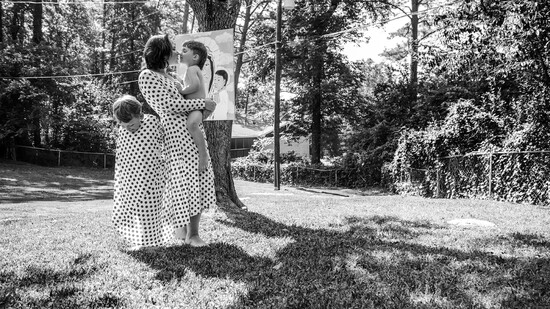
At Red Mountain Theatre's annual sensory show, my younger son, Ronin, took off all his clothes in the audience.
This was, I decided later, a bold interpretation of the phrase come as you are. I had brought him to a performance designed to welcome children whose bodies and brains experience the world differently. Ronin apparently wanted to know exactly how far that welcome extended. Turns out, pretty far.
I grew up in Birmingham, in a family of immigrants who came through New York before heading south in 1976. My childhood smelled of garlic and sounded like a church potluck — a strange, wonderful mix of Mediterranean cooking and Southern accents. Then, like every young person certain that real life is happening somewhere else, I left.
I lived in Atlanta, New York City, and San Francisco. I loved the museums, the food, the fashion, and the sense that I could walk outside and become someone new before lunch. Then I paid $2,500 for a ground-floor one-bedroom with a view that clarified things fast. Around then, Birmingham started looking less like the place I'd left and more like the place I missed.
I came home because I missed my family and wanted to raise my kids near them. Birmingham offered a balance I hadn't found anywhere else: room to breathe, just enough city to keep me curious, and traffic that has never once made me question my life choices. I was happy to be home. I had no idea yet how much I needed it.
Both of my sons have been diagnosed with autism. A diagnosis comes with a stack of practical questions—appointments, paperwork, a vocabulary you never planned on learning. It also comes with a particular kind of loneliness. People who love you want to help. But love doesn’t come with an instruction manual.
Then I met Sara Nall, the director of Mitchell's Place. She called. She texted. She emailed me suggestions at hours that made me wonder if she slept. She shared what she knew before she had any reason to, and kept sharing it as we navigated both my boys' diagnoses. Eventually, both of my sons found their place at Mitchell's Place. I'm still grateful — for the care they get there, and for a woman who was kind to my family before she had any reason to be.
Through Mitchell's Place, I found The Autism Parent, a support group co-founded by Mary Lorino and Paula Bedran. Once a month, I sat with parents who understood without requiring a lengthy explanation first — an underrated luxury. That's also where I met Veronica McGee of Kyle's Cool Beans and Bre Conner of Emmett's Workshop. Both are fierce advocates, but in completely different ways, and both are unstoppable. Watching them, I realized there's no single way to fight for your kid. There are as many ways as there are mothers willing to do it.
I've since joined UAB's LEND program because I wanted to become a better advocate — for my boys and for other families doing this alongside me. I'm also a designer and fine artist, which meant I was always going to make something out of this. Somewhere between the LEND coursework and those monthly meetings, that something started to take shape.
It became Mothers in FULL: a project of portraits, interviews, and unvarnished stories about mothers raising autistic children. I want to show the whole person: her humor, work, friendships, ambitions, exhaustion, and extremely specific opinions about shoes, should she care to share them. Photographer Jennifer Alsabrook-Turner and I are building portraits that let these women be seen as themselves first, mothers second — because motherhood takes up a tremendous amount of a life, but it was never supposed to be the whole thing.
I keep coming back to Ronin at the theatre. In a different room, I might have spent the whole show bracing for a reaction — the sideways glance, the quiet tsk, the assumption that he just needed more discipline. That day, inclusion wasn't an afterthought; it had been built into the room. My son still managed to surprise everyone, myself included. He's good at that. But the room had made space for him before we ever walked in.
That’s what Birmingham keeps giving my family: people who pass along a name, make a call, start a group, build a program, or put on a show and leave the door open for the kid who’s decided that pants are optional. I left home looking for more room to become myself. I came back and found people making room for us, too.