There is a fried fish sandwich at Emelina that is not really a fried fish sandwich.
It is a memory.
Chef Osmel González grew up eating minuta during long beach days with his family in Cuba.
At Emelina, it becomes something else entirely: delicate tempura, a fried-egg emulsion, re-fried tomato and a whisper of caviar for salinity, set on a handmade wooden plate carved to resemble waves and sand, a brass uva caleta, the sea grape leaf that dots Cuban beaches, resting alongside it. A warm amber consommé, enriched with beef tallow, arrives as a side car. It is a playful recollection of the soups that used to follow those beach days, back when they doubled as a cure for whatever the night before had left behind.
It is Cuban food, certainly. But it is also a question.
What might Cuban cuisine have become if history had been different?
That question is at the heart of Emelina, the intimate 16-seat tasting-menu restaurant that opened earlier this year in West Palm Beach's historic Flamingo Park District. Rather than simply recreating the dishes González remembers, he and his wife, Colombian chef Camila Salazar, imagine what those traditions might look like after generations of unrestricted travel, cultural exchange, access to ingredients and modern culinary technique.
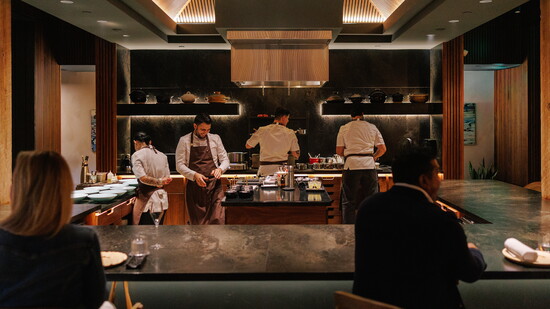
Guests take in the answer from a U-shaped counter, where González, Salazar and their small team cook and plate in real time, the tasting menu unfolding as both dinner and narrative. The room holds up its end of the story: warm walnut millwork, Shou Sugi Ban-treated walls, a black soapstone chef's counter and lime-washed walls with a gently aged patina, rattan-backed stools drawn up close, clusters of tropical plants softening the edges. Works by the Latin artist Antonio Ugarte hang throughout. The overall effect reaches for the glamour of Havana's golden age. It finds it.
Four months after opening, Emelina made it official at the 2026 Michelin Guide Florida ceremony. It is Palm Beach County's only Michelin-starred restaurant. It is also something bigger: the first Michelin star ever awarded to Cuban cuisine, anywhere in the world. No Cuban restaurant had ever earned one. Decades of political isolation had kept it from ever getting the chance to try.
"Cuban cuisine has been waiting a long time for this moment," Salazar says, "and we are deeply grateful to be part of it."
That is the headline, of course.
But it isn't really the story.
The story begins with a woman named Emelina.
She was González’s grandmother, whose grace, warmth and effortless glamour embodied both the Cuba he remembered and the one that still lives in the imagination of those who left.
“This restaurant is for her, and for that imagined Cuba,” González says. “When Camila and I built this menu, we weren’t trying to make Cuban food more sophisticated—it has always been sophisticated, in the hands of the grandmothers and home cooks who shaped it. We were trying to imagine what it could have become if history had been different.”
And if a grandmother provides the restaurant’s soul, a love story helped provide its other half.
González and Salazar met while working at a hotel restaurant, she as a pastry chef and he on the hotline. His courtship strategy was appropriately food-centric: he kept offering her something to eat, hoping she’d accept and give him an opening to ask for something sweet in return.
She never took the bait, but eventually the two began dating—though González insists Salazar was the one who really started things. Fittingly, their first date was at a Cuban restaurant. Salazar, who grew up in Colombia and knew little about Cuban cuisine, looked to her Cuban date for guidance.
“What should we order?” she asked.
“I don’t know,” González replied.
“What do you mean? You’re Cuban.”
They ended up with rice and a fried egg.
“He was nervous,” Salazar says.
Years later, the couple would open a restaurant devoted to exploring the possibilities of the cuisine González was apparently too flustered to order on their first date.
By then, both had built formidable international résumés, training at acclaimed kitchens including Matador Room, Disfrutar and SingleThread before reuniting professionally at EntreNos. González co-founded the Miami concept, with Salazar serving as COO; it earned Michelin stars in 2024 and 2025 and a Green Star in 2025.
The idea resonated with Perez Miranda. Venezuelan-born and an artist by training, he spent 15 years in Japan and has developed more than 70 restaurant projects over his 42-year career. His APM Restaurant Group includes Michelin-starred Ogawa, Hiyakawa and Midorie.
By February, Emelina was open. Less than four months later, it had a Michelin star.
Perez Miranda laughs at the speed of it all. “I’ve done more than 70 of these—I stopped counting at 70—and this is the fastest restaurant I’ve ever done.”
His Japanese experience also supplies another layer to Emelina's distinctly Latin story. Perez Miranda trains his teams around three principles he brought home from Japan: omotenashi, or mindful hospitality; komakai, an exacting attention to detail; and sensai, sensitivity and balance.
“I want people to say we have good food, but excellent service,” he says.
That precision surrounds González and Salazar's deeply personal food.
Guests sit around a U-shaped counter as the chefs cook and plate in front of them, allowing the tasting menu to unfold as both dinner and narrative.
Yuca takes one of Cuban cooking's essential ingredients and presents it in three textures alongside lightly pickled Florida oysters. Pusandao turns toward Salazar's Colombian heritage, connecting the Pacific coast of Colombia and Cuba through their shared African influences, coconut, fish, banana and herbs.
The ingredients change with Florida's seasons. The chefs work with local farms and producers, adjusting dishes according to what is available rather than forcing ingredients onto the plate simply because the menu demands them.
It is a philosophy González and Salazar developed through years spent in kitchens around the world. Yet at Emelina, all those miles ultimately lead back to somewhere deeply personal.
Back to Cuba.
Back to Colombia.
Back to two young restaurant workers flirting badly over cookies and stolen ice cream.
And back to a grandmother whose name is now on the door.
Michelin arrived extraordinarily quickly. For a restaurant that opened in February to earn a star by May is an achievement worthy of all the attention it has received.
But perhaps the more interesting accomplishment is what happened before Michelin ever arrived.
González, Salazar and Perez Miranda took a cuisine deeply associated with memory and exile and refused to preserve it under glass. Instead, they allowed it to keep moving—to Spain and California and Japan, through Colombia and Florida, through their own lives and ultimately into a tiny dining room in West Palm Beach.
Emelina remembers where Cuban food came from.
More provocatively, it asks where it might have gone.
Cuban cuisine has been waiting a long time for this moment.