One of my favorite things about this time of year is the abundance of peaches, which are at their prime from July through September. At their peak, their flavor, texture and aroma create a sensory experience, while their balance of sweetness and acidity brings any dish to life. Bottom line—peaches have a magic all their own.
Peaches have an origin story that stretches back to China more than 4,000 years ago. They journeyed west on the Silk Road to Persia and then on to the Mediterranean world. There, they were embraced by the Romans who planted peach orchards across their empire, helping the fruit take root in Europe. By the Middle Ages, peaches were well established in Europe.
It was Spanish explorers who introduced peaches to the Americas in the 16th century. Indigenous peoples quickly adopted and cultivated them, integrating peaches into their agricultural traditions long before widespread European settlement.
Two centuries later, peaches were thriving across the United States, becoming especially associated with the South. Georgia made the peach its state symbol, although South Carolina’s annual peach production is often larger.
Today, peaches are grown worldwide—from China (still the largest producer) to Italy, Spain, Turkey and the United States.
The standout aspect of peaches is the contrasts they embody: firm yet yielding; sweet yet tart; floral yet earthy. That’s what makes them so versatile in the kitchen, playing nicely with savory and sweet ingredients. When raw, peaches resonate with freshness and perfume. When cooked, they deepen, caramelize, and develop a richer, almost honeyed complexity. Their high water content means they break down nicely in heat, creating natural sauces and syrups without much intervention.
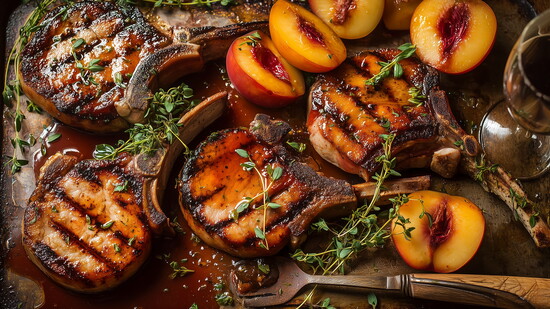
The following recipe showcases all the characteristics of cooked peaches. Swordfish steaks can be substituted for the pork chops.
Grilled Pork Chops with Peaches, Plums and Bacon
Ingredients
-
2 pork chops
-
1/2 cup shallots, slivered
-
1 peach, cored and thickly sliced
-
1 plum, cored and thickly sliced
-
1/2 cup apple cider vinegar
-
1/4 cup honey
-
2 tbsp. barbecue sauce
-
4 slices bacon, cooked and rough chopped
-
1/2 cup scallions, rough chopped
-
1/2 cup butter
-
Sea salt
Method
-
After patting dry, season the pork chops with olive oil and salt and pepper to taste. On a grill or in a grill pan over medium-high heat, sear for 5 minutes on each side, until the internal temperature reaches 125 degrees for medium and 155 degrees for well done.
-
Meanwhile, in a heavy-bottomed saucepan, heat 4 tablespoons of olive oil and sauté the peaches, plums, honey and butter for 5 minutes undisturbed to caramelize the fruit. Then flip the fruit and add the shallots. Sauté for another 3 to 5 minutes until the shallots are just taking on some color and the fruit has caramelized on the other side.
-
Add the scallions and bacon last and season with salt and pepper to taste. Stir well. Bring to a simmer.
-
Place the pork chops in the center of the plates. Arrange the peaches and plums attractively around the pork.
-
Serve immediately with warmed firecracker peach sauce, which is great with grilled shrimp, too.
Firecracker Peach Sauce
Ingredients
-
6 cups peaches, chopped
-
2 cups peaches, peeled and finely diced
-
1 cup seedless serrano chilies, chopped
-
1/4 cup apple cider vinegar
-
1 bay leaf
-
1 clove
-
1/2-inch cinnamon stick
-
1/2 tsp. coarse salt
Method
-
Combine the chopped peaches, chilies, vinegar, salt, clove, bay leaf and cinnamon stick in a large, heavy-duty saucepan over medium heat.
-
Cook, stirring frequently, for about 15 minutes or until the peaches are falling apart and the mixture has reduced by half.
-
Remove from the heat and cool. Remove and discard the bay leaf. Stir in the diced peaches and pour into a nonreactive container. Cover and refrigerate until ready to use.
About Chef David Burke
Brooklyn-born chef and restaurateur David Burke, who was raised and continues to live in New Jersey, is known for playful, precision-driven modern American cooking and elevated comfort classics. His restaurants span New Jersey and beyond, including Red Horse by David Burke at The Bernards Inn and The Station Tavern in Bernardsville.
To learn more, explore his restaurants, or get in touch, visit chefdavidburke.com and follow his culinary adventures on Instagram @chefdavidburke.