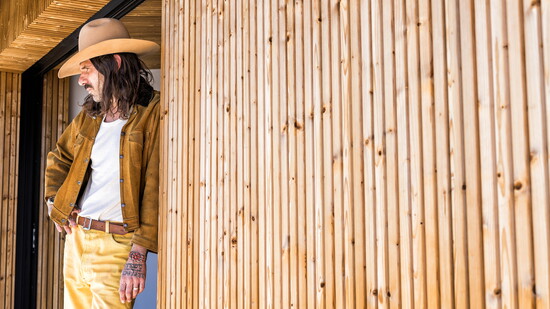
From blasting Led Zeppelin cassettes to painting cowboys in the desert, Mark Maggiori’s journey from France to the American West is as cinematic as his canvases. Raised far from ranch life, he now creates from his Scottsdale studio and has become a standout in contemporary Western art. His work has headlined magazines, topped $500,000 at auction, and won fans worldwide.
In this exclusive conversation, Mark retraces his path from a teenage road trip across America to a music career, a film detour, and the moment it all clicked in a cowboy museum in Oklahoma.
Mark, let's rewind to the beginning. At 15, you left France and crossed the American West for the first time.
We went to the Grand Canyon… Canyon de Chelly, did the whole thing. Me and my cousin were like, “Yeah, that’s cool. It’s hot.” We were 15. Really, I was just obsessed with Vans, and determined to find the teddy bear shoes I so desperately wanted in the U.S.
Did you ever track them down?
No, but I collect Vans. I have one of the biggest collections of high-top Vans, even some from the 60s and 70s.
When you got back to France, you started a band?
Yeah. I loved skateboarding and skating leads to music. On that road trip, my uncle bought us tapes from gas stations. We got Led Zeppelin. Those tapes changed everything.
I started learning guitar because of Led Zeppelin. I greatly admired the singer, Robert Plant. But his voice was untouchable. So I decided I’d be Jimmy Page instead.
Our band was called Pleymo. I was the singer. We got big in France, and signed with Sony/Epic.
What kind of music did you play?
Nu-metal. French Limp Bizkit. Rapped in French. Crazy shows. Huge crowds. We toured everywhere.
What was the band’s breakout moment?
We gave our demo to a guy at a record store. He put it in the listening station. A few days later, he sold out and invited us to play. There was a line around the block. During the show, the crowd was so wild they broke the stage. That’s when I knew we were onto something.
And you were also juggling art school...
Yes. I studied graphic design at the Académie Julian in Paris. During the week, I was in school and interning at Disney. On weekends, I was playing concerts with the band. No sleep. Total grind.
I thought I’d go into animation or concept art, maybe work at Disney. I actually did three summers as an intern with them.
When did you start directing music videos?
I started directing our own videos because I had a vision for how the band should look. Then other bands started asking me to direct for them. That led to a full career in music videos and commercials.
I met my wife on set. Later, we did a short film together in Chloride, Arizona.
When did you begin transitioning from video to painting?
I was visiting her family in Oklahoma and her dad said, “Go check out the Cowboy Museum.” I did and it blew my mind. I didn’t even know Western art existed like that. I stayed for three hours and left thinking, “This is what I want to do.”
What did you paint first?
A cowboy, based on an old black-and-white photo. Then I photographed a friend on a horse and painted that.
And you started blowing up on Instagram...
My wife made me do it. I was against it. But she said, “Trust me.” And it opened every door.
A gallery in L.A. saw my work on Instagram and invited me to bring in some pieces. I brought three. They wrote me a check for $5,000. That moment changed everything.
I still post on social myself. I write my own captions. It’s all real.
Was the Western art world skeptical of you at first?
A bit. I made some mistakes, wrong ropes, wrong hats. But I had mentors. I studied, I listened.
What’s your painting process like today?
Slower, deeper. I used to make 25 paintings a year. Now I do maybe 7 or 8. But each one means more.
What draws you to cowboys?
The solitude. The freedom. They represent independence, connection to the land.
What’s the most your work has sold for?
$500,000. I still can’t believe it. But I don’t paint for money. I paint because I have something to say.
And you have a fan in Kevin Costner!
Surreal. I showed him one of my works and he loved it. Later, I painted him from a photo and sent it to him. He replied, “Sir, you are a poet with a paintbrush.” That was a moment.
What’s life like day to day for you in Scottsdale?
Mellow. Wake up, make coffee, see my daughter off to school. Then I paint. I like the quiet.
I love Arizona. It's clean, calm, and good for our family. And there’s inspiration everywhere.
Your wife is American artist and designer Petecia Le Fawnhawk. Do you collaborate on creative projects?
Sometimes. She has her own art practice, but we inspire each other. We have different styles, and that’s a good thing.
What’s something people might not know about you?
I’m shy. I think more than I talk.
What do you do when you hit creative blocks?
I go outside and remind myself why I paint.
What’s one painting that means the most to you?
A portrait of my wife.
What do you listen to when you paint?
Led Zeppelin, always. Pink Floyd, old-school rock. Silence is powerful, too.
What do you want your legacy to be?
I hope people say I cared. That I painted with truth. That I honored the West and made space for beauty in chaos.
markmaggiori.com
“We were 15. Really, I was just obsessed with Vans.”