At the Garagiola family’s Sunday dinners, baseball was rarely far from the table. Joe Garagiola Sr. might talk shop with his son, Joe Jr., about the team, share a story from St. Louis or NBC, or offer his thoughts on the state of the game. And when the Diamondbacks were playing, three generations gathered on the couch to watch.
For Chris Garagiola, those evenings were more than family time. They were a baseball education.
“When the baseball season was in progress, we always had a game on,” he recalls. “On the couch was my grandfather, my Dad, and myself; and those two would break down the game in such granular detail that to this day, it’s arguably the best baseball education I’ve ever received. Imagine picking through the mind of a former player-turned-analyst, and an active General Manager. That’s what it was like for eight-year-old me almost every Sunday.”
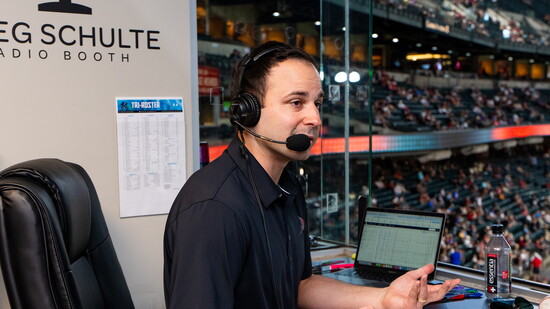
Beginning in 2027, Chris will bring that lifelong education, and a voice all his own, to the Diamondbacks’ television broadcasts on DBACKS.TV. The third-generation D-back will call games from the Joe Garagiola Broadcast Booth, following his grandfather, Hall of Fame broadcaster Joe Garagiola Sr., whose career spanned 58 years, including 15 seasons with Arizona. His father, Joe Garagiola Jr., helped bring baseball to the Valley and served as the team’s original general manager, building the inaugural 1998 club and the 2001 World Series championship team.
Chris knows what those names mean to the game. But when he thinks of his father and grandfather, he first thinks of the men he knew at home.
“I see two men who represent the epitome of success in the game of baseball, albeit in two different ways,” he says. “I look at myself as someone who has an opportunity to add to that success if I remember that there’s still a long way to go until I get to where I want to be. I’ve earned the opportunity to be the television voice of the Diamondbacks, but it’s my responsibility to prove that I deserve that distinction.”
His earliest memories of his father at work date to the Diamondbacks’ inaugural 1998 season. Joe Jr. was up at six each morning, driving his children to school before heading straight to the office. He often didn’t return home until an hour after the game had ended.
“It’s a tremendous workload for any general manager,” Chris says, “and his daily commitment to the grind showed me what’s required to be successful in any endeavor.”
The lessons his father passed down were less about baseball than about how to live. “Up until recently we haven’t had much discussion about the business-side of baseball or sports in general,” Chris says. “I think my Dad was more focused on providing guidance and advice that any parent would wish to pass along to their child. The things that come to mind are, ‘treat people with respect,’ ‘show up on time and prepared,’ be accountable and take responsibility for your mistakes.’ That’s the type of wisdom that shapes and prepares someone for life, not just work.”
As a boy, Chris was six during the Diamondbacks’ first season and nine when they won the World Series. He remembers going to games with his mother and sisters, then sneaking up to the general manager’s box to spend a few innings with his dad. He also remembers how his father made a demanding job look steady from the outside.
“You can imagine how stressful job can be when you play every day in a sport where everyone loses between 50-70 games a year (at least),” he says. “But my Dad (along with Sandy Johnson, Mike Rizzo, and Bob Miller, who worked in the FO with Dad) was always warm, never conveyed any worry about the team, and never let me see the tough days that occasionally got to him.”
The championship moments remain vivid: Steve Finley’s catch in center field to clinch the pennant in Atlanta, then Luis Gonzalez’s title-clinching hit against Mariano Rivera. “I’ve seen that play probably a thousand times in my life and my eyes still water every time I hear it.”
His grandfather’s fame took longer to understand. To young Chris, Joe Sr. was simply Papa: the warm, loving grandfather at the dinner table, telling stories and making people laugh. When classmates asked if he was related to Joe Garagiola, Chris didn’t yet understand the scale of the question.
As he grew older, he began to grasp his grandfather’s extraordinary reach in baseball and television. One conversation with his oldest sister helped make it real: she told him there was a time when arguably the two most recognizable men in America were the president and Papa.
“What I always remember is being this positive and upbeat force,” Chris says. “And I learned second-hand the power laughter can have, especially laughing at yourself. It’s probably the best piece of second-hand information I could have ever learned from him that prepared me for this job.”
The family name opened a door to a legacy, but Chris was determined to build his own path. After college, he had internship offers with the Dodgers and Reds. With Vin Scully retiring and his grandfather’s long history with him at NBC, Los Angeles might have seemed the obvious choice. Chris chose Cincinnati instead.
“I felt a pressure to figure things out on my own,” he says, “so I chose the internship in Cincinnati (which I had never been) and learned from some fantastic people in that organization.” He credits Rob Butcher, Larry Herms and Jamie Ramsay, and remembers how his interest in radio took shape when Marty Brennaman invited him into the booth to watch and listen alongside Jeff Brantley. That experience eventually led him to the Double-A Pensacola Blue Wahoos, where, in 2017, “my professional dream began to take shape.”
The possibility of broadcasting had surfaced years earlier, during a final attempt to earn a college baseball offer at IMG Academy. At orientation, a former actor named Steve Schenbaum led an improv exercise called “yes and,” asking Chris to keep a conversation going by accepting and building on whatever came his way.
“I was going to make a fool out myself in front of 30 students and their parents,” Chris remembers. “To this day, I have no idea why I felt some comfortable, but we went back-and-forth for about ten minutes before Steve finally ended our sketch and told the class, ‘Ok it’s not normally supposed to look that easy!’”
The moment stayed with him. “I always felt more comfortable speaking in front of large crowds as compared to trying to hit a 92-mph fastball.”
The announcement of his new role brought relief and pride, but also a rush of gratitude. He thought of his wife, Macy, who stood by him when he was “just a guy grinding away in the minors.” He thought of his mother and father, who supported him and encouraged him to try new things and keep improving.
“When they told me how proud they were, I just saw two people who supported me endlessly,” he says. “I owe all of them... my whole family, really.... for this opportunity and I hope they know that whatever ‘success’ I achieve is just as much theirs.”
That gratitude feels especially fitting in December, when Chris’s family gathers for Christmas. His older siblings have started families of their own, making it harder to get everyone together, but the holidays remain an important time to reconnect. Has the baseball talk at family gatherings eased over the years?
“I’d like to think that we have toned down on the constant baseball chatter during the holidays,” he says, “but if you ask my wife or my siblings, they would probably tell you that nothing has changed since the family dinners back in the day.”
Now, as he prepares to call games in a booth named for his grandfather, Chris feels the weight of the opportunity.
“It’s a huge responsibility to call games from any television booth,” he says. “It’s a whole different type of pressure when it’s your grandfather and you know exactly how good he was. If he’s not the ‘Michael Jordan’ of baseball broadcasters, then he’s somewhere else on that Mount Rushmore.”
He isn’t trying to recreate his grandfather’s career. He hopes, instead, to make his own contribution to the community that shaped his family. “My grandfather did so much charitable work here in Arizona because he believed it was important,” Chris says. “I want to be remembered for loving Arizona.”
He hopes people will remember that he loved baseball, the Diamondbacks, broadcasting and connecting with the fans, and that he kept using “that chip on my shoulder as the engine that pushes me to be better.” Maybe, he says, that will be enough to get him next to Cooperstown, “where I can be beside my grandfather one more time.”
“Those two would break down the game in such granular detail that to this day, it’s arguably the best baseball education I’ve ever received.”