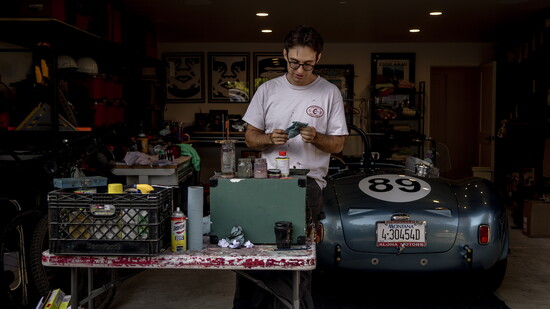
Before vinyl wrap. Before digital print. Before a computer ever touched a logo — there was a man with a brush, a steady hand, and paint that smelled like a race shop.
Every sign over a bar, every letter on a delivery truck, every number on a race car door was put there by hand. The spacing, the weight, the serif on a capital R — all of it was judgment, craft, and muscle memory. At places like Orange Show Speedway and 605 Speedway, Saturday nights in Southern California smelled like exhaust and enamel, and a car wasn't ready to race until the lettering was done. It was the only way. Then it wasn't, and most people never noticed it was gone.
Bailey Clayton noticed.
Growing up in Temecula, Clayton was drawn early to lettering — calligraphy first, then chalk, then a fateful pandemic window at Eat Marketplace where he picked up oil-based enamel for the first time. The drag of the brush on glass, the way the paint moved — it clicked immediately. He started hitting up every business on Old Town's front street, portfolio in hand. Within a year, he was full-time. Five years in, he's doing work that stops people cold.
Drive through Old Town or Murrieta and you'll find his hand in barbershop windows, A-frames, and tattoo shop signs finished in burnished gold leaf — a process so painstaking it can take 25 to 30 hours for a single sign. The gold arrives in delicate books, sheets so thin they practically float. Applied over water-moistened glass with a long squirrel-hair brush, the leaf jumps off the page on static alone and dries to a perfectly mirrored finish. Want it to look aged and crackled? There's a technique for that too — animal-hide glue applied just so, tightening as it dries, pulling fragments of the surface with it. The result looks like it's been above a barbershop door since 1938. It was put there last Tuesday.
It's not a lost art. It's just that almost nobody does it anymore.
But the vehicles are where the craft gets serious — and where the calls started coming from places Clayton didn't expect.
Mercedes-Benz runs a classic restoration center in Long Beach where they take historic cars back to nut-and-bolt original condition. They called Clayton to letter a car with a story most people have never heard: a 1960s Mercedes sedan that had been raced by a Swedish woman in an Argentinian rally in 1963 — a race she won by four hours, in an era when fatalities during competition were common. The car had originally been commissioned as a restoration project for actor Patrick Dempsey, but when that fell through, Mercedes took it over. They needed the graphics done true to the original period style. They found Clayton.
"When people want something permanent on a car like that," he says, "I'm always a little amazed they trust me with it. But you just have to pick up the brush."
That job said something about where he operates. Vehicle lettering is a narrow niche within an already small world — maybe three people in Southern California can credibly do it at that level. The research alone on a period-correct livery can take days. Clayton studies original sponsor logos in their era-accurate forms, tracks down the right version of a Shell or Bosch badge from a specific decade, builds the whole visual story before a brush touches paint.
And the clients who find him aren't just looking for graphics. They're bringing him family history.
A 356 Porsche passed down through three generations gets racing livery that honors a father's legacy. A number chosen because a grandfather had that ham radio call sign — back when a personalized plate meant you had your own frequency first. One man spent 15 years sourcing donor cars to restore a single 356, pulling pieces from 30 different vehicles, and when it was finally ready, he called Clayton to put the graphics on. After a decade and a half of mechanical work, the lettering is what gives the car its story at first glance.
"That's the part I love," Clayton says. "They've been living with this car for years, and I get to put the cherry on top. The story becomes visible."
He spends days in people's garages. Becomes friends with clients he's never met before pulling up with his brushes and patterns. At the end of a long session on somebody's truck, it's tacos and conversation, two people talking about cars and fathers and what things used to look like before everything got so disposable. That's the texture of this work that doesn't show up in the Instagram photos.
Clayton paints vehicles the way they used to be painted — and ages them the way time actually would. Dry-brushed, thinned, worn at the edges where a brush stroke naturally lifts off metal. A truck reading "Kinman Bros — Semi Reliable — Parts & Service Since 1948" looks like it survived three decades of hard use. It was bare sheet metal two weeks ago. A Porsche door assembled from three fictional sponsor eras looks like it lived every one of them. He contributed hand-lettered detail to a build connected to Magnus Walker — the Porsche collector with a million Instagram followers — a small piece in a larger show car. One car. One conversation with the right person.
"I always felt like if I could do three or four trucks a year, I'd be stoked," he says. "And now, some summers, I'm doing one a week."
He's starting to show up at bigger events — live painting at an air-cooled show in Orange County, planning Texas trips around car clubs — not because he's arrived, but because he's building. Intentionally, one car at a time.
His wife Kim runs Ember & Alder, a hand-poured candle and home goods shop at Vail Headquarters. They live here. They're rooted here. Two young entrepreneurs doing work that can't be outsourced, in a town that still knows the difference.
In an era when everything can be wrapped, printed, and swapped out by Tuesday, Bailey Clayton is making things meant to last — and making them look like they already have.
Find him on Instagram. You'll know it when you see it.