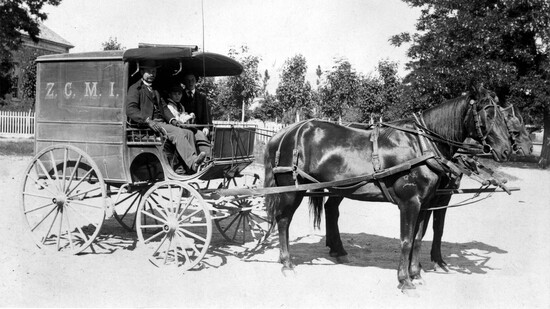
When we think of investment, we often think in modern terms; stocks, property, and financial returns. But in 1868, Utah’s leaders were thinking about something deeper: investing in people.
In October of that year, Brigham Young and a group of community leaders founded Zion’s Cooperative Mercantile Institution—better known as ZCMI. Sometimes called “America’s First Department Store,” it was created at a pivotal moment. The railroad was approaching the Great Basin, bringing new markets, new goods, and new competition. Territorial growth promised opportunity, but it also threatened the fragile, homegrown economy the Latter-day Saints had worked to build.
ZCMI was their answer.
Rather than compete individually against national chains and eastern merchants, communities pooled their resources. The store operated under a cooperative model: goods were sold “as low as they can possibly be sold,” with profits divided among the people at large. It was not simply a store, it was a system designed to strengthen local manufacturing and keep money circulating within the community.
The impact was immediate. In its first year, sales exceeded $1.25 million. ZCMI offered clothing, wagons, machinery, sewing machines, carpets, and everyday necessities. Local cooperatives could purchase goods at the same price offered in Salt Lake City, ensuring rural settlements were not left behind.
Southern Utah quickly became part of this cooperative network.
In Washington County, a ZCMI building stood attached to the cotton factory located at 385 West Telegraph Street housing the Washington Co-op from 1875 to 1921. In downtown St. George, another branch operated at 75 North Main Street for a time, linking the red rock desert to a regional system of trade.
Even smaller settlements adopted the cooperative spirit. In Pinto, a mercantile institution presided over by James Eldridge operated out of a room in his home. In Hebron and Grafton, cooperative cattle herds were established, along with dairy in Hebron, and meat production in Grafton. In Rockville, wagons loaded with fruit traveled to Milford to reach the railroad, where produce was shipped north to ZCMI in Salt Lake City.
These were investments not only in commerce, but in stability.
ZCMI stores were marked with the phrase “Holiness to the Lord” above their entrances, often accompanied by the All-Seeing Eye. The message was clear: economic life and spiritual life were not separate. Supporting local industry was seen as a sacred duty.
The cooperative system did more than sell goods, it wove Southern Utah into a larger economic fabric while preserving local control. It gave isolated settlements access to markets and fair pricing, while allowing them to remain rooted in their own labor and production.
In an era of rapid change, ZCMI represented a bold investment in self-reliance, shared prosperity, and community trust. Its legacy reminds us that sometimes the strongest returns come not from individual gain, but from investing together for the greater good.
Anna Lytle is a Southern Utah–based independent researcher and storyteller with a passion for uncovering the human stories behind the region’s past. She's the creator of the podcast What Once Was, where she blends research with storytelling to share the history of Southern Utah.