Along Main Street in West Orange, a series of brick buildings stand quietly behind iron gates and courtyards, their modest exteriors offering little hint of the groundbreaking work once carried out inside. This is Thomas Edison National Historical Park, a place where invention was industrialized, collaboration became innovation and ideas that shaped everyday life were brought into being.
Established in 1962 and encompassing 21 acres, the park preserves Thomas Edison’s West Orange laboratory complex and his nearby residence, Glenmont. Together, these sites tell a deeply New Jersey story—one rooted in experimentation, perseverance and the belief that progress is built through both imagination and hard work.
A Laboratory Unlike Any Other
Designed in 1887 by architect H. Hudson Holly, Edison’s West Orange laboratory operated for more than 40 years and is widely considered the world’s first industrial research and development facility. Unlike the solitary inventor stereotype often associated with Edison, the West Orange campus was built around collaboration. Engineers, machinists, chemists and assistants worked together across multiple buildings, refining ideas and transforming concepts into practical products.
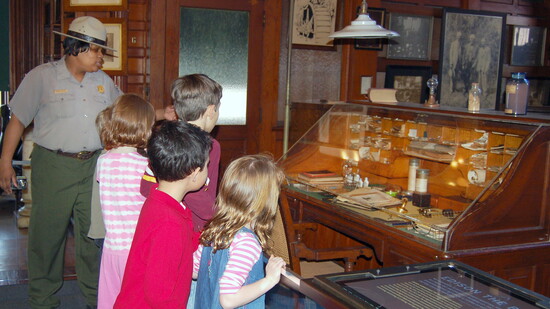
Inside the main laboratory building, visitors can still see machine shops, worktables and the library where Edison and his team studied, experimented and debated. Belts and pulleys once powered equipment, while phonographs played recorded sound—then a revolutionary concept. It was here that Edison and his staff improved motion picture technology, developed storage batteries and refined sound recording, among hundreds of other projects.
The National Park Service describes the site as “where modern America was invented,” a statement that feels tangible as visitors move room to room, tracing the physical spaces where invention became a repeatable process rather than a stroke of luck.
Preserving a System of Innovation
What sets the West Orange laboratory apart is not just what was invented there, but how. Edison’s approach—assembling teams, standardizing experimentation and documenting results—laid the foundation for the research models still used by companies and universities today. In that sense, the park preserves not only historic buildings but also the blueprint for modern innovation.
The laboratory complex includes several original structures open to the public, including the main laboratory, chemistry lab and library. The visitor center, located in Building 1, offers orientation films, exhibits and a museum store, helping guests understand the scope of Edison’s work before exploring the grounds.
More than 6,000 historical photographs related to Edison and his West Orange operations are available through the National Park Service’s online gallery, providing a visual record of daily life inside the labs and the people who worked alongside Edison.
Glenmont: Home Life Behind the Genius
A short drive uphill from the laboratory complex sits Glenmont, the Edison family residence. The three-story brick mansion, surrounded by mature trees and landscaped grounds, offers a more intimate look at Edison’s life beyond the laboratory walls.
Visitors who purchase tour tickets can walk through rooms furnished with original décor and personal belongings, gaining insight into family life at the turn of the 20th century. Glenmont reflects the balance Edison maintained between relentless experimentation and home life with his wife, Mina, and their children.
Guided tours of the house are designed to share both historical context and personal stories, revealing Edison not only as an inventor but as a husband, father and community member. Access to the Glenmont grounds is also available through self-guided cell phone tours, allowing visitors to explore the estate at their own pace.
Stories for All Ages
Thomas Edison National Historical Park is as much an educational resource as it is a historic site. School groups, families and history enthusiasts are drawn to the park’s layered storytelling, which blends technical achievement with human narrative.
Audio tours—available online and through mobile devices—offer deep dives into specific areas of the laboratory complex and Glenmont grounds. The Junior Ranger program introduces younger visitors to Edison’s work through hands-on activities and guided exploration, reinforcing the park’s role in inspiring future generations.
The Glenmont Garage, open as staffing allows, features Edison’s historic vehicles, highlighting his interest in transportation and mechanical innovation. Nearby, the Glenmont greenhouse—maintained with the help of volunteers—houses plants similar to those grown by the Edison family, adding another dimension to the site’s living history.
A Living Part of New Jersey’s Landscape
Beyond its role as a museum, the national park remains an active part of the region’s cultural and recreational landscape. It serves as a stop along the Washington Rock & Roll Tour, a cycling route supported by the New Jersey Department of Transportation that connects several North Jersey destinations, including Verona Park, the Montclair Art Museum, South Mountain Reservation and Turtle Back Zoo.
This integration into broader community experiences reflects Edison’s own connection to New Jersey. Though born in Ohio, Edison chose West Orange as the center of his most ambitious work, cementing the state’s place in the story of American innovation.
Planning a Visit
Visitors begin their experience at the Laboratory Complex at 211 Main St., where parking is available and ranger staff provide information and assistance. A car pass obtained at the visitor center is required before driving to the Glenmont estate.
Admission to the park is $15 per person, with discounted rates for educational groups and an annual park pass available. Glenmont house tour tickets must be reserved in advance through Recreation.gov and include a small, nonrefundable reservation fee.
The park observes a seasonal winter closure, with buildings closed through January. Guests are encouraged to check current conditions and alerts before planning their visit.
Why It Still Matters
More than a century after Edison’s teams filled the West Orange labs with noise, motion and experimentation, the site continues to resonate. In an era driven by rapid technological change, Thomas Edison National Historical Park offers perspective—a reminder that innovation is rarely instantaneous and almost never solitary.
The preserved laboratories and home at Glenmont tell a story not only of invention, but of persistence, teamwork and place. They remind visitors that some of the world’s most influential ideas were developed not in distant capitals, but right here in New Jersey.
As a Home Issue feature, the park stands as a powerful example of how place shapes progress. The same buildings that once fostered invention now invite reflection, learning and connection—proving that the legacy of innovation is, at its core, a story about home.
For hours, tour reservations and updates, visit nps.gov or contact the park at (973) 736-0550.
“Where modern America was invented.”