When you're designing a kitchen, it's easy to spend most of your time thinking about the big decisions: cabinetry, countertops, appliances and flooring.
But there's another element you'll interact with every single day: the kitchen faucet.
It may be a relatively small fixture, but the right faucet can make your kitchen more functional, complement the overall design and even make everyday tasks a little easier.
Before choosing one based solely on appearance, consider these five things.
Start With the Way You Use Your Kitchen
The best place to start isn't with a faucet catalog. It's with your daily routine.
If you're constantly washing large pots, rinsing produce or filling oversized pitchers, you'll want to pay attention to the faucet's height, reach and spray functionality.
If your kitchen is the heart of your home—with kids grabbing snacks, guests gathering around the island and meals being prepared throughout the day—convenience may be just as important as aesthetics.
Features such as pull-down spray heads, touch activation and touchless operation can be incredibly useful, but only if they fit the way you actually use your space.
Don't choose a faucet because it has the most features. Choose the features that will make your life easier.
Think About Your Sink First
Your faucet and sink have a relationship, so it's worth considering them together.
A deep farmhouse sink, for example, may call for a faucet with plenty of height and reach. A large workstation sink may benefit from a faucet that gives you plenty of flexibility around the basin.
You should also consider the faucet's installation requirements and the number of holes available in your countertop or sink.
And if you're planning a new kitchen, don't wait until every other selection has been made before thinking about your faucet.
Choosing your sink and faucet together can help ensure that the two work beautifully—and function well—side by side.
Consider How Much Technology You Really Want
Kitchen faucets have come a long way.
Today, you can find everything from traditional two-handle bridge faucets to sleek single-handle designs with touch or touchless activation.
But technology isn't automatically better.
Ask yourself what would genuinely be useful. Someone who cooks frequently may love being able to turn on the water without touching the faucet with messy hands. Someone else may prefer the simplicity of a traditional handle.
There's no right answer.
The best technology is the technology you'll actually use.
Don't Underestimate Finish and Scale
Your faucet is part of the overall design of your kitchen, so think beyond whether you like the shape.
Look at the other finishes in the room—cabinet hardware, appliances, lighting, sink and other plumbing fixtures.
You don't necessarily have to match everything perfectly. In fact, mixing finishes can create a much more collected and interesting look.
Scale matters, too.
A substantial bridge faucet can become a beautiful focal point over a large farmhouse sink, while a streamlined faucet may be a better fit for a smaller or more minimalist kitchen.
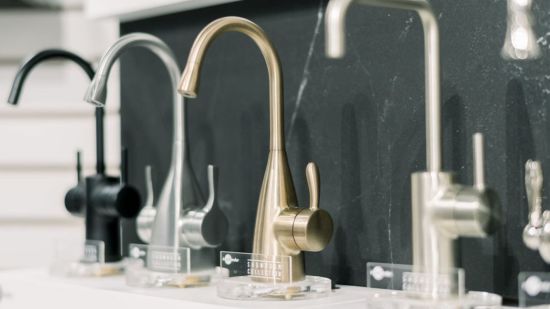
Whenever possible, look at finishes and fixtures in person. Colors, textures and even the visual weight of a faucet can be surprisingly different in person than they appear on a screen.
Try It Before You Buy It
This may be the most overlooked part of choosing a faucet.
You can look at hundreds of photos online, read reviews and compare specifications—but you can't tell how a faucet feels in your hand from a product page.
Try the handle.
Pull out the spray head.
Move it around the sink.
Look at the finish under different lighting.
Pay attention to the height and reach.
Those little details can tell you more about whether a faucet is right for you than another hour of scrolling through photos.
That's one of the advantages of visiting a kitchen and bath showroom. You can see different styles together, compare finishes and experience the fixtures before they're installed in your home.
A Beautiful Kitchen Should Work Beautifully, Too
The most successful kitchens aren't just beautiful to look at. They're designed around the people who use them.
Your faucet is a small part of the overall room, but it's one you'll interact with constantly. Taking a little extra time to consider how it functions, how it works with your sink and how it fits into your design can make a surprisingly big difference.
And sometimes the best way to know you've found the right one is simple:
Put your hands on it.
For homeowners who want to compare kitchen faucets, sinks and finishes in person, GLS Supply Kitchen & Bath Showrooms offers a wide selection of plumbing fixtures at its Alabama showrooms, with consultants available to help you find options that fit both your design and your everyday needs.