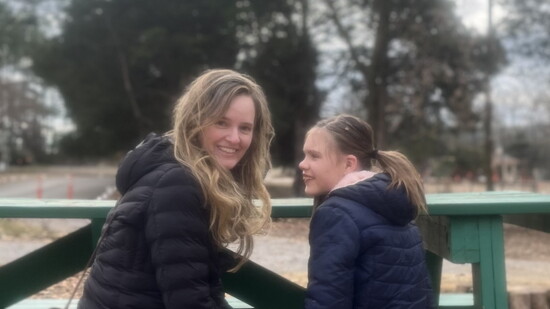
As an English teacher, there are few things I love more than precise language. Every day, I open my high school classes with a one-word check-in, a small but mighty challenge for students to determine exactly how they feel that day. What one word reflects the multitudes that young people hold at any given moment? It’s hard to sum up anything with just a word, but the attempt is always valiant.
My love of language extends back as far as I can remember, with a passion for reading and writing that was baked into my bones. As a teacher and writer, language remains a central fascination in my life. But something significant happened in my relationship with language when, almost 16 years ago, I became a mother. I learned the limits of language when it comes to love.
My daughter, Henny, was born with a neurological condition that makes communication difficult. Her life has been a slow unfolding of medical mysteries, with at times murky diagnoses and, over the years, every attempt we could muster to improve both her health and ensure her quality of life. She has autistic-like tendencies, though she is not autistic. She has intractable epilepsy and mobility issues. She is, as Southerners say, sweet as pie unless she’s madder than a wet hen; when that happens, take cover. But one of the most significant features of her mysterious profile is that, though she is almost sixteen, she still does not speak.
I became her mother through the grace of God, and parenting a special needs child is the spiritual journey of a lifetime. Her little brother, Thomas, was born 3½ years later. He is a giant of a kid with a heart as big as his now adult-sized, 12-year-old body. He spoke early and never stopped. Parenting him is not any easier, because all parenting seems to be the hard work of managing a deep well of love for your child with the challenge of guiding them into the best versions of themselves.
Yet in a relationship with a non-verbal child, even these parameters become tricky. No one is ever “right,” no one wins an argument, and no one has the last word. There are painful limits to what I can offer her in every domain; beyond medical care and occasional therapeutic interventions, I cannot change her existential condition. The most I can do is show up each day, opening myself with a generous heart, curious spirit, and determined faith that she, like all of us, was born with a distinct and beautiful sense of purpose.
My relationship with my non-verbal child is one long experiment in presence, and in this, it has challenged and grown me completely. We don’t talk on the phone or text, and we never will. Every bit of information I get from her is through full, physical presence with her every single day. It’s magical, it’s brutal. It is so many things that as I write this, my hyper-verbal self struggles to find language that accurately describes the experience.
But there is one thing I know for sure: It is love.
One of my favorite writers and teachers is a Quaker man named Parker Palmer. In his book Let Your Life Speak, he describes going through a deep clinical depression during mid-life. Though many people tried to show up for him during this dark time, he writes about the tender experience of one friend who came daily but often would not speak, showing up as a quiet, loving presence in his life instead of trying to fix, advise, or encourage him out of his depression. Palmer writes that “one of the hardest things we must do sometimes is to be present to another person’s pain without trying to ‘fix’ it, to simply stand respectfully at the edge of that person’s mystery and misery.” My inability to change much about the fundamental condition of my child is one of the most difficult challenges and one of the greatest gifts of both loving and being loved by her. She has such an eager heart, and a strong desire to be present and engaged regardless of her lack of language, which has turned my own sense of worth upside down and humbled me immensely. Palmer goes on to write that we often say so many “pious words about God’s presence in our lives but believing, on the contrary, that nothing good is going to happen unless we make it happen.” Accepting my own limitations and learning to trust God in her care has expanded my sense of love manyfold. When I surrender my desire to fix, I am free to show up, to sit down, and to listen beyond words.
One of my favorite Alabamians, Helen Keller, once said “You cannot touch love, but you can feel the sweetness it pours into everything.” Though she could not see or hear, the feeling of love was as real and present to her as to anyone. Her words are a testament that love has a language all its own; a language of presence, of humility, and of surrender if we can slow ourselves down enough to give and receive its sweetness. The greatest lesson I’ve learned from my daughter is the enduring quality of love. As people I love pass on from this physical plane, it’s clear to me that the true, distilled, present energy that is love between people never dies. It may morph and evolve, but enduring love will not fade, doesn’t die, and never withers. Love does not diminish with time or space. It is palpable energy that is born again and again.
One of the most significant features of her mysterious profile is that, though she is
almost sixteen, she still does not speak.
I know for sure: It is love.