The Lyndon Baines Johnson Presidential Library has reimagined how it tells history, and this summer, there's never been a better reason for Austinites to walk through its doors.
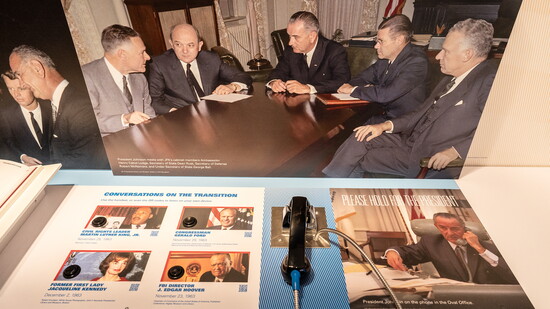
The library's newly renovated permanent exhibit, more than two and a half years in the making, replaces the dense wall texts of its 2012 predecessor with an immersive, multi-sensory experience designed for visitors of all ages. It traces LBJ's journey from Hill Country beginnings to the White House, then follows the impact of Great Society legislation through 1981. Every major text panel is now available in both English and Spanish.
"We've created a space where visitors can put themselves in that moment and decide for themselves what role people played, and what role they can play," said Lara Hall, the library's curator.
Interactive elements are woven throughout: video, audio, flip panels, and a touchscreen "America 1964" wall that holds the complexity of an era defined simultaneously by middle-class prosperity and the urgent need for civil rights legislation. Among the most affecting additions is "Voices from the Archives," where visitors place a card on a reader and hear a letter read aloud with the writer's handwriting projected on screen. One comes from Lorraine Bridges, a teenager who wrote President Johnson in 1965 about being denied a seat in a hospital waiting room because of the color of her skin. Another is from Steven Gottlieb, a boy who raised $60 at a neighborhood fair and sent it to the White House to support the VISTA program.
"Those letters illustrate what people who had no agency at the time could still do," Hall said.
Hall recommends the exhibit for children ages 6 and up. Younger kids will gravitate toward vintage telephones, interactive flip panels, and stories about LBJ's own boyhood, including a book and poem that stuck with him from fifth grade all the way to the presidency. The museum's beloved classics, the presidential limousine, Oval Office replica, and animatronic LBJ, remain as well.
Two temporary exhibits add even more reason to visit. Austin Past and Present, on display through early 2027 and curated by former Austin American-Statesman photographer Jay Godwin, juxtaposes decades of city photography.
"What he's really captured are these ideas of what Austin is… the sense of community, the sense of big town, small town," Hall said.
What We Bring to the Table explores American immigration history through personal stories anchored in actual kitchen tables, where visitors of all ages, especially younger children, can sit, do hands-on activities like sewing cards and playing checkers, and connect over shared histories. Recipes woven throughout the exhibit highlight how food has carried culture and tradition across generations.
On the library's 10th floor, a special American Experiment exhibition features rare foundational documents on loan from the National Archives. Among them are the Brown v. Board of Education ruling, the 14th Amendment, the Louisiana Purchase, the Statue of Liberty deed of gift, and patents from the Wright Brothers, Alexander Graham Bell, and Thomas Edison.
"We're celebrating 250 years of this ongoing American experiment, and these documents are really the foundation of that conversation,” Hall said.
For the first time ever, the LBJ Library will remain open until 9 p.m. every Wednesday through Sept. 2, giving families, students, and anyone curious about American history additional opportunities to experience these extraordinary documents and exhibits on their own schedule.
Whether you're a lifelong Austinite, a parent planning a summer outing, or a first-time visitor, Hall says the library is intentional about making everyone feel welcome.
"So many people struggle with where they belong in the American story," she said. "Creating space for anyone to come in and find their place — that was really important to us."
The LBJ Library is located at 2313 Red River St. on the University of Texas campus. Advance ticket purchase is encouraged.
You won't just be encountering the past — you'll get to experience how it was shaped by everyday people.