Thirty years from now, Owner, Trent Johnson hopes someone can open the door to Greeley Hat Works and immediately know where they are.
Maybe it will be the smell.
Trent has spent so many years surrounded by felt, leather, steam, and the workings of a hat shop that he no longer notices the particular scent others mention when they walk inside. But he hopes it is still there. More importantly, he hopes the warmth is there. The people. The unmistakable feeling that walking into Greeley Hat Works is an experience rather than simply a transaction.
Not everyone who walks through the door buys a hat that day. Trent does not want that to change. The goal has never been to simply “close the deal.” A customer might have a head measured, talk through how a hat will be worn, watch a pattern take shape, meet the people behind the craft, and begin to understand why something handmade takes time.
For Trent, that experience is as much a part of Greeley Hat Works as the finished hat.
It is also why he is not particularly concerned that handmade hatmaking exists in a world increasingly built around speed. There will always be something faster. There will always be something cheaper. But Trent believes slow has been given an unfair reputation.
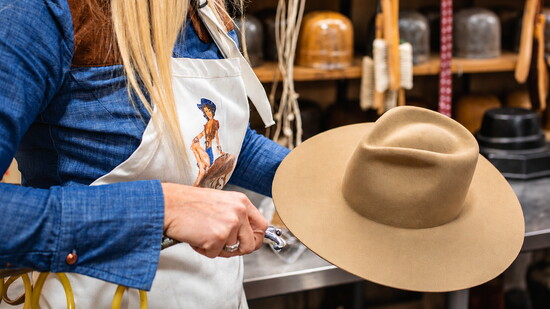
At Greeley Hat Works, slow means measuring a head rather than assuming a size. It means tracing its individual shape, adjusting 46 pins to capture its contours, and hand-cutting a cedar pattern to preserve them. It means talking with the person who will wear the hat about where it is going, what it needs to do, and how it should feel.
None of that is fast. That is precisely the point.
“Slow is precision,” Trent says. “Slow is not perfection.”
The distinction matters to him. Perfection is not the promise. Attention is. Craftsmanship is. Taking the time to notice the details is.
Trent has had opportunities to purchase equipment that could make parts of the process faster. He knows how mass-production factories achieve their volume. But increasing speed simply because the technology exists has never been the measure of progress at Greeley Hat Works.
The people learning the craft today give him confidence that it does not have to be.
When Trent talks about the crafters working inside Greeley Hat Works, one phrase comes quickly: “I'm in awe.” He sees individuals with different personalities, interests, and strengths learning a craft that depends on human hands and judgment. And he still gets a particular satisfaction when a customer returns years later loving a hat, allowing Trent to look at the records, find the initials of the person who made it, and introduce that crafter to the person who has been wearing their work.
He remembers doing exactly that from much farther away. While at a show in Australia, Trent met a man whose Greeley Hat Works hat had been worn so extensively that its satin liner was gone. Trent photographed the inside and sent it back to the team in Greeley so the employee whose initials remained inside could see where their work had ended up.
A hat made by someone in Greeley had crossed an ocean, been worn for years, and eventually found its way back to its maker through a photograph.
That is the legacy Trent wants the next generation to understand.
Not simply how to make the hat, but why the details matter. Why the person wearing it matters. Why quality, customer service, integrity, and personality should remain recognizable regardless of how large the company becomes or what tools become available.
Thirty years from now, Trent will not measure success by whether Greeley Hat Works resisted change. It has been changing for more than a century. The tools may evolve. The business may grow. Another generation of hatmakers will leave its own fingerprints on the craft.
What matters is whether the right things remain.
The quality. The integrity. The personality. The warmth of being greeted by another person. The time spent understanding who a hat is for before beginning to make it. The experience of walking through the door and knowing this could only be Greeley Hat Works.
And Trent hopes he gets to see it.
“Wow,” he says, allowing himself to picture the shop three decades from now. “I hope I'm still here to walk in the door in 30 years.”
If he is, perhaps the greatest measure of what he built will not be how much has stayed exactly the same.
It will be what he recognizes.
The smell of the shop. The warmth of the people. A customer lingering longer than expected. A hatmaker taking the time to get something right. Steam rising somewhere in the background. Another generation is learning that slow can mean precision, and that the person beneath the hat matters as much as the hat itself.
Greeley Hat Works was already a legacy when Trent Johnson walked into it more than 30 years ago. He did not begin its story, and the greatest hope for a steward may be that he will not be the one to finish it.
Someday, another generation will carry it forward.
And if they preserve the things that mattered most, Trent will be able to open that door, breathe it in, look around, and know exactly where he is.