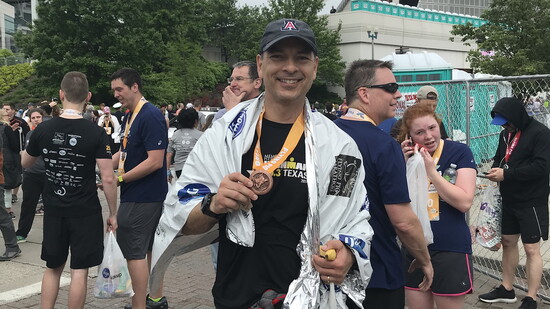
Sixteen times, Wayne Fraleigh has stood at the start line of an Ironman—knowing exactly what waits on the other side of the water, the miles, and the hours still ahead. A 2.4-mile swim. A 112-mile bike ride. A full marathon to finish. Seventeen hours to complete it all. It is a distance that tests not only physical endurance, but mental resolve in its purest form. For Wayne, it became something more than a race. It became a framework for how he approaches challenge, leadership, and the quiet discipline required to keep moving forward when the outcome is uncertain.
Today, as Chief Executive Officer of Orthopaedic & Spine Center of the Rockies (OCR), Wayne leads with a perspective shaped far beyond boardrooms and strategy sessions. Long before that role, his life was defined by endurance of a different kind. As a student-athlete on the University of Arizona football team, he learned discipline early, but it was a devastating, career-ending injury that would ultimately reshape his path. A serious neck injury during a college football game forced everything to stop, stripping away the identity he had built and leaving him to rebuild from a place few ever anticipate. What followed was not immediate clarity, but a gradual shift in perspective—one that would later define how he navigates both personal and professional challenges.
Years later, in 2013, that perspective was tested again in an unexpected way. While serving in a leadership role connected to the former Ironman Sports Medicine Institute in Houston, Wayne was invited to the Ironman World Championships in Kona to learn about their medical set-up. There, standing at the finish line, he witnessed something that reframed what endurance truly looked like. Many athletes crossing that line were not defined by ease or even by physical perfection. They were defined by persistence—blind competitors, amputees, cancer survivors, and individuals who had faced extraordinary setbacks yet still chose to move forward. “I looked at them and thought, why not me?” he says. At the time, he had never run more than a couple of miles, and lingering physical challenges, including his serious neck injury and a heart condition, made the idea seem even more unlikely. Still, he started.
The first endurance event, a half marathon, was difficult in ways he had not anticipated. The first half Ironman brought even more uncertainty when his heart went into atrial fibrillation mid-race. He finished anyway. Soon after, doctors told him he would need a cardiac procedure and months of recovery—timing that could have easily marked the end of the pursuit of completing an Ironman. Instead, it became part of the process. By November 2014, just months after surgery, Wayne completed his first full Ironman, crossing a finish line that represented far more than physical endurance. It marked a shift in how he understood limitations, not as fixed barriers, but as variables to be worked through with patience, resilience, and discipline.
Today, Wayne has competed in 16 Ironman races, completing 13. Each one carries its own set of challenges, but one in particular stands apart. At the Ironman World Championships in Nice, France, he threw his back out the morning of the race. Bent forward, in extreme pain, and unsure if he could even begin, he made a decision that had nothing to do with time or placement. “My dad taught me that it's not what happens to you, but it's how you handle what happens to you. I told myself I’ll push through each discipline until my body is unable to.” Wayne noted. He was eventually pulled for missing the run cutoff, meaning the race would not count as an official finish. Still, he continued and completed the distance. What remained was not a medal, but something far more defining—the understanding that breaking through your physical and mental limits can matter far more than any recognition or reward.
That distinction matters, because for Wayne, the Ironman has never been about the finish line. It is about what the process demands: consistency, resilience, and the ability to stay steady in moments that test both physical and mental limits. Those same principles now shape how he leads Orthopaedic & Spine Center of the Rockies. Healthcare, much like endurance racing, is constantly shifting, requiring leaders to make decisions in an environment where variables are rarely within their control. Costs rise, systems evolve, and independent practices face increasing pressure to adapt to stay relevant. Leading through that requires more than strategy. It requires perspective. “You can’t get too high or too low,” Wayne says. “You deal with what’s in front of you and make the best decision you can.”
That mindset carries into how he approaches leadership on a daily basis. Rather than stepping away from the clinical side of care, Wayne remains closely connected to it, maintaining his physical therapy license and spending time with both physicians and staff. The goal is not distance, but alignment—understanding how decisions made at an organizational level impact the patient experience in real time. “If you take care of your team, they’ll take care of the patient,” he says, a philosophy that reflects the same interconnected support system required to complete an Ironman. “It’s never just about you. My support team, especially my wife and kids, have sacrificed a lot for me to pursue this journey. Success comes when the whole team works together to make dreams and aspirations possible.”
Outside of work, that same sense of discipline and connection shapes his approach to life. Rather than separating work and home, he views them as integrated, recognizing that the ability to lead effectively is tied to how well everything else is aligned. Strong in his Christian faith, early mornings begin with devotion, prayer, and exercise, grounding the day before it begins in mind, spirit, and body. Family remains a constant priority, not as something balanced against work, but as something that exists alongside it. It is a structure that allows for both intensity and presence, a combination that mirrors the endurance required in both racing and leadership.
At its core, Wayne’s story is not about titles or accomplishments. It is about the moments that ask more than expected, and the decision to meet them anyway. Most will never stand at the start line of an Ironman, and they do not need to. The distance itself is not the point. What matters is the question it represents, one that extends far beyond the race course.
What is the challenge that feels just out of reach—and what would it take to pursue it anyway?
“I looked at them and thought, why not me?”