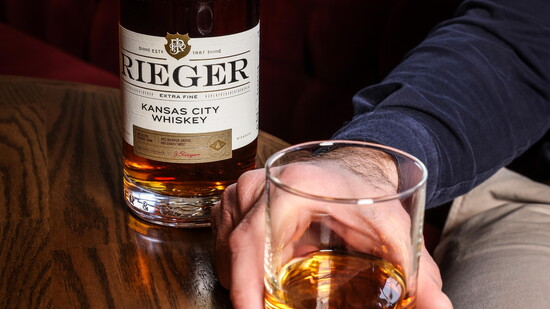
In Kansas City, the name J. Rieger & Co. carries history. For Andy Rieger, it also carries responsibility.
Reviving his family’s distillery was never about nostalgia. It was about finishing what was interrupted. His great-great-great-grandfather, Jacob Rieger, built one of the largest distilleries in the country before Prohibition shut it down in 1919. For decades, the business lived only as a family story. In 2010, after his father passed away, Rieger realized the legacy would either continue through him or end with him.
“It never felt like starting a company,” he says. “It felt like finishing a sentence that got cut off in 1919.”
What began as a revival quickly became something more. There was no inherited infrastructure, no building, no customers. Rieger describes the early days as a true startup, vacuuming a 15,000 square foot warehouse at three in the morning with little more than conviction. The family history served as a compass. When your name is on the bottle, shortcuts are not an option.
From the beginning, the goal was not to create a precious, niche luxury brand. Jacob Rieger built whiskey meant to be enjoyed regularly. Quality without pretension. That philosophy still guides the company today. Rather than recreate 19th century formulas for the sake of preservation, Rieger rebuilt the products for modern drinkers. “If we only preserved the formula, we would be protecting a story instead of serving a drinker,” he says. The ambition is simple. Become the favorite bottle on the shelf, not the one saved for special occasions.
That commitment to quality has defined the company’s growth. The vodka program is overseen by a former master distiller of Smirnoff. The gin program is led by the former master distiller of Tanqueray and creator of Tanqueray No. 10. The whiskey program began with the former master distiller of Maker’s Mark. The whiskeys run through two stills over two days, doubling labor and cost, but improving the final product. Rieger often points out that better does not have to mean expensive. His $30 Bourbon has earned national recognition while remaining accessible.
In 2025, respected critic Fred Minnick named J. Rieger & Co. the top independent whiskey distiller in the country and later included its $30 Bourbon in his Top 100 list. It was the most affordable bottle on that list. For Rieger, moments like that signal progress. “If you keep doing the right things long enough, people notice,” he says.
Today, the company’s bottles are distributed in more than two dozen states. Yet Rieger has never viewed expansion as an excuse to distance the brand from Kansas City. The original distillery operated here from 1887 until Prohibition. Rebuilding in the same city was not optional. It was foundational.
“This has always been and always will be our hometown,” he says. “Because of that, we want our hometown to have the best reputation in the country.”
That mindset shapes how he thinks about community investment. The company’s campus is a major historic renovation in the East Bottoms, complete with multiple bars, restaurants, and even a slide. It may never produce the kind of financial return a spreadsheet would prefer. But to Rieger, that is beside the point. Someone had to go first.
“If investment only follows what the market can give a standard return on, nothing changes,” he says. “We chose the long road.”
The bet was that quality, combined with visible commitment, would help reset expectations for what Kansas City could build. Now developers and distilleries from outside the region visit the campus before planning their own projects. The risk of going first has become part of the city’s momentum.
Rieger is clear that being local is not the selling point. “Local should not be the reason you choose something. Quality should.” Outside Kansas City, he notes, no one buys a bottle out of civic loyalty. The product has to stand on its own next to names like Tito’s, Tanqueray, Maker’s Mark, and Buffalo Trace. When it does, hometown pride follows naturally.
Leadership, in his view, is less about authority and more about stewardship. Hundreds of families now rely on the company for a paycheck. Acting inconsistently would reflect not only on the brand, but on everyone connected to it. “When your name is on it you choose what it stands for,” he says. He chose quality.
As he looks ahead 10 to 20 years, Rieger’s ambition is measured but clear. Healthy growth. Perhaps two or three times larger. Still affordable. Still uncompromising. “The goal is to be known as the highest quality distilled spirits producer in America while remaining affordable,” he says. “That feels very Kansas City.”
For an April issue focused on investment, Rieger’s story offers a broader definition of the term. Investment is not only capital deployed for return. It is belief in a neighborhood before it is proven. It is choosing higher standards even when they cost more. It is restoring a family name not for sentiment, but for substance.
When asked what he hopes people say about his chapter of the Rieger story, his answer is straightforward. That the rebuild was difficult, creative, and worth it. And that Kansas City embraced it enough to keep it alive.