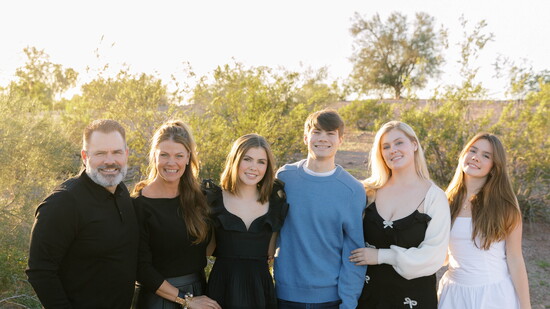
Meg H. Seoane has spent years returning to the early moments, trying to understand when her mother first began to change. Not to relive them, but to make sense of what happened. To answer the questions she once carried into doctor’s offices. To explain what could never quite be explained.
“It all becomes more clear in retrospect,” she says now. “But in the moment, it’s next to impossible to see the first signs clearly. My advice to anyone going through this is to give yourself grace.”
Her mother had always been precise, thoughtful, deeply intentional in the way she lived. In her early sixties, with three daughters grown and married, she decided to give each of them a handwritten cookbook. Every recipe carefully copied by hand so no daughter would feel more special than another. It was exactly the kind of thing she would do.
But when Meg and her sisters began using the books, something felt off. Recipes were repeated. Some were missing. Measurements drifted. The woman who never missed a detail was suddenly losing them.
They laughed about it. They filled in the blanks together. Only later would Meg realize the cookbook was the first goodbye.
Then came the subtler changes. Her mother withdrew from crowds. She spoke less. She seemed sad. It felt reasonable to blame the stage of life. The youngest daughter had just moved out. The house was suddenly quiet. Nothing about it seemed urgent.
Until the day Meg delivered her third child.
Recovering from a C section, she needed her mother to help with driving. The woman who had flown around the world for decades could no longer follow simple directions.
“Slowly, then quite suddenly, it hit me,” Meg says. “It was cognitive.”
From there, the unraveling accelerated. Doctors missed the diagnosis. Anxiety was suggested. Then more medication. Meg knew something was wrong, even when no one could name it yet. By the time they reached the USF Byrd Alzheimer's and Research Center in Florida, her mother was already in moderate to severe stages of the disease. Even now, Meg says, they never truly learned what caused the neurodegeneration.
Still, there was much of her mother that remained.
Among her daughters, she had always been known as the baby whisperer. Newborns who defeated everyone else somehow settled in her arms. No amount of colic could outlast her patience. Even as the disease took pieces of her memory, that gift never left her.
“So she couldn’t cook anymore or host large gatherings,” Meg says, “but the key to unlocking this new phase was finding and highlighting the ways she could instinctively feel valuable."
Meg learned to look for what stayed. To stop measuring loss and start noticing presence.
“You never really lose the person while they’re here,” she says. “You are continually meeting them in the present moment, trying to honor who they are now, not who they used to be.”
Their relationship changed shape. Conversations grew shorter. Activities became simpler. They happily sang along together to The Sound of Music. They laughed at America’s Funniest Videos. They learned to connect in the spaces that still existed.
“We needed her to know she still held an honored place in our family,” Meg says.
Her father never left her mother’s side. He became her caregiver, her constant, her witness. Meg watched the man who had built his life with this woman now build his days around her care.
When her mother passed, the loss did not feel sudden. It felt like the end of a very long vigil.
Meg was 44 when her mother died. The older she gets, the younger that sounds. At the time, her children were between 5 and 15, and the family was split across the country. She had just moved to Phoenix when everything back home became unbearably hard.
“I held a lot of it to myself,” Meg says. “It’s a really sad thing to talk about when you’re meeting new people. But if I could go back and give myself advice, it would be this: be open about the things that are hard in your life so people can help you.”
Grief stayed. It did not leave when the hospital visits ended. It did not quiet with time. It simply changed form.
Faith became one of the anchors that carried her through. A neighbor across the street taught her how to pray the rosary. Neighbors who were not Catholic joined. One of her closest friends, who is Jewish, sat beside her after her mother passed and prayed as well. It was her way of honoring Meg’s mother. Different faith, same intention.
When Meg finally returned to Phoenix after her mother’s death, the moment that met her at baggage claim stayed with her forever.
“My kids ran toward me,” she says. “Being wrapped up in them and in my sweet husband’s bear hug, I have never felt so safe. At the end of the day, that is everything. Your family.”
Meg did not want her mother’s story to disappear when the disease was over. She did not want the learning, the staying, the caring to end in silence. She needed somewhere for all of it to go.
That need became Croquet for a Cure.
Not as a project. Not as an event idea. But as an extension of a life that had shaped her.
What began as a small gathering grew into something much larger. Over the years, the event has raised more than $260,000 for Alzheimer’s research, patient care, and the new Cognitive Care Clinic at the Bob Bove Neuroscience Institute in Old Town Scottsdale. But the numbers were never the point.
The point was the people.
The families.
The conversations.
The quiet understanding that forms between those who recognize pieces of themselves in one another’s stories.
Meg carries her mother with her now in everything she does. In the way she listens when another woman begins telling a story she recognizes too well. In the way she notices the small details that matter. In the patience she offers, not as something learned, but as something inherited.
Healing also arrived in motion often through hiking. Meg looks for heart shaped rocks and leaves them where others can easily find them. Sometimes she returns later and finds they have been moved or piled together.
“It’s my quiet Godwink,” she says. “A guardian angel moment that makes me smile and think of my parents. It feels like forever and a blink at the same time since I’ve had them next to me.”
At home in Arcadia, she is raising her own children inside that same quiet philosophy of presence. They know their grandmother’s story. They understand that love is not always loud. Sometimes it is sitting beside someone and staying. Sometimes it is learning how to hold joy and sorrow at the same time. They have grown up watching their mother build something meaningful from what she lost, and in doing so, they have learned what it means to live with intention.
Croquet for a Cure now threads through her everyday life. It shows up in school conversations, in community gatherings, in the way neighbors and friends step closer when someone’s family begins walking a road Meg knows well. There is no separation between the woman she is at home and the woman who leads this effort. It is all one life.
Each year, when the event returns, Meg watches people arrive with their own stories. Some come hopeful. Some exhausted. Some quietly afraid. Over the course of the day, conversations unfold that do not happen easily anywhere else. People talk about their parents, their spouses, their children. They talk about fear. They talk about memory. They talk about what they are trying to hold onto. And in those moments, Meg sees what her mother’s life has become.
Not something that ended.
Something that continues.
There is one truth Meg wishes more families understood earlier in the Alzheimer’s journey. Acceptance is the great turning point. The diagnosis is terrifying, and it is tempting to resist it. But without acceptance, you cannot let go of the life you thought you would have and begin learning new ways of connecting with the person you love.
“If I could have given my dad the gift of acceptance earlier, I would have,” Meg says. “It broke his heart to come to terms with the diagnosis. But once he truly understood it, he could release the expectations. As painful as that was, it allowed him to love her in ways that were still possible.”
When Meg thinks about her mother now, she no longer tries to locate the exact moment when things first changed. She understands that love did not disappear when memory did. It simply asked her to learn a new language. One built on presence, patience, and the decision to keep showing up even when the future feels uncertain.
That is the love she carries forward.
croquetforacure.org
"You never lose the person while they are here. You meet them again and again in the present, learning to honor who they are now, not who they were."
ERA OF HOPE GALA
An Evening Benefitting the Alzheimer’s Association Desert Southwest Chapter
Friday, April 24 | Arizona Science Center
Emceed by PVCL’s Nadine Bubeck
As the number of Americans living with Alzheimer’s surpasses 7 million for the first time, nearly 4 in 5 Americans say they would want to know if they had the disease early and would pursue treatment even with risks if it could slow progression, according to the 2025 Alzheimer’s Disease Facts and Figures Report.
“This year’s report finds that the impact of Alzheimer’s on Arizona residents and families is significant,” says Terri Spitz, Executive Director of the Alzheimer’s Association Desert Southwest Chapter. “We must advance awareness, research, and treatments that can slow the current trajectory and support Arizona families.”
A signature night of giving back, the Era of Hope Gala unites the Valley in support of families impacted by Alzheimer’s and all other dementia, raising critical funds for care, research, and support.
Why It Matters
• 151,500 Arizonans 65+ living with Alzheimer’s
• Recent data reflects a notable rise in deaths related to Alzheimer's disease.
• 240,000 unpaid caregivers
Learn more: alz.org/dsw
Gala Tickets: alz.org/EraofHopeGala