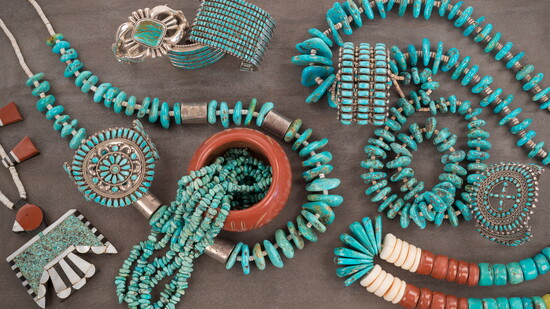
It seems the more we learn about native artisans the less we know. It is such a vast artistic endeavor from pre-colonial creations to today that it seems beyond the scope of our understanding. But let's take a journey from the beginning of these art forms and witness history unfold as we travel from there to present day.
Phase One: The Ancient Trade Networks (Pre-1400s)
Long before European contact, the Hohokam of the Gila, Salt, and Santa Cruz river systems were already master jewelers. Working turquoise from nearby Bisbee and Kingman deposits with nothing but stone tools, they ground, drilled, and strung beads so fine that some could pass through a window screen.
Their signature achievement was etched shell, a technique unique in the ancient world, applied to Pacific and Gulf of California shells hauled inland along extensive trade routes. To the north, Ancestral Puebloan communities at Chaco Canyon accumulated thousands of turquoise pieces, some traded as far as what today is Central America and the Yucatan. By the 1400s, this exchange network stretched hundreds of miles in a dozen destinations, moving turquoise, shell, and finished ornaments across cultural lines.
Phase Two: Contact and Continuity (1500s–1700s)
Spanish arrival in the 16th century didn't interrupt these traditions so much as layer onto them. Turquoise remained sacred and was pressed into kiva beams for protection, offered at the sipapu as a symbol of emergence from the underworld. Pueblo, Zuni, and Navajo artisans continued working stone, shell, bone, and wood, developing the heishe beads, a Santo Domingo term for thin, hand-rolled discs of shell or turquoise into an art form and a currency of trade in its own right. Metal remained largely absent from Southwestern work during this period, even as Spanish colonists introduced silversmithing techniques that would not take root among Native artisans for another two centuries.
Phase Three: The Silver Revolution (1850s–1900)
The turning point came at mid-century, when Navajo smiths began learning silverwork from Mexican plateros. The craft spread quickly: by 1880, the first turquoise stones were being set into silver, with Navajo smiths initially using the stone sparingly, as an accent to bold, hand-hammered silver forms including squash blossom necklaces, concha belts, bow guards. The Zuni, working from a different aesthetic tradition rooted in lapidary precision, moved toward intricate stone-to-stone inlay and needlepoint clusters. The Hopi came to silverwork last and by a different path entirely. Sikyatki potter-turned-smith Sikyatata is credited as the first Hopi silversmith, in 1898, but geographic isolation and limited silver supply kept most Hopi artisans working shell and stone well into the 20th century.
Phase Four: Divergence and Distinction (1900–1950s)
Coral entered the palette around 1900, and each tribe's style sharpened into something recognizable at a glance. The Hopi eventually developed overlay work with one layer of silver cut and soldered over an oxidized base as their own signature, distinct from Navajo repoussé and Zuni mosaic inlay. Trading posts and a growing tourist economy created new markets, and new pressures, as Native jewelers balanced ceremonial meaning against commercial demand.
Phase Five: Recognition and Renewal (1960s–Present)
The mid-to-late 20th century brought individual artists with their unique designs (rather than broader tribal styles alone) into gallery and museum recognition, from Zuni fetish carvers to contemporary Navajo and Hopi smiths blending traditional technique with modern design.
Today, in Tucson and across southern Arizona, that lineage is visible everywhere: at the Heard Museum, in Fourth Avenue galleries, at the annual gem and mineral shows that draw collectors worldwide. The materials, turquoise, shell, silver, remain the same ones the Hohokam first shaped by hand more than two thousand years ago. What's changed is the hand doing the shaping, generation after generation, tribe after tribe, an unbroken thread from Cerrillos and Kingman turquoise mines to the display cases of the present day.