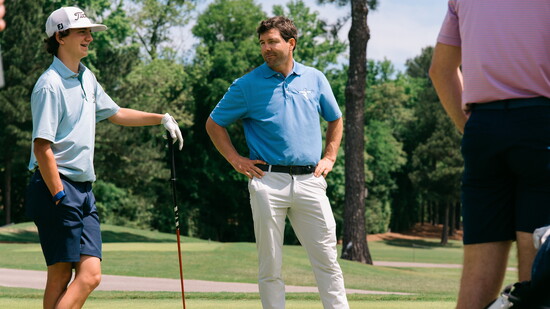
The lab work wrapped up yesterday. Sensors, movement screens, and two hours of Thomas Twitty watching data tell the truth about golf motion. Today, the setting shifts from lab to fairway. Finn Burkholder, a college-bound senior from Houston, is walking the course with Twitty, putting yesterday’s findings into action. His father follows a few steps behind. Joining them is SJ Thomas, a standout freshman at Mountain Brook High School and a longtime ETRAK client, who knows this drill well. Between holes, Twitty talks. Between shots, he says almost nothing — a single word, a color, a letter. The kind of shorthand that only works when the groundwork has already been laid.
This is the second time Finn and his family have made the trip from Houston to Birmingham. They met Twitty through Axis Golf Academy, one of Houston’s premier junior academies, where he has built a devoted following among players and coaches. Finn recently signed to play college golf at Mississippi State, where Twitty and ETRAK will now be within driving distance. “If he needs help,” his father says, “Thomas is just a drive away.”
Finn’s father played and coached basketball at UNC Charlotte. He is not a man who uses words carelessly. “A lot of golf teachers are teaching geometry,” he says, watching his son line up a shot. “Thomas teaches physics. He’s teaching my son time, tension, width.” He pauses. “And he can do it the old school way, but also with data.”
Finn is equally precise. “He’ll say a word like tension, and I realize I’ve been tensing the wrong things instead of just making my swing wider,” he says. What clicked most was understanding his own effort ranges. “I have a blue swing, kind of a cruising effort, a green swing that’s stock, and a red one where I’m trying to kill it. Thomas helped me see I was living in the blue range when I didn’t need to be.”
That kind of self-knowledge is exactly what Twitty has spent twenty years trying to give people. But to understand why ETRAK exists, it helps to understand what happened to golf.
Twitty believes the sport shifted permanently during the Tiger Woods era. “If that swoosh had never been on Tiger’s hat,” he says, “I don’t know if Finn’s standing here right now.” What Nike and Tiger did together, he argues, was usher in the athletic era of golf. Once the hobbyist became an athlete, equipment manufacturers responded. Drivers got larger. Golf balls curved less. Players swung harder because equipment now allowed it. The athletic revolution, however, came at a price. Injuries became more frequent because the body wasn’t equipped to handle this new age of firepower. Then sports science entered the equation — what Twitty calls performance engineering. “The rapid evolution of golf from hobby to sport,” Twitty says, “requires us to now engineer performance if we are going to do it safely and effectively. The rise of performance engineering is why ETRAK exists.” He isn’t being dramatic. He means ETRAK literally would not need to exist if golf were still what it was in 1985.
The gap his company fills is specific. “We hear clients say ‘It looks great, but it feels bad,’ and that’s the disconnect we help solve.” A player can make a motion that looks textbook on video, but still feels incomplete to the person making it. The reason, Twitty explains, is that feel and function are two different things, and bridging the gap in instruction without performance engineering is extremely difficult. “Feel is never real,” he says. “What you’re feeling is rarely accurate, and it’s rarely as big or exaggerated as it seems to you.”
His journey to bridge the gap started with the founding of Pure Performance, a data-driven training facility in Birmingham, back in 2013. Seeing a need for more performance engineering solutions, ETRAK Technologies was founded in 2019. ETRAK’s first product was the Phoenix — a high-performance wearable device built with a Birmingham engineering firm that captures precise movement data in real time across every plane of motion. In the lab, it doesn’t just show what a swing looks like. It reveals why it works — or why it doesn’t. “Most people are so into right and wrong,” he says. “They struggle to understand cause and effect. That’s where we help clarify what’s actually happening.”
Today, ETRAK brings performance engineering to life through a two-day experience called Stay and Play: day one in the lab, where the data does the talking, and day two on the course, where players learn to feel what those findings actually mean.
Twitty’s process begins with understanding how a player naturally moves before asking them to change anything. “We don’t want to change you first,” he says. “We want to understand you.”
From there, progress happens through small sequences of drills layered over time. He compares it to learning an instrument. “Motion is like music,” he says. “It’s scientifically based, but artistically expressed. When you know something well enough, it’s only then that you can be creative with it.”
His clients range from PGA Tour players and coaches to entry-level beginners. “No one is immune to the fundamentals of motion. We all need insight and a process to get better,” he says. “Without data, you’re building a feeling on a guess.”
He built all of this in Birmingham, his hometown, which he considers an advantage rather than a limitation. “Birmingham is the best-kept secret in the country,” he says. “Here, the product comes first.”
Back on the course, Finn lines up another shot. One word from Twitty. The next swing is smoother, simpler, better. Yesterday, the lab showed them the physics. Today, Finn is feeling it.
Motion is like music. It's scientifically based, but artistically expressed.
What to expect at ETRAK
The process begins with a discovery call, followed by a two-hour evaluation covering physical screening, motion analysis, and a personalized training workflow. The Stay and Play option pairs a lab day with an on-course session to put the findings into practice immediately. ETRAK works with competitive juniors, college and professional players, and recreational golfers at all levels.
Visit ETRAK.tech or email info@etrak.tech to learn more.