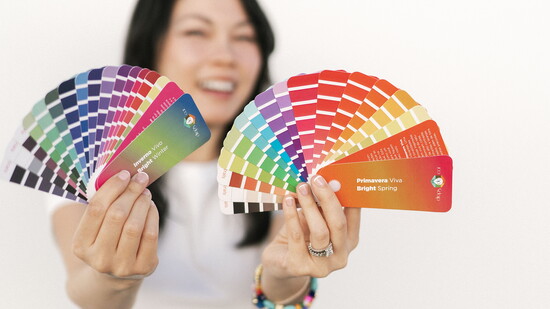
Theresa Breitton spent 14 years helping launch new lines in the fashion industry in New York—for Gap, Ralph Lauren, and Tommy Hilfiger. “Each launch had its own color story,” she says, citing rich palettes and carefully curated combos. “Color wasn’t just aesthetic. It was strategic, emotional, and powerful.”
Now a double-certified color consultant and Folsom resident, Breitton, owner of Beauty by Theresa, provides color analysis for clients at Image Studios El Dorado Hills. “Color analysis isn’t just about clothing or makeup,” she says. “It’s about helping people see themselves in a new light and understand how to work with their natural features. When someone sees how the right colors instantly brighten their skin, enhance their eyes, and bring out their natural beauty, it’s incredibly powerful.”
Here, she tells us more.
How did your training shape your approach to color analysis?
I began my certification with Color Me Beautiful, an institution that popularized color analysis in the 1970s with the classic four-season system. That led me to the 12-season system through Drops de Cor, founded by Sissa German, who became my mentor. We first test three core color dimensions: value (light vs. dark), chroma (soft vs. bright), and temperature (warm vs. cool). This allows us to identify someone’s true color harmony before determining their seasonal palette. It beautifully blends art and science.
What’s most important in determining someone’s best colors?
Skin tone covers the largest surface area of the face, so it has the greatest influence on how someone reacts to color. Eye color and hair color are helpful indicators, but they’re secondary. I’m ultimately looking for visual harmony—the right colors brighten the complexion, bring out the eyes, and create an overall sense of balance.
Can two people with similar features end up with completely different palettes?
Absolutely. Example: Many Asians naturally have dark brown hair and dark brown eyes, and you might assume they all fall into deeper seasons like Autumn or Winter. In reality, clients with those same features fall into Spring and Summer palettes as well. When we drape colors near the face, the skin will brighten and look more even, or it may appear dull, shadowed, or sallow. Professional color analysis focuses on the full picture—how skin tone, contrast, and color dimensions interact.
Are there universal colors that work for everyone?
There isn’t a single color that truly works perfectly on every person. That said, a few colors are surprisingly adaptable across many palettes. Examples: raspberry pink, true red, deep wine or burgundy, teal green, and deep teal or navy. These colors tend to have a relatively neutral temperature, medium-to-high saturation, and a medium-to-deep value, which allows them to complement many different complexions.
Once someone knows their palette, how should they start updating?
Tops, blouses, sweaters, and outerwear have the biggest visual impact because they frame the face and interact directly with skin tone. Makeup is another great starting point because it can dramatically enhance your overall look.
What kind of confidence shift do you see when someone starts wearing their best colors?
I witness an immediate shift in energy and confidence. They feel more vibrant, more aligned, and more authentically themselves. It’s almost like a natural filter—the person shines first, and the colors simply enhance what’s already there.
What happens during a color party?
Color parties are a condensed version of a full consultation. Each guest goes through the draping process, where I test different colors near the face. It takes 15–20 minutes per person. The group watches each person’s transformation. Guests start guessing each other’s seasons, comparing palettes, and reacting to the dramatic difference the right colors make. Guests walk away with a physical (card identifying their palette) and digital palette they can use when shopping for clothing, makeup, and accessories. Many groups continue the fun afterward by organizing makeup or clothing swaps.
What do you find most meaningful about your work?
Many women come to color analysis during moments of transition—after having children, a milestone birthday like turning 50, a divorce, or a new career chapter. They’re ready to rediscover themselves. Color analysis becomes a beautiful gateway. It’s not just about clothing or makeup—it’s about reconnecting with your identity, redefining your personal style, and allowing yourself to feel vibrant and confident again.
Finally, what color season are you?
I’m a Cool Winter. I look best in high-contrast, bold jewel tones like sapphire blue, royal purple, ruby red, and magenta pink. Once I started wearing my colors consistently, I noticed an immediate difference—my features popped, my hair looked shinier, and my skin appeared brighter and more radiant. I shifted toward cool-toned pink blushes, bolder eye makeup like deep plums and charcoal; even navy eyeliner. For lips, cherry reds, blue-based reds, and berry shades. Hair was another big change. I used to add caramel brown highlights, but once I realized high contrast suits me best, I returned to my natural black hair. I feel polished, vibrant, and authentically myself every day. When you know the colors that enhance you, you show up to the world feeling like your best self.
beautybytheresa.com
IG @beautybytheresaxo
“When someone begins wearing their best colors, I witness an immediate shift in energy and confidence.”