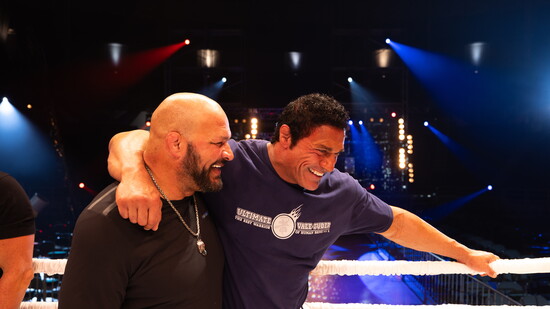
Before the red carpets and before Dwayne "The Rock" Johnson stepped into his body, Mark Kerr walked out of a hotel room in Japan carrying a pillowcase filled with cash.
No entourage. No press. No security.
Just a world champion fighter trying to get hundreds of thousands of dollars through an airport without getting robbed.
Today, Mark is best known as The Smashing Machine, the undefeated MMA force whose dominance helped define an entire sport. His life is now the subject of a major motion picture starring Dwayne Johnson and Emily Blunt, both Golden Globe nominees, with the film earning major awards buzz of its own.
But beyond the big screen, this is a story about Mark and Francie, husband and wife who call Scottsdale home. Their love story. Their second act. And a rare, unfiltered conversation in the middle of movie madness that keeps it real.
Before The Smashing Machine movie, how did you feel knowing your life might be told on screen someday?
Honestly, I tried not to think about it. I had already lived through the HBO documentary, and that was raw. That was happening in real time. I did not have control over how I was portrayed then because I did not have control over my life. So when the idea of a movie came up years later, I did not want to attach myself emotionally to it.
I have learned that when you attach your identity to outcomes, you suffer. So I kept living my life. If the movie happened, it happened. If it didn't, I was still going to wake up the next morning and do the work.
How did it feel when you first learned Dwayne Johnson wanted to play you?
Disbelief... then pressure.
This was not some fictional character. This was my life. My mistakes. My addiction. My relationships. My worst moments. If he got it wrong, people would not just critique the performance. They would be judging me all over again.
But what mattered to me was that he was not interested in playing a hero. He wanted to play a human being. That is when I started to trust it.
You later learned he had carried your story with him for years.
Yes. So humbling and heavy.
To know someone watched that documentary back in 2003 and never forgot it. To know it stayed with him all those years. That told me it was not about fighting. It was about addiction, identity, pain, and trying to control chaos.
That made me feel seen in a way I had not before.
After the movie was announced, there was a long period of silence. What was happening during that time?
It was quiet.
I had Dwayne’s number for three years and never texted him once. It didn't feel right. Movies take forever. They die all the time. I did not want to be the guy checking in asking if it was still happening.
So, I focused on what I could control. My health. My sobriety. My marriage. My work. If the movie came back around, great. If it didn’t, my life was still full.
Francie was the one who finally suggested I reach out.
And so you did.
Yes. I called his agent. He said your ears must have been burning and told me he could not say anything. Dwayne even texted me. Then nothing. Then another text. Then nothing again.
Finally, he called and said the movie was moving forward.
At that point, I didn’t even know Emily Blunt had signed on. I didn’t know Benny Safdie was directing. I didn’t know A24 was producing it. Everything was already in motion.
That’s when it became real.
What was your involvement once the movie officially moved forward?
The script was the first real work.
Working with Benny was not like working on a movie. It was like therapy. We were not just shaping scenes. We were digging into moments I had not revisited in decades.
There were things I had to look at and say, that was me. No excuses. No blaming circumstances. Ownership.
That was uncomfortable. Necessary. But uncomfortable.
Did you ever want to soften certain moments or protect parts of your story?
Of course. Anyone would.
But that was not the point. The point was truth. Benny wanted authenticity. Dwayne wanted authenticity. They were not interested in protecting my ego.
Once I accepted that, it became freeing.
How closely did Dwayne study you as a person?
He became my shadow.
He paid attention to things people do not think about. How I sat when I was overwhelmed. How my voice changed when I was uncomfortable. How I shut down emotionally instead of reacting.
We trained together. We talked. He listened more than he spoke.
The first time I saw him in prosthetics wearing my shoes, I turned around and started cursing. It was like looking in the mirror twenty years ago.
Nobody else could have done it.
Was there a moment on set that truly shook you?
Seeing my house.
They did not build fake walls. They built my actual house. Full rooms. Layout. Artwork. Everything. The cameras were hidden. The lights were buried.
A lot of scenes were done in one take. No resets. No second chances. That meant the emotions were raw and real.
It felt invasive in the most respectful way possible. They also used all my real mementos and trophies.
The movie does not sanitize your addiction.
I did not take opiates to get high. I took them to function. To train. To stay available. Availability was my currency. Promoters did not care how you felt. They cared if you could fight.
Back then everybody did it. It was accepted. Nobody talked about it.
Shame isolates you. And isolation kills people. If showing that saves one person, it is worth it.
You fought all over the world. Japan stands out. What was that like in real life?
Japan was surreal.
They paid ten times more than anywhere else and they paid cash. The first time I got paid, I went into a hotel room. There were guys smoking cigarettes. A suitcase on the table. They asked what currency I wanted. Dollars.
They counted it out in front of me. I signed the contract. I did not realize until later I was fighting for the Yakuza.
I did not know how I was supposed to get that money home. I took a pillowcase off the bed, filled it with cash, tied it up, and walked out.
That is how the sport worked back then.
You’ve taken a lot of damage over the years. What was your worst injury?
Tore my transverse abdominals.
Fighting at your level is not just physical. What is it like taking another man’s will?
It almost sounds sick to say it, but taking another man’s will is the hardest thing in the world to do. Once you are able to do it, it becomes the most addicting thing in the world.
Early on, your record was 11–0. Describe the feeling of winning.
Ecstasy.
It’s not like a team sport with eleven guys on the field. It’s you. You won or you lost.
You get addicted to the crowd. The adulation. That environment. To be honest, it’s a feeling nothing else has ever given me.
What was your signature move?
Controlling somebody.
How did you earn the name The Smashing Machine?
My first fight in Brazil was against Fabio Gurgel, one of the most respected Brazilian jiu jitsu fighters in the world.
Fifteen minutes. No rounds. No time limits. Basement of a hotel in São Paulo. Bare knuckle.
He wouldn’t give me his will. He wouldn’t quit. He wouldn’t tap.
I fractured his orbital. Broke his nose. Knocked teeth out. The referee stepped in.
The next day his wife called me. Fabio wanted to have me over for lunch.
I thought it was a setup. It wasn’t. It was lovely.
He set the stage for how I would carry myself as a fighter.
Why the Smashing Machine? Because I pounded him like a machine.
People think fighters hate each other. It’s competition.
Were you always wired this way growing up?
As a kid, I was a daredevil. I wanted to be Evel Knievel.
Francie, you knew Mark long before the movie and long before you were together. How do you describe your love story now?
It is a story of timing and consistency.
We crossed paths for decades. We were not ready then. When we reconnected, it was not fireworks. It was showing up. Training together. Encouragement. Trust.
This love did not rush. It waited. And that made all the difference.
Mark, Watching the finished film for the first time in Venice, what did that moment feel like?
Heavy and accurate.
I had seen an early cut before Venice, but it wasn’t finished. No music. No crowd. No full emotional weight.
Venice was the first time I saw it fully realized. There was a fifteen-minute standing ovation. I leaned over to Dwayne and asked if that was normal. He said no. It was not normal for any of us.
Is there a moment at the end of the movie that hits you the hardest?
When the credits roll and it says, Now you know his name. His name is Mark Kerr.
For a long time I was the fighter. Or the addict. Or the cautionary tale.
That moment felt like ownership of my full story.
What do people still misunderstand about strength?
They think strength is the absence of emotion. It is not.
The strongest thing I have ever done is ask for help. Write poems. Cry. Be honest.
Vulnerability is strength.
Final message.
You can recreate yourself.
What’s next for you?
A book, probably. A podcast coming soon… we have great interviews lined up. And a collaboration with Auragens, as I prioritize my health and wellness.
In addition, Franci and I own Absolute Wellness, where we design elevated wellness spaces that enhance the way people live. Through refined environments, premium fitness/recovery experiences, and thoughtfully curated wellness products, we bring intentional wellbeing into both residential and commercial spaces.
Absoulute-Wellness.com
"Taking another man’s will is the hardest thing to do. Once you do it, however, it becomes the most addicting thing in the world."
"Why the 'Smashing Machine' title? Because I pounded him like a machine."