Spring is when the house tells the truth.
Not the kind of truth you can measure, but the kind you can feel, standing barefoot in morning light. The places that feel heavy suddenly feel heavier. The rooms that once felt “fine” start to feel unfinished. The palette that once felt clean starts to feel cold. And what you thought was contentment reveals itself as something else entirely: a quiet longing for your home to love you back.
That is what spring does. It does not simply arrive with fresh air. It arrives with a mirror. And in that mirror, many of us find the same question waiting. Not “what’s trending,” but what’s missing? What secret do the most beautiful homes seem to know, the ones that feel warm the second you walk in? The ones that make hosting feel effortless. The ones that hold your life with a kind of calm authority. The ones you don’t just admire, but crave.
Susan Semmelmann has built her career answering that question.
As founder and lead designer of Semmelmann Interiors, Susan has earned her place as a renowned and respected designer whose signature fireplaces, ethereal aesthetic, and couture product offering have caught the attention of many in the industry and beyond. But to reduce her work to aesthetic would be to miss the point. Susan is less interested in decorating a home than she is in shaping the life inside it.
To Susan, the home is not a backdrop. It is not a display case for good taste. It is a formative space, one that carries the power to shape how you feel, how you gather, how you recover, how you show up in the world.
“Home is a sanctuary,” Susan says. “Not a showroom. Not a stage. It’s the place you should be able to exhale, feel safe, and come back to yourself.”
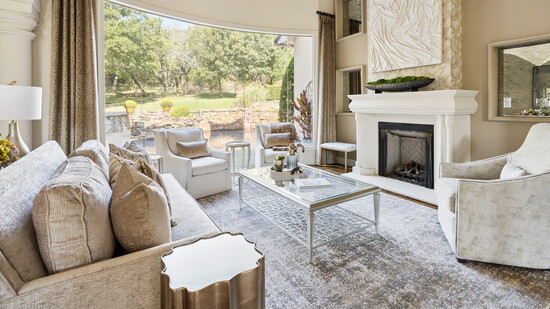
If there is a signature to her spaces, it is that they feel as good as they look. Yes, there are statement moments, the kind the design world whispers about: fireplaces turned into sculpture, lighting that reads like jewelry suspended midair, materials layered with a couture hand. But what makes her work unforgettable is what you feel inside it: a sense of grounding. A sense of belonging. As if the home was designed not to impress, but to serve.
Susan’s philosophy is a rare one in an era of constant consumption. She does not believe in chasing more. She believes in chasing meaning. Her guiding line, The Spirit of Living Is in the Giving, isn’t a tagline to her. It is the throughline. A method of stewardship by which she indoctrinates her entire life.
She speaks about design the way some people speak about calling: as something that carries responsibility. As something that should create peace, not pressure. Fulfillment, not friction. “Good design grounds you, guides you, and gives back,” Susan says. “It should steady your spirit, support your rhythms, and make everyday life feel more meaningful.”
When people say they don’t love their home, they rarely mean they don’t love the square footage. Most of the time, they’re describing mismatch. A home that does not support the season of life they’re in. A room that doesn’t know what it’s for. A layout that makes daily rituals feel harder than they need to be. A living room that looks polished but doesn’t invite conversation. A bedroom that photographs well but doesn’t restore.
Susan begins where the most enduring design always begins: with the person. Before she selects a fabric or a finish, she asks questions that have nothing to do with trends and everything to do with truth. How do you gather? What does your morning feel like? What do you want your evenings to become? Where do you exhale? Where do you pray? What do you want your children to remember about the atmosphere of their home?
In other words, she designs homes that serve the life inside them, not just the eye. “We want your home to serve you,” Susan says. “Because when your home supports you, you have more energy to pour into what matters and more capacity to serve others.”
That one idea explains why her homes feel so personal, especially for the woman who has built a beautiful life and now wants her home to reflect the same authority and intention. Not just success, but identity. Not just luxury, but legacy.
This spring, the most elevated homes are shifting in a way that feels both aesthetic and emotional. The palette is warming, but not in a loud way. Think creamy whites that lean buttery instead of blue, taupes, mushroom tones, flax, camel, clay. Neutrals that do not feel blank, but grounded, like the room is exhaling.
Susan has long believed that warmth is not merely a style choice. It’s a sensory experience. It lives in the finish of a surface, the reflectivity of stone, the undertone of a textile, the way natural light moves across the room. A home can be technically beautiful and still feel cold if the materials don’t soften the experience.
Which is why texture is rising as the true marker of luxury. Not the kind of luxury that performs, but the kind that belongs. Linen that breathes. Velvet that holds light like a jewel. Mohair and bouclé used not as trend statements but as tactile softness. Leathered stone. Fluting. Wood grain that feels organic rather than overly polished.
There is also a return to something we are craving culturally, whether or not we can name it: hospitality. Furniture is softening. Curves are returning. Seats are deeper. Layouts are becoming more communal, less rigid, more conversational. At first glance these shifts appear purely visual, but they’re emotional, too. We want rooms that hold people well. We want our homes to stop feeling like museums and start feeling like places where laughter is allowed.
And then, in nearly every home Susan designs, there is one moment that feels brave. Not loud. Not random. Just decisive. A sculptural fireplace. A dramatic pendant. A slab of stone that makes the room feel anchored. A cabinet detail that feels custom and intentional. Art that stops you mid-sentence. The kind of signature moment that quietly says: this home belongs to someone.
That is where Susan’s philosophy becomes unmistakably her own. She doesn’t design copies of what already exists. She designs spaces that feel original because the people living in them are original. “We design the never been done before,” Susan says. “Not for shock value, but because your home should feel like yours. Original. Personal. Unmistakable.”
That is the difference between a home you admire and a home you love. Admiration is aesthetic. Love is personal. Love is meaning.
This month marks a meaningful milestone for Susan and her team: seven years in business, celebrated in the only way Susan knows how, by letting design become a conduit for generosity. Her team’s latest charitable project debuts this month as part of the St. Jude Dream Home Showplace Tour at Carillon Parc (open to the public through March 22), supporting St. Jude Children’s Research Hospital in its mission to save lives. With a goal of raising $1 million, the tour represents Susan’s tenth charity showhome to date, further cementing her belief that beauty should never exist for beauty’s sake alone. To Susan, design is not separate from giving. It is a vehicle for impact.
It’s hard to sit with Susan and not feel the subtext of everything she’s saying: that the home is not simply where you live, it is one of the greatest levers you have to shape how you feel. How you lead. How you mother. How you host. How you recover. How you become.
So if you’re looking at your home this spring and wondering why it doesn’t quite feel like you, don’t start with what’s trending. Start with what you’re craving. Start with what you need your home to give you. Warmth. Ease. Beauty. Belonging. A quiet sense of peace that makes you feel, finally, at home.
Because spring isn’t asking you to change everything. It’s inviting you to make it mean something.
“Home is a sanctuary,” Susan says. “Not a showroom. Not a stage. It’s the place you should be able to exhale, feel safe, and come back to yourself.”