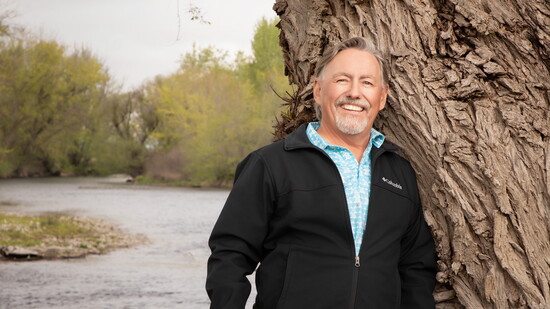
For more than four decades, I had a privilege few people will ever experience—an invitation into thousands of living rooms every night.
As a sports and news anchor, I spent 40 years telling the stories of communities, athletes, leaders, and ordinary people living extraordinary moments. Along the way, I was fortunate to receive an Emmy Award and a national Edward R. Murrow Award.
But awards aren’t what stay with me.
What stays with me are the people, the stories, and the journey that took me from small-town Missouri to some of the biggest stages in sports and politics—and eventually back home to Idaho.
Learning the Craft in Small-Town Missouri
Graduating from the University of Missouri in 1978, I was eager to get into the business. My first job was at KFVS-TV in Cape Girardeau, Missouri.
I was what we called a “one-man band.” I shot my own video, wrote and edited my stories, and anchored weekend sports. It was exhausting—but there’s no better way to learn television journalism than doing every job in the newsroom yourself.
Ironically, the industry has come full circle. Many young reporters today are once again shooting, writing, and editing their own stories for multiple platforms.
The First Call From Boise
In 1983, KTVB in Boise called and offered me the opportunity to become Sports Director. My wife and I packed up and headed west.
Those five years helped shape me professionally and personally. I fell in love with Idaho—the mountains, the people, and the sense of community that defines the state.
Life moved quickly. In December 1984, we welcomed twin daughters—my first set of twins. I would anchor the late news, then head home for midnight feedings.
It was exhausting and wonderful all at the same time.
A Bigger Market and a Legendary Sports Town
After five great years in Boise, I faced a tough decision. In 1988, I accepted a position at WISN-TV in Milwaukee.
Milwaukee was a bigger television market and one of America’s great sports towns. I covered the Green Bay Packers, Milwaukee Brewers, Milwaukee Bucks, and the PGA Tour. Over time, I was honored to receive several Wisconsin Broadcaster of the Year awards.
I also hosted the Wisconsin Lottery’s Money Game. That 30-minute show was a blast every week. At one point, believe it or not, we actually beat Saturday Night Live in the Saturday night ratings in Wisconsin.
Life Changes
Milwaukee also brought major changes in my personal life.
I went through a divorce and remarried in 1992—to a Wisconsin girl who has now been my partner for more than three decades.
Then in 2002, we welcomed another set of twin daughters.
Two sets of twins, eighteen years apart. I guess lightning really can strike twice.
Pittsburgh: Where Sports Is Religion
In 1995, I moved to Pittsburgh to become the main sports anchor at WTAE-TV.
If you want to understand how deeply sports can matter to a city, spend some time in Pittsburgh. The Steelers, Penguins, and Pirates are woven into the rhythm of life there.
I covered Super Bowl XXX when the Steelers faced the Dallas Cowboys. I had the privilege of getting to know Arnold Palmer, one of golf’s most beloved legends, and I witnessed Mario Lemieux’s comeback from non-Hodgkin lymphoma—one of the most inspiring stories in sports.
Conversations With Legends
Over the years, I had the opportunity to interview some of the most recognizable names in sports and public life—Muhammad Ali, Michael Jordan, Wayne Gretzky, Mitt Romney, John McCain, and Joe Biden among them.
Those conversations taught me something important.
Behind every famous face is a human story.
And good journalism is about telling that story honestly.
The Call That Brought Me Home
Then in 1997, Boise called again.
The offer meant taking a pay cut. I remember telling my wife, “We can’t afford to go back, right?”
She looked at me and said something I’ll never forget: “The twins are there. We can’t afford not to.”
I cried.
And we went home.
From Sports Anchor to News Anchor
Back at KTVB, my role gradually shifted from sports to news. I eventually moved into the main anchor chair, covering stories that shaped Idaho and the region.
I reported on Governor Dirk Kempthorne’s nomination hearings during the George W. Bush administration and co-produced and anchored an award-winning “Day in the Life” piece on Senator Jim Risch.
I also had the opportunity to report from several Olympic Games, including Sydney, Salt Lake, Athens, Torino, and Vancouver.
Those 30-day assignments were some of the most gratifying moments of my career.
Covering History in Idaho
Some of the most unforgettable points of my career happened right here in Idaho.
I stood on the sidelines for Boise State’s historic Fiesta Bowl victories—moments that electrified the entire state.
But journalism also means covering tragedy. I reported on heartbreaking crimes and tragic cases, as well as devastating wildfires and other natural disasters across our state.
Through it all, I watched southern Idaho transform into one of the fastest-growing and most vibrant family- and sports-friendly regions in the country.
The Soul of Local Television
While journalism was always the job, community service became the mission.
Years ago, a KTVB president told me something that stayed with me: “News is the heart of a television station, but community service is its soul.”
I tried to live by that philosophy—supporting nonprofits that serve children, vulnerable families, the food-insecure, and refugees starting new lives in Idaho.
That commitment hasn’t ended in retirement.
I’m an active member of Inspire Excellence, which helps young people pursue careers in the trades while showcasing nonprofits making a difference across our state. I’m also involved with the Borbonus Family Foundation and its work supporting veterans and advancing education for students at CWI and beyond.
A Business That Keeps Changing
The television industry has changed dramatically during my career.
Streaming platforms and mobile news alerts have transformed how audiences consume information. The days when families gathered around the television at 6 and 10 p.m. to watch one of three local stations are fading.
Today’s journalists must reach viewers across multiple screens and platforms. It’s increasingly a young person’s profession—and if I’m being honest, keeping up with that pace of change in the final years of my career wasn’t easy.
I’m in awe of how hard the current generation of broadcast journalists works to tell their stories.
The Rule That Guided My Career
Through it all—career moves, championships, tragedies, and raising two sets of twin daughters—I tried to live by a simple rule:
Tell the story honestly.
Never forget the people behind the story.
And never forget the people watching it.
I tried to “do right” by those principles, and they guided every broadcast.
And when I look back now, the truth is simple.
I wouldn’t change a single chapter of the story.