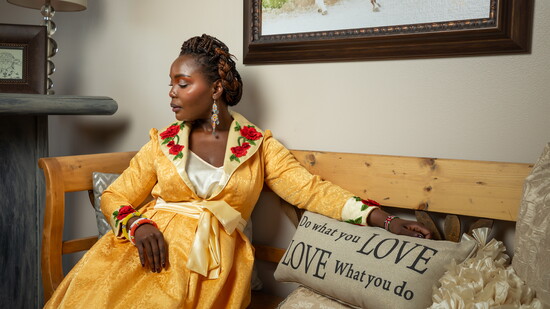
Before Winnie Christensen talked about fashion, she talked about the bracelets on her wrist.
Handcrafted by women in Kenya's Umoja Village, they are daily reminders of the artisans behind them and the culture they represent. Wearing them is Winnie's quiet way of honoring those women while keeping a piece of home close.
That was the moment, over our cup of coffee, I realized this wasn't really a story about fashion. It was a story about people.
"Everyone has fashion," Winnie says. "It's an extension of yourself." To her, what we wear is often the first invitation to learn someone's story.
The Treasure Valley has grown in ways few could have predicted, and with that growth has come a richness of culture and perspective that continues to shape who we are. Growth brings exciting opportunities, but it also asks something of us. It asks us to know one another a little better. Winnie believes fashion can help. Not because clothing matters most. Conversation does.
She first brought that vision to life through the Miss Africa Idaho pageant, creating a place where women could celebrate their heritage while building confidence and discovering their voice. That work led to an invitation to participate in WICON, a conference dedicated to empowering women. Standing on that stage, she shared a dream still taking shape — what would become the Culture for Change Foundation. People didn't simply applaud. They stepped forward. At the time, the Foundation didn't even have a bank account or nonprofit status. What it did have was a community willing to help build it.
Today, in its eighth year, the Urban Cultural Fashion Show brings together designers, models, artists, and families from across Idaho and beyond.
"When you see it," Winnie says, "it takes your breath away."
People arrive expecting a fashion show. They leave talking about the people behind the designs. For Winnie, that's the measure of success. That's where community begins.
Winnie is quick to point out that neither the Urban Cultural Fashion Show nor the Culture for Change Foundation would exist without an incredible team who share the same vision. She sees both as community efforts, not individual accomplishments.
When we arrived at the photographer's studio, Winnie explained why she had paired a tailored blue blazer with a traditional African dress. "This is me," she said. The blazer reflected the professional life she has built in Idaho. The dress reflected the Kenyan heritage she continues to carry with her. Together, they told her story.
Later, she slipped into a striking yellow embroidered coat by Christina Chapman, founder of Kay Chula Designs, layered over a silk dress — a piece Winnie had admired on the Urban Cultural Fashion Show runway and immediately fallen in love with. Before the session began, the photographer quietly wondered whether the outfit might feel too dramatic for the article. Once Winnie stepped in front of the camera, it made perfect sense. It wasn't simply something she wore. It was an expression of who she is.
A few minutes later, the conversation turned to photo retouching. Winnie had one request. "Leave my smile lines," she said with a laugh. "I earned those." In her Kenyan culture, those lines are a sign of a happy, healthy life.
That same desire to create opportunity led Winnie to help establish the Culture for Change Foundation, which today offers nearly a dozen programs that strengthen the community. Sewing is just one expression of that broader mission — helping participants discover confidence while creating something with their own hands.
Even the clothing itself reflects her philosophy. Pointing to the traditional garment she's wearing, Winnie explains that the seams are intentionally designed so they can be let out or taken in as life changes. The garment grows with the woman who wears it. Nothing is wasted. Every stitch has purpose.
She describes her personal style with one word: Vibrant. Her wardrobe reflects the same warmth, confidence, and generosity she brings into every conversation. "Fashion is art," she says. "We should support designers." She points to Idaho-born designer Cartier Dior Eliasen — whose work transforming reclaimed materials like potato sacks into wearable art is exactly the kind of innovation Winnie believes deserves greater recognition — as proof that extraordinary creative talent already exists here.
As the Treasure Valley continues to grow, Winnie hopes the Urban Cultural Fashion Show remains a place where people celebrate culture, discover creativity, and feel they belong.
We all wear a story. In a growing community, learning to read one another's may be how belonging begins.