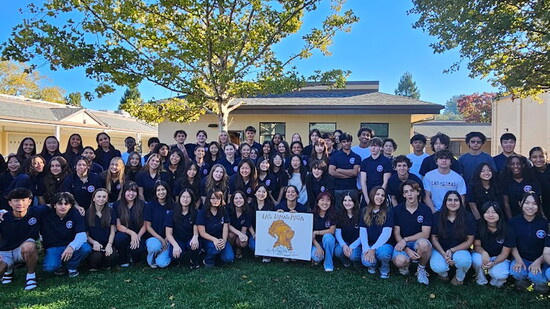
Before enrolling in Las Lomas High School's Biomedical Science Pathway program, 17-year-old Kamila Sanchez never expected to become passionate about healthcare or to pursue a career in science or medicine.
“A friend encouraged me to join, and it helped me discover a career path,” said the rising senior.
The Biomedical Science Pathway is one of many programs supported by the Walnut Creek Education Foundation (WCEF), a nonprofit that helps fund educational opportunities throughout Walnut Creek's public school district.
Founded in 1983, WCEF raises private funds for programs at the elementary, middle, and high school levels.
What began as a grassroots effort to keep school libraries open has grown into a community-supported foundation serving more than 5,100 students across eight schools.
Today, WCEF continues to fund elementary libraries as well as art, music, and science labs. It also funds middle school and high school electives, including the high school career pathways programs, that are at risk of being cut due to funding limitations.
"The programs we support are not extras," shared Executive Director Kiroun Saluja. "They are essential parts of a well-rounded education that foster creativity, critical thinking, connection, and student well-being."
California's public school funding model does not fully cover what families have come to expect in local schools, said Saluja. WCEF helps bridge that gap by supporting programs that might otherwise be reduced or eliminated.
The Biomedical Science Pathway is one of several high school programs supported through WCEF's annual grant to the Acalanes Union High School District. The program was developed by teacher Kathleen Mooney, who formerly served as Las Lomas' school nurse.
"This program provides students with hands-on, career-focused learning experiences that introduce them to the fields of medicine, biotechnology, anatomy, physiology, and healthcare," said Mooney.
Through age-appropriate labs and collaborative projects, students explore different subjects and gain real-world experience over their four years of high school.
The program also partners with HOSA-Future Health Professionals, a global student organization that holds numerous events and competitions throughout the school year.
"One of the most impactful parts of the Biomedical Pathway has been my involvement in HOSA," said Arbaz Malik, a rising senior. "The pathway hasn't just taught me about biology. It has given me a head start on my future career."
Las Lomas rising junior Kayla Fu added that the program has provided opportunities that extend beyond the classroom. "The community is incredible," she said. "I've learned more from this program than anything else."
Nik Ratzlaff, a science and leadership teacher at Walnut Creek Intermediate School, said WCEF helps fund electives and provides resources that enhance classroom learning.
In one recent lesson, students used lasers and sensors to study how fiber-optic technology transmits information, connecting science concepts to real-world applications.
"Without funding from WCEF, we would not be able to add labs that use tools outside of our curriculum," Ratzlaff shared.
Kai Calica, who recently graduated from eighth grade, said those experiences have made science both engaging and meaningful.
Saluja said the foundation's goal is to ensure that all students have access to enriching educational opportunities regardless of their background or circumstances.
For Calica, that mission is already making a difference.
"I really enjoyed the hands-on activities and experiments because I learn best by doing things," she said.