Seventeen-year-old Aaron Cass was adrift, floundering in a sea of adolescent pressures. His dad’s gift of the book “Zen Flesh, Zen Bones,” a collection of Zen Buddhist parables, would be the surprising lifeline that rescued the troubled youth and set him on the path to a new way of life. While reading the thought-provoking book, Cass’s problems seemed to melt away. “It was transformative for me,” he says.
But the book of Zen parables was only the first step in Cass’s journey. The philosophies he soaked up so eagerly urged him to find a practice to complement his newfound reflective attitude. The teen had no idea where to look, but fate soon intervened by way of a poster promoting classes in something called aikido. This unique martial art would change his life, beginning with his training at Portsmouth Aikido.
Thirty years later, the now 47-year-old Cass has been the chief instructor since 2009 at the very dojo where he discovered the art he loves. Cass exudes a rare kind of calmness—a quiet confidence that puts those around him instantly at ease. But never underestimate the formidable physical and mental power of this fifth-degree black belt. “You can’t really be confident in the world without knowing you can deal with whatever comes at you,” he says.
Cass’s comfortable-in-his-own-skin demeanor is in part a result of the three years he spent living in Japan, where he taught English and further pursued his aikido study. While in this exotic and beautiful Asian country, Cass immersed himself in the culture, learning to speak Japanese fluently and even meeting the woman he would marry.
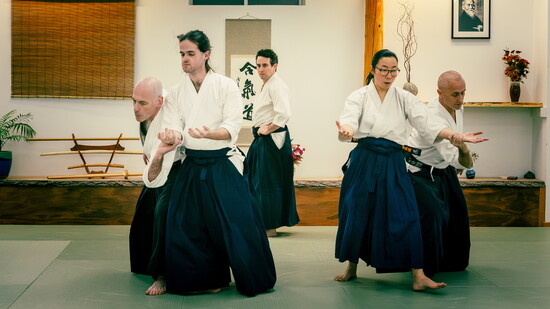
Unlike other martial arts, aikido teaches practitioners to blend with an opponent’s energy, redirect it, and disarm the opponent without causing harm. While this distinctive martial art is sometimes called “The Art of Peace,” Cass stresses that it is “still a martial art.” The aikidoka, or practitioner, needs to be effective. “That’s how you build confidence and find true calmness,” he says.
The health benefits go beyond physical fitness. O-Sensei said that “Aikido is medicine for a sick world,” and that it is “a path to refining the body and the spirit.” Of course, the sick world he refers to is rife with social maladies as well as physical ones, and this “peaceful” martial art provides salve for these wounds also. Aikido’s mindset is not about winning or competing. While it does involve physical confrontation, it presents a means of resolving conflict by neutralizing an attack.
In addition, aikido is a fun physical art. The classes combine tumbling and aerobics with flexibility and balance training, all enhanced with a spiritual quality of Zen mindfulness.
Portsmouth Aikido is a nonprofit that offers classes for adults and children. Cass has witnessed firsthand the profound benefits of aikido for young people, including his own two kids. This discipline has taught them to respond to difficulties with a positive attitude, centeredness, and awareness.
The classes are fundamentally social, putting socially isolated kids into an arena of personal interaction. Learning to stay safe in threatening situations builds valuable confidence. One mother, Enna, writes, “Since joining aikido, our son’s self-confidence has blossomed.” Adults reap significant benefits as well. Allison, an adult student, embraces the “joyful spirit” in the classes and writes, “Aikido has given me something more than a hobby. I have a practice.”
Judy Ringer founded Portsmouth Aikido in 1995. This martial art has transformed her life—and mindset. “Aikido has become the lens through which I see the world,” she says. “It has centered me.” Her perspective has shifted from being right to being curious, something that opens wide the window of communication with people of differing viewpoints. She has now practiced this meaningful discipline physically and spiritually for 25 years and is a third-degree black belt.
Ringer came to aikido through what she calls “the doorway of conflict.” Dealing with endless discord in the workplace, she was searching for a way to diffuse it. She discovered the perfect solution in aikido. “Conflict happens,” she says. “It’s what we do with it that makes the difference.” The determined Ringer vowed to help people apply the philosophy of aikido to daily life by appreciating other viewpoints and turning enemies into allies. She has given numerous interactive presentations and written two books on the subject.
Aikido teaches that you can choose how you respond to people and actions in life. You don’t have to fight—you can be powerful in a peaceful way. Aikido shows us a different kind of power. Ringer likes to quote the Great Teacher by saying, “The true martial art is love.”
Portsmouth Aikido
620 Peverly Hill Rd, Portsmouth, N.H.
603.275.1262
portsmouthaikido.org
Cass exudes a rare kind of calmness—a quiet confidence that puts those around him instantly at ease. But never underestimate the formidable physical and mental power of this fifth-degree black belt.
Aikido’s mindset is not about winning or competing. While it does involve physical confrontation, it presents a means of resolving conflict by neutralizing an attack.
Morihei Ueshiba, known as O-Sensei (Great Teacher), founded the traditional Japanese art of aikido in the early 20th century. Translated as “The Way of Harmony,” aikido is based on the principle of aiki, the balance of dual opposing forces.