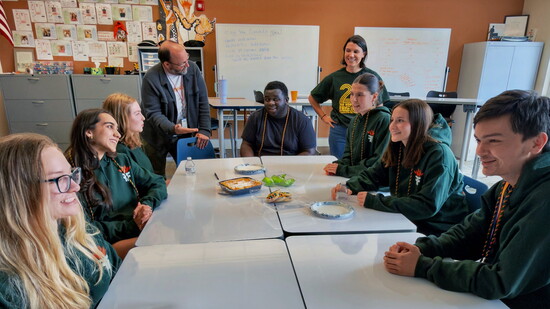
This year, Webster Groves High School launched a two‑hour daily deep dive into civic life, public service, and real‑world internships. Seven students signed up—without a single peer to tell them what to expect. As the seniors of Webster Groves High School's first Frick Center cohort prepare to head off to universities across the country—from George Washington to the University of Chicago to Mizzou—they're carrying something most college freshmen won't have: the practiced confidence to sit across from someone who thinks differently, and keep talking anyway.
Brian Keller, K-12 Science and Social Studies Curriculum Coordinator at Webster Groves High School, noted that alumni Bob and Barbara Frick noticed a growing gap in how adults communicate. "They gave us a simple charge: create a course around civil discourse, free speech, and the economic impact of both," said Brian.
Alison Bryar, AP Government and Politics and the Frick Center's Program Coordinator, said, "We want the Frick Center to be an opportunity for students to explore ways civics makes positive change—through meaningful civil discourse and authentic experiences, including The Forum, which these seven students founded."
Q: How has this class changed the way you navigate conversations?
Kiran Bergfeld: We learned how to disagree and be okay with it. That alone makes every relationship easier.
Cassie Fischer: I used to see everything as black and white. This class pushed me into the gray. Now I'm comfortable being unsure.
Nicholas Phillips: We naturally surround ourselves with people who agree with us. This class forced us to hear every side. That's rare.
Lucinda Thorn: I'm more confident starting conversations now. Talking with so many leaders and professionals made it feel less intimidating to approach new people.
Juliette Mueller: This class builds confidence in being able to respond. Now I'm more confident participating in conversations I would have shied away from.
Ruby Reeves: We had site visits and guest speakers we would have never accessed otherwise. I feel so much more prepared to speak my opinion.
Austin Minute: I used to be extremely shy—I wouldn't talk to anyone outside my friend group. By the end of the year, I self-nominated to be one of our commencement speakers.
Q: How did your internship experiences shape your futures?
Juliette Mueller: I interned with criminal defense attorney Elizabeth Ramsey. It completely reformed the way I think about the justice system. I want to pursue criminal defense, and that experience is a big reason why.
Ruby Reeves: I interned with Webster Groves Mayor Laura Arnold. Learning to read bills and interpret court cases opened my eyes to policy in ways I hadn't expected.
Nicholas Phillips: I interned with reference librarian John Egel at the Webster Groves Public Library researching the history of local homes. It deepened my love of history and my desire to understand it from every perspective.
Lucinda Thorn: My internship was with the League of Women Voters, where I worked on social media outreach for young voters. It made me a more confident advocate—essential for any career.
Cassie Fischer: I took a philosophy class at WashU before choosing it as my major. This class taught me how much I don't know—and how much I want to learn.
Austin Bennett: I interned with Shawn Finnegan at Webster Groves City Hall. This experience showed me how many different fields can create positive change for someone, somewhere.
Kiran Bergfeld: I interned with State Representative Jo Doll. It opened my eyes to public policy—and reminded me how much there is still to learn.
Q: How did the program reshape your relationship with information from online and social media?
Lucinda Thorn: This course stresses checking sources. It's unproductive to have important conversations if your information isn't valid.
Cassie Fischer: We were required to find Tier 1, peer-reviewed sources. Now, when I see something on social media, I actually investigate whether it's true. That skill will stay with me.
Juliette Mueller: I took a WashU class on free speech through the program, exploring how social media has transformed free speech in America. It added a whole other layer of perspective.
Q: What are your key takeaways?
Kiran Bergfeld: Being able to talk about hard things, being okay with different opinions, and practicing productive discourse—that's vital to democracy.
Lucinda Thorn: I went from having no clue about my career to having too many choices. I would not have found that anywhere else.
Nicholas Phillips: A program like this would benefit younger students too. It would give kids a head start in developing the skills to talk to people they'd otherwise never meet.
Lucinda Thorn: There's been talk about expanding The Frick Center to other districts. More students having access means more graduates prepared to step into the real world.
Cassie Fischer: We didn't mention how close we all got. We call ourselves the Frick Family. That bond is one of the best parts of this year.
For more information about the Frick Center at Webster Groves High School, visit webstergroves.k12.mo.us.