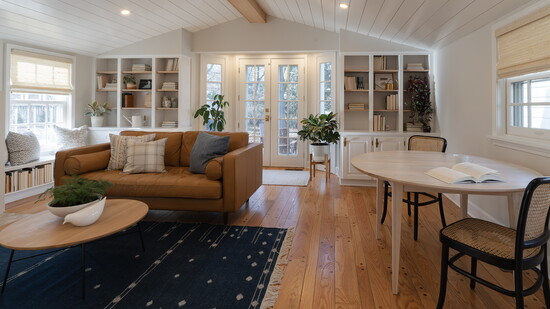
As an early American “boom town,” Rochester and the surrounding region are steeped in history. In its earliest days, the Genesee River and the Erie Canal fueled the area’s growth, transforming it into a bustling hub. Today, that history is still visible in the historic and vintage homes in neighborhoods like Corn Hill, Browncroft, and Cobbs Hill, and across the city’s outlying towns and villages—each with its own distinct and vibrant past.
Whether built 80 years ago or 150, these homes that have stood the test of time offer unmistakable curbside character to passersby, while their interiors remain a mystery known only to those who live within their walls and the guests welcomed inside. While many homeowners embrace the charm and craftsmanship of a bygone era, modern living brings new expectations, like how to merge historic character with contemporary comfort and functionality.
Vintage Meets Modern Living
For realtor and resident Susan Glenz, who has always been drawn to the character of older homes, transforming her 1940s Pittsford house meant honoring the past while making it livable for today. The result is an exterior that evokes turn-of-the-century cobblestone charm and an interior that blends modern design with vintage aesthetics.
“I had a very clear vision—I wanted it to look like the home had historically been here before 1945,” Glenz explains. “It was one of those projects where you really had to rip the Band-Aid off and do it all.”
Reimagining the Exterior
The house, originally built with cedar shake, had woodpecker holes in the siding, a one-car garage, and an unheated breezeway. Glenz embraced the full project: The exterior was redone with all-stone facades, a new roof, and windows.
“Because the house exterior is stone, I went with white siding because I wanted the stone to really be the hero,” she says. She also added a grand front porch with white pillars and a covered entryway for guests. A two-car garage replaced the one-car version, and a sunroom plus a covered porch with retractable screens (“kind of like a greenhouse,” she notes) completed the exterior renovation. “It has a very old-but-new vibe,” she adds.
Interior Renovation
Glenz worked with local remodeling firm Cedar + Deed when renovating the interior of her home. According to Erin Eder, one-half of the Cedar + Deed duo along with DeeDee DiMarco, “Susan had the ideas and we worked with her, the architect, and the builder collaboratively.”
Inside, Glenz also wanted a beautiful and functional mudroom as a “warm, welcoming, beautiful space for the dogs.” Built-in dog crates feature gold mesh doors in a criss-cross pattern (“reminiscent of an older aesthetic”), with access to a covered dog run and a fridge for food. Dark wainscoting, crown molding, soapstone countertops, and a dark organic stone floor give the space a moody, vintage feel.
She also customized wallpaper on Etsy to feature her dogs. “It has this old beautiful feel of a room, but it introduces this sense of whimsy that introduced my dogs into the wallpaper,” she explains.
Kitchen & Finishing Touches
The kitchen cabinetry reaches the ceiling with crown molding throughout, and all hardware is gold or brass. Finishing touches, including house numbers, completed the transformation. Despite the extensive exterior overhaul, Glenz says the home fits perfectly into her mature, established neighborhood. “I don’t think there’s very many houses like mine, and it fits in a neighborhood that isn’t cookie cutter.”
Three Historic Homes, Three Different Styles
When taking on a vintage project, Danielle Barnes, principal designer and creative director of DMB Interior Design-Build in Fairport, says that one of the first things they do is look at how much character they’re trying to preserve versus how much needs to be replaced or removed. “Then it’s a balancing factor of, can we save it?” she explains, noting that sometimes they simply can’t.
One of the most important things to take into considerations? ”Function, function, function. How is the family going to live and use the space?”
Balancing Modern and Vintage
Of course, what happens when a couple has different tastes?
That was the case of a Webster home built in 1900 that, in Barnes’ words, “was a fun juxtaposition" where he wanted contemporary and white, while she wanted all vintage.
The solution? Barnes ended up maintaining all the oak, the molding, and the door. Some molding had to be replaced to match, and the floors were replaced to look vintage. On the modern end, they made the ceilings and cabinets bright white but added in little vintage details, like natural marble and a farmhouse sink with a modern take.
Downtown Renovation
A 1908 home recently received a new kitchen designed to feel seamless with the rest of the house. Much of the design focused on creating a space that was predominantly white while still feeling colorful—using patterned tile on the floor, removing the pantry walls, and opening the space to the kitchen. Vintage elements were intentionally layered in, including hardware likely dating to the 1940s or ’50s, which Barnes cleaned and restored to shine like new.
“They didn’t want it to feel like a completely different part of the house, but rather something that reflected their own personality,” she says. “Their style isn’t vintage, but they also didn’t want to destroy the character of the home.”
From Pantry to Bar
A closet area that had turned into a pantry, where chocolate always melted due to the heat run being so close, transformed into a stylish bar complete with a sink. They also added windows and shiplapped the whole ceiling. In addition, they kept the swinging door into the dining room and added more brass hardware and natural marble. “This [project] veered more modern than it did vintage,” she says. “It more nods to vintage, than its in your face type of feel.”
Structural Surprises
When they talk about "unforeseen circumstances,” Barnes says a 1940s home in Brighton was a classic case. This included a huge crack in the bathroom floor, with the discovery that all the floor joists holding up the tub had been cut, making it structurally unsound. “Every time we opened up a wall or a ceiling, it was a disaster,” she says. Every week was a new challenge, and the renovation took a long time to complete, she explains. But the vision for the woman who lived there was all worth it—to transform it into a feminine, cozy cottage, making everything a “little more colorful and playful," she says. “It was meant to be more of a little retreat. Come home and relax."
Vintage + Modern: Tips from a Designer
When working on a vintage home, it’s important to keep to one bygone era. “You won’t want anything from the wrong decade,” Barnes says. Pick modern-day pieces to complement the era of the house. “Pick one personality.”
Doors from older times are harder to find and can’t be easily created, so it’s nice when you can restore them. While moldings can be re-created, it’s better if you can keep the originals. “It’s almost like a vibe, you walk in, you know if it’s new or not,” she says.
Barnes emphasizes that functionality beats keeping something original, but it’s a balance. “The more I can save the better. I always think, what do I want the end to look like and feel like and function like? Versus letting one item drive the entire design.”
“It’s really amazing to see a house that's 100 years old and to re-create a renovation that's going to last in another 50-plus years. That to me feels really good.”