His first sewing machine was a Singer that his mother had won as a teenager at the Oklahoma State Fair sewing competition. It was old enough to be built from real metal. “It sewed like a dream,” says David D’Angelo Caldwell, who learned to run it as a boy in Choctaw and promptly turned it on his own wardrobe. Wide-leg jeans were hard to find in Oklahoma then, so he cut his open along the inseam and set in extra fabric. “Knowing how to use a sewing machine unlocked the ideas in my head, allowing me to create new silhouettes,” he says.
He has been letting out seams ever since. In 2004 he put a name to the work, launching David D’Angelo with one-of-a-kind hats sewn from old sweaters, a habit that sent him deep into thrift stores for material. “Reusing materials like this taught me how to be resourceful. … Design school taught me the fundamentals of design but visiting thrift stores was a portal to designs of the past,” he says.
That same year he was in Italy’s Veneto region studying international business, not yet committed to design. The Italians settled it. “Their ethos of style is effortless and so very chic,” he says. By the end of the semester he had decided to come home and learn to build garments himself.
The degree done, he moved to New York and interned at the fashion house of Zac Posen, still the chapter he names as most formative. He worked among pattern makers, cutters, and designers from around the world, and left with enough confidence to mount his own 10-piece women’s wear collection during New York Fashion Week in 2009. Bravo cast him the following summer on The Fashion Show, Ultimate Collection, opposite Isaac Mizrahi and Iman. He tailored on set for Paula Abdul and Jackie Evancho.
Family eventually pulled him back. He met his wife, Autum, at the art museum in Oklahoma City. They moved to Tulsa in 2012 and started a family in 2016. “Tulsa was always the plan,” he says. He knew one person here when he arrived, then spent nearly a decade managing Black Optical at Center 1, building the relationships he still works from.
His studio and retail space now sit on the third floor of that same building, in Brookside, tucked above OREN. Ten years of his working life have been spent in the neighborhood, among its shop owners and restaurateurs, and he calls it the center of luxury in Tulsa. “It’s a beautiful space,” he says.
Day to day he is making custom garments, planning pop-up events, styling celebrity clients, and building character jackets and props for The Lowdown Show. The red carpet work has traveled furthest. When Sterlin Harjo was weighing what to wear to the 76th Emmy Awards, David proposed sand lamb suede with black calf hair lapels in place of a traditional tuxedo. He was mowing the lawn when the confirmation text arrived. Two months of work later, the suit was finished, carrying buttons cast in sterling silver by Tulsa jeweler Landon Thomas and stamped with the Muscogee knot. Sterlin landed on Esquire’s best-dressed list.
The heirloom jackets are the center of the practice. “A family heirloom is anything that holds value to a person. Heirlooms are not defined by age. They are defined by the memories they carry,” says David. Hides come from tanneries in Italy and Turkey by way of New York suppliers. A single calf hair jacket takes roughly six hides, about 45 square feet of material, laid out to minimize seams. Two hours to cut, eight to construct. Seams are overlapped three-eighths of an inch and topstitched. “Leather has that ability to transport you just by the way that it smells or the way that it feels,” says David. He builds every one of them personally and will hand construction to a factory only when he finds one he fully trusts and scale demands it. “But for now it’s all me,” he says.
Calf hair is costly and, for most designers, intimidating. David came at it sideways, using pattern drafting and industrial garment construction rather than the hand tools of traditional leather craft. A nylon presser foot and the right needles solved it. “Once I figured out the machine the rest fell into place,” he says. Leather, to him, is a natural material with a life and a character of its own, and a well-made piece should never feel disposable.
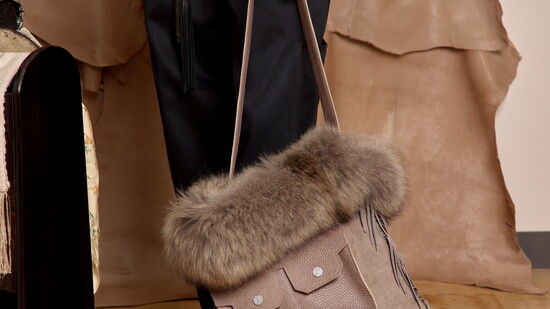
The photography accompanying this story runs on the same instincts. Photographer Heather Broomhall, a Central Saint Martins alumna, shot the images, and her approach aligned closely with David’s. The shoot takes up Oklahoma cowboy culture without the usual costume. “We really wanted to lean into the cowboy culture of Oklahoma, but not in a traditional way,” David says. The hero piece is a classic-cut calf hair jacket lined in silk crepe de chine, styled against a saddle by Will S. Harris, provided by Fabricut. Heather kept encouraging new looks as the day went on, and both she and David knew when the frames landed.
For anyone in Tulsa who wants to dress better and doesn’t know where to begin, David’s advice is simple. Start with one great staple piece: a jacket cut properly, trousers that actually fit, a shirt that works a dozen ways. Build from there. Fifty years from now, when someone pulls one of his jackets from a closet, David wants the first thought to be how timeless it looks. “I want it to remind people of the many stories it holds, and in that moment a new story has begun.”