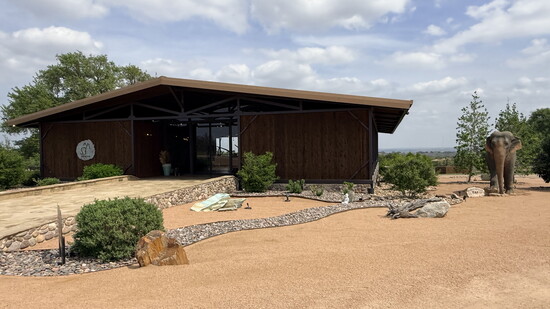
Many people understand the basic care required by dogs and cats. Grooming, vaccinations, nail trims and routine veterinary visits are familiar parts of pet ownership. Across the Texas Hill Country, residents may also know the needs of horses and livestock. Caring for an elephant, however, introduces an entirely different scale of responsibility. At The Preserve outside Fredericksburg, visitors receive a close look at that responsibility through an educational experience centered on Asian elephants. Owners Kari and Gary Johnson and their team share how positive reinforcement helps the animals participate in their own care.
The elephants’ size commands attention as soon as they walk into the open-air pavilion, but their movement soon becomes equally striking. At spoken cues, they move with a mesmerizing combination of strength, agility and grace. They lift and position their feet, allowing caregivers to inspect toenails and footpads. For visitors, the demonstration provides an answer to a question they may never have considered: How do caregivers safely examine and care for an animal weighing several thousand pounds?
Physical health represents only one part of the experience. Guests also learn about elephant anatomy, diet, behavior and intelligence, along with the differences between Asian and African elephants.
“We couldn’t sit in a room and just stare, and neither can they,” a member of The Preserve’s team explains. “A big part of animal welfare is mental exercise.”
Rather than simply presenting facts, the experience allows visitors to observe how the animals respond to caregivers and cues as they navigate the world around them.
More Than Facts
World Elephant Day, observed annually on August 12, raises awareness about elephant conservation and the challenges elephants face. For Asian elephants in particular, one of the greatest threats is ongoing loss, fragmentation of habitat and human-elephant conflict. Kari Johnson says education plays a critical role in conservation.
“Once you’ve met an elephant, I can’t imagine you’re not going to do anything you can to help them if you get a chance,” says Kari Johnson.
Guests also discover that elephants have distinct personalities. “The part that surprised me the most was to learn how different their personalities are,” one visitor remarked during a recent experience. Those personalities become evident as the elephants interact with caregivers and respond to familiar routines.
A Lifetime With Elephants
For Kari and Gary Johnson, the experience reflects decades working with elephants.
“I started full-time apprenticeship with my stepdad, an elephant trainer, when I was 14,” Kari says. “That’s all I’ve done my entire life. Elephants are how we started. Elephants are how we’re going to end up. This isn’t just a business. This is our lives, our family.”
Building Understanding
Today, the Johnsons view the elephants at The Preserve as ambassadors for their wild counterparts, helping visitors develop a connection to animals many would otherwise only encounter through photos, documentaries or zoo exhibits. The experience gives guests access to details that statistics alone cannot convey: the condition of an elephant’s foot, the precision of its movements and the communication required to support its daily health.
Visitors may arrive curious about an elephant’s size or strength. They leave with a more complete understanding and appreciation for the animals’ physical needs, intelligence and capacity. And in the spirit of World Elephant Day, that understanding may be the most important lesson of all. As Jane Goodall observed, understanding leads to caring, caring leads to helping, and helping creates a future where elephants can thrive